
The Anatomy of a 240 Volt Outlet for Electric Car Charging
Installing a 240 volt outlet for electric car charging is one of the most high-demand residential electrical projects today. Unlike standard 120V household receptacles, an Electric Vehicle Supply Equipment (EVSE) connection draws a massive, continuous electrical load for 8 to 14 hours at a time. This continuous duty cycle exposes marginal wiring to extreme thermal stress, making strict adherence to National Electrical Code (NEC) standards and precise wiring diagrams non-negotiable.
This wiring diagram reference focuses on the industry-standard NEMA 14-50R receptacle, the most versatile and widely supported 240V outlet for Level 2 EV charging. Whether you are wiring for a Tesla Mobile Connector, a ChargePoint Home Flex, or a Ford Charge Station Pro, understanding the terminal mapping, conductor sizing, and NEC continuous load rules is critical for a safe, fire-proof installation.
NEMA 14-50 vs. NEMA 6-50: Receptacle Configuration Matrix
While both receptacles deliver 240V at 50 Amps, their internal wiring diagrams differ fundamentally. The U.S. Department of Energy notes that while hardwired EVSEs are gaining popularity, the NEMA 14-50 remains the gold standard for plug-in units due to its compatibility with both EVs and recreational vehicles (RVs).
| Feature | NEMA 14-50R (4-Wire) | NEMA 6-50R (3-Wire) |
|---|---|---|
| Voltage / Amperage | 125/250V / 50A | 250V / 50A |
| Terminal Mapping | X (Hot), Y (Hot), W (Neutral), G (Ground) | X (Hot), Y (Hot), G (Ground) |
| Required Conductors | 2 Hots, 1 Neutral, 1 Ground | 2 Hots, 1 Ground |
| EVSE Compatibility | Universal (Tesla, Rivian, Ford, GM) | Limited (Requires specific EVSE plugs) |
| RV Compatibility | Yes (Standard 50A RV hookup) | No |
Wiring Diagram Reference: NEMA 14-50R Terminal Mapping
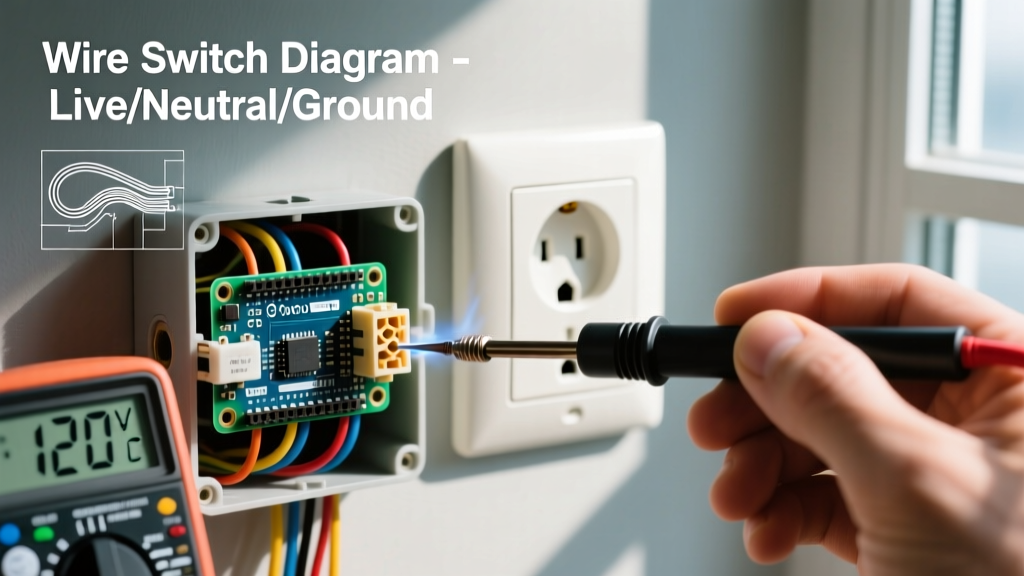
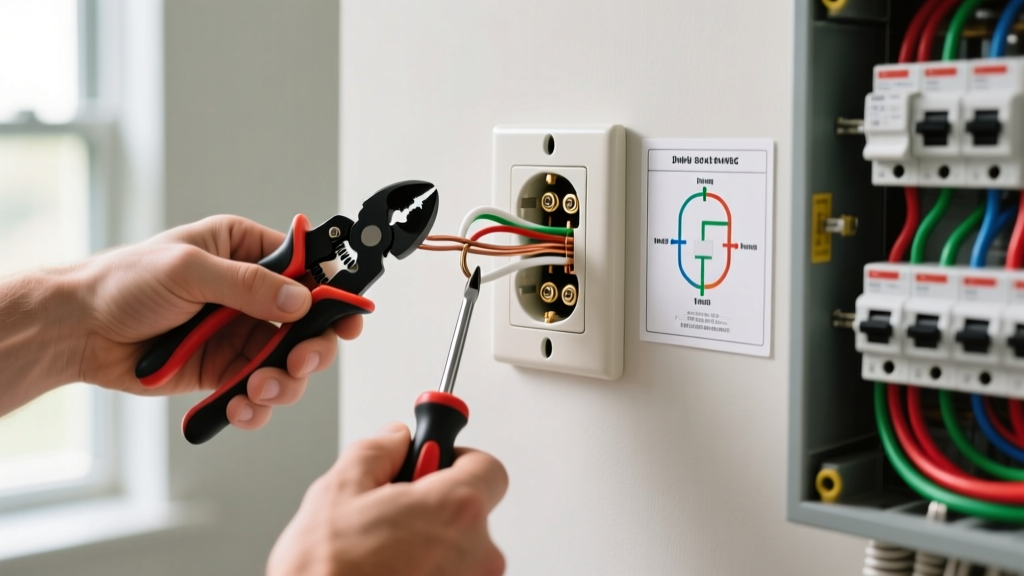
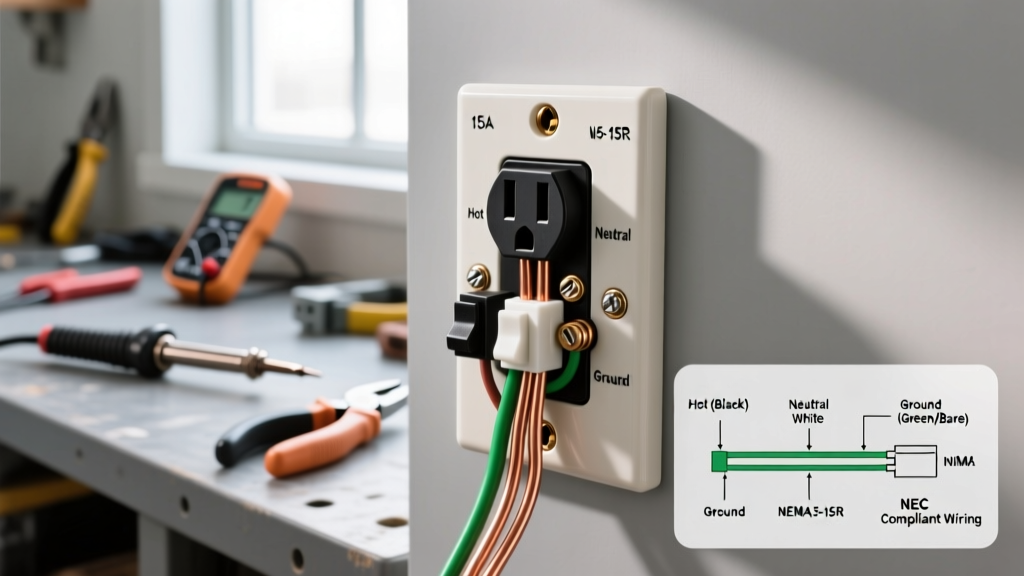
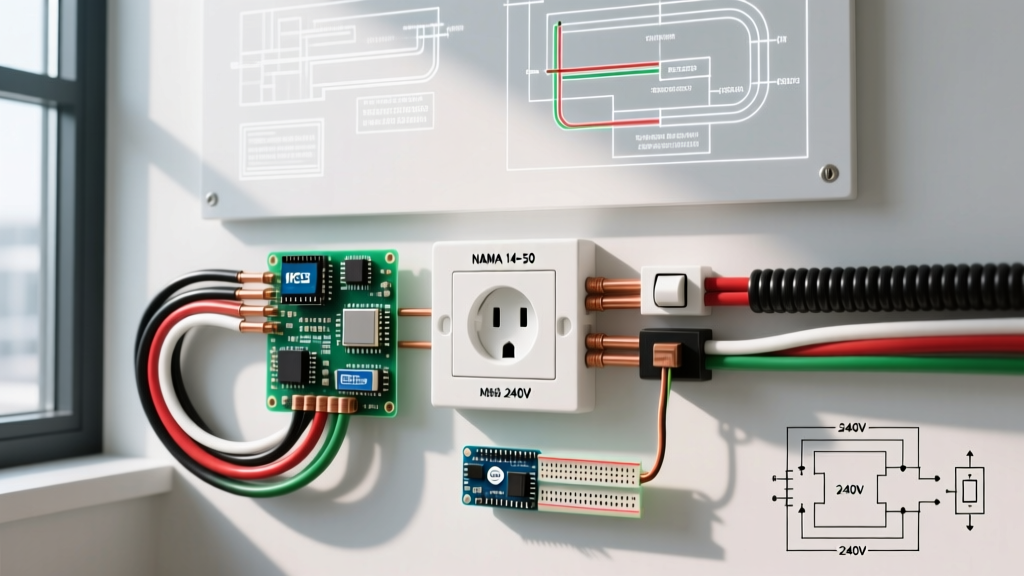
When wiring a 240 volt outlet for electric car applications, the physical orientation of the NEMA 14-50R receptacle dictates the terminal mapping. With the ground pin at the bottom (6 o'clock position), the internal screw terminals map as follows:
- X Terminal (Brass Screw - Right): Connect to Line 1 (Black conductor, 240V).
- Y Terminal (Brass Screw - Left): Connect to Line 2 (Red conductor, 240V).
- W Terminal (Silver Screw - Top): Connect to Neutral (White conductor). Note: Most EVSEs do not actively use the neutral for 240V charging, but the NEC requires it to be present and terminated in a 14-50R configuration.
- G Terminal (Green Screw - Bottom): Connect to Equipment Grounding Conductor (Bare copper or Green).
Expert Note on Neutral Sizing: Under NEC Article 220, the neutral conductor for a NEMA 14-50 EV circuit does not carry the continuous charging load. However, best practice dictates running a fully sized neutral (same gauge as the hots) to prevent voltage drop imbalances and to ensure the circuit can safely support future RV loads which may utilize 120V legs.
NEC Code Mandates & The GFCI Dilemma
Wiring a 240V EV outlet requires navigating two critical sections of the National Fire Protection Association (NFPA 70) NEC Code:
1. The 80% Continuous Load Rule (NEC 210.20 & 625.40)
EV charging is classified as a continuous load (operating for 3 hours or more). Therefore, a 50-Amp breaker can only safely deliver 40 Amps of continuous current. If your EVSE is rated to pull 48 Amps, you cannot use a plug-in NEMA 14-50 outlet; you must hardwire the unit to a 60-Amp breaker. A 50-Amp breaker strictly limits the EVSE software to a 40-Amp maximum draw.
2. The Garage GFCI Requirement (NEC 210.8(A)(5))
Recent NEC cycles mandate GFCI (Ground Fault Circuit Interrupter) protection for all 125V through 250V receptacles rated 50A or less installed in garages. This creates a known engineering conflict: EVSEs contain internal GFCI and ground-monitoring logic. Stacking a GFCI breaker on top of an EVSE's internal GFCI frequently causes nuisance tripping, leaving the car uncharged in the morning.
The Workaround: If your local AHJ (Authority Having Jurisdiction) strictly enforces 210.8(A)(5), use a high-quality 50A GFCI breaker (e.g., Square D HOM250GFICP) and ensure the EVSE is set to 40A. However, many inspectors allow the GFCI requirement to be bypassed if the EVSE is hardwired rather than plugged into a receptacle.
Wire Sizing & Conductor Selection Matrix
Selecting the correct wire gauge is where many DIY installations fail. The NEC treats different insulation types and cable assemblies differently. According to EC&M's branch circuit guidelines, you must pay strict attention to the 60°C vs. 75°C ampacity columns.
| Cable Type | Insulation Rating | Required Gauge for 50A Breaker | NEC Reference |
|---|---|---|---|
| NM-B (Romex) | 60°C (90°C derated) | 4 AWG Copper | NEC 334.80 |
| THHN/THWN-2 (In Conduit) | 75°C (Termination limit) | 6 AWG Copper | NEC 310.15(B)(16) |
| Aluminum (XHHW-2 in Conduit) | 75°C | 4 AWG Aluminum | NEC 310.15(B)(16) |
Critical Warning: Do not use 6 AWG NM-B (Romex) on a 50-Amp breaker. Although 6 AWG copper is rated for 55 Amps in the 60°C column, NEC 240.4(B) does not allow rounding up to the next standard breaker size for 55A. You must use 4 AWG NM-B for a 50A circuit if running Romex. For THHN in EMT conduit, 6 AWG is perfectly legal and standard.
Step-by-Step Installation & Torque Specifications
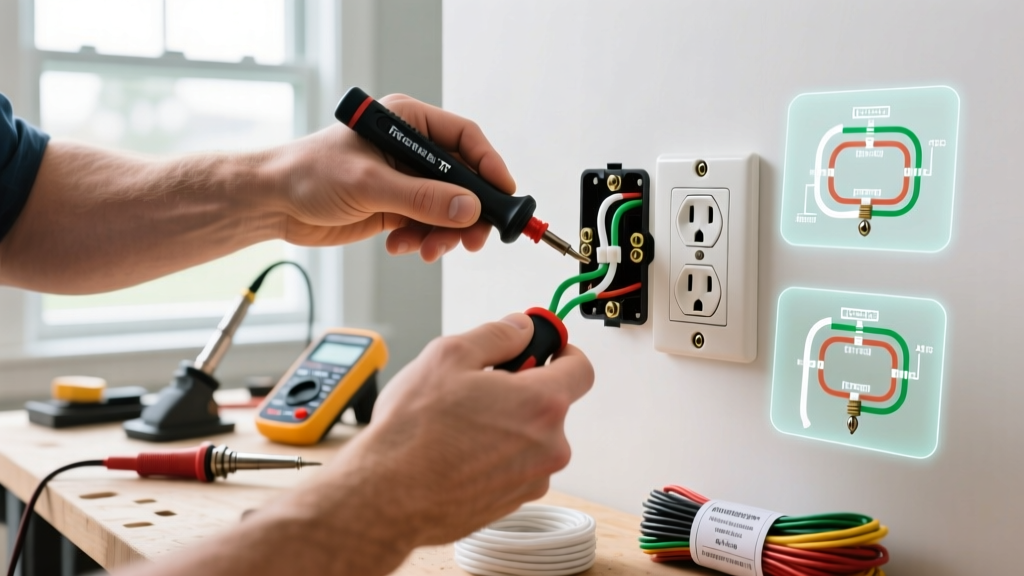
Thermal runaway at the receptacle face is the leading cause of EV charging fires. This is almost always caused by under-torqued terminal screws creating high-resistance micro-arcs. Follow this exact sequence:
- Strip Conductors: Strip exactly 5/8" of insulation from the 4 AWG or 6 AWG conductors. Do not nick the copper.
- Terminate Ground First: Secure the bare/green ground wire to the G terminal. Torque to the manufacturer's specification.
- Terminate Neutral: Secure the white wire to the W (silver) terminal.
- Terminate Hots: Secure black and red to the X and Y (brass) terminals. Phase sequence does not matter for single-phase 240V EVSEs.
- Apply Calibrated Torque: Use an inch-pound torque screwdriver. For the industry-standard Hubbell 9450A receptacle, the required torque is 75 in-lbs. Do not guess this step.
- Strain Relief: Ensure the cable clamp in the junction box is tightened securely so no physical tension transfers to the terminal screws.
Known Failure Modes: The Receptacle Melting Epidemic
Between 2021 and 2024, the EV community documented widespread melting of residential-grade NEMA 14-50 receptacles (specifically certain Leviton and generic import models) when subjected to 40A continuous EV loads. These receptacles utilized internal rivets and thin brass contact wipers that could not dissipate the heat generated by a 10-hour charging session.
The 2026 Standard: Never use a standard $15 residential-grade receptacle for EV charging. You must specify a commercial/industrial-grade receptacle designed for high-heat continuous duty. The universally recommended models by master electricians are:
- Hubbell 9450A (Industrial Grade, ~$120)
- Bryant 9450FR (Hubbell's consumer-facing brand, ~$85)
- Cooper/Arrow Hart 5754N (~$90)
These units feature massive solid brass terminal blocks, high-tension contact wipers, and thermoset phenolic bodies that resist melting up to 150°C.
2026 Material Cost Breakdown (50A Circuit, 50ft Run in EMT)
- Hubbell 9450A Receptacle: $125.00
- 50A 2-Pole Breaker (Square D QO): $45.00
- 150ft 6 AWG THHN (Black, Red, White, Green): $180.00
- 3/4" EMT Conduit & Fittings: $65.00
- Heavy-Duty 4-Gang Junction Box & Cover: $35.00
- Total Material Cost: ~$450.00 (Excluding labor and permits)
Final Inspection Checklist
Before energizing the circuit and plugging in your EVSE, verify the following with a multimeter and visual inspection:
- Line-to-Line (X to Y) reads 240V (±5%).
- Line-to-Neutral (X to W, Y to W) reads 120V.
- Line-to-Ground (X to G, Y to G) reads 120V.
- Neutral-to-Ground reads 0V (confirming no bootleg grounds or neutral-ground bonds at the subpanel).
- All terminal screws verified with a calibrated torque screwdriver.
By treating the 240 volt outlet for electric car installation as a heavy-duty industrial circuit rather than a standard appliance hookup, you ensure decades of safe, high-speed Level 2 charging without the risk of thermal degradation or nuisance breaker trips.