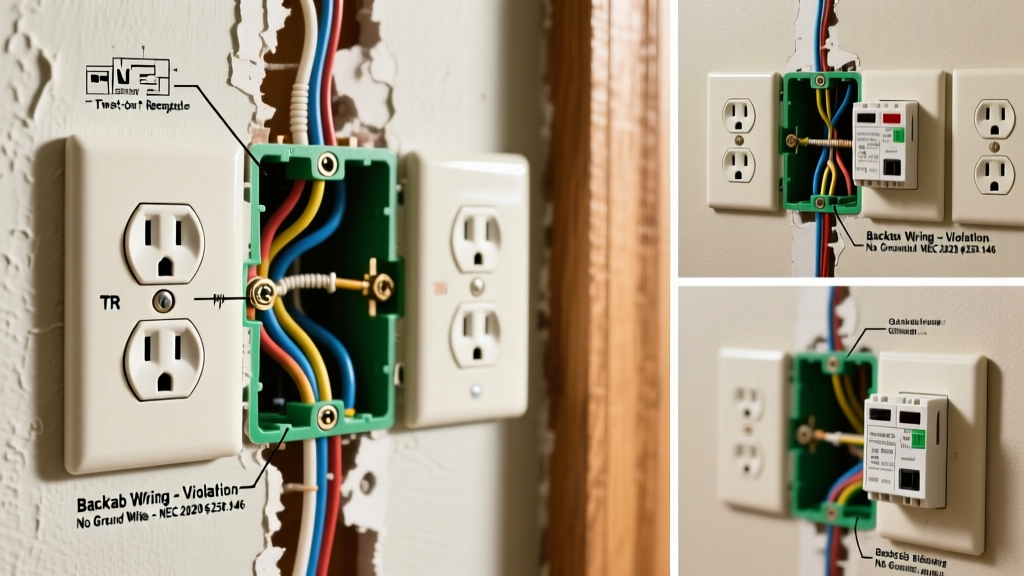

Why Visual Identification Matters for NEC Compliance
When homeowners and DIYers search for electrical outlet pictures, they are usually trying to match a specific wall plate style or figure out how to wire a 3-way switch. However, analyzing visual references is also one of the most effective ways to audit a home for National Electrical Code (NEC) violations. As jurisdictions across the country adopt the 2020 and 2023 NEC cycles into their 2026 building standards, older homes are riddled with legacy receptacles that no longer meet modern safety benchmarks.
By knowing exactly what to look for in electrical outlet pictures, you can identify hazardous wiring methods, missing safety features, and improper placements before they lead to arc faults or electrical fires. Below, we decode the most common code violations visible in receptacle photos and explain how to bring your system up to standard.
5 Common Code Violations Spotted in Electrical Outlet Pictures
1. Missing Tamper-Resistant (TR) Markings
If you are looking at electrical outlet pictures of a home built or renovated before 2008, you are likely looking at a major code violation. Under NEC 406.12, all 15-amp and 20-amp, 125-volt and 250-volt non-locking receptacles installed in dwelling units must be Tamper-Resistant (TR).
"Tamper-resistant receptacles are designed with internal shutter mechanisms that block the insertion of foreign objects, reducing the risk of childhood shock and burns." — Electrical Safety Foundation International (ESFI)
Visual Cue: Look closely at the face of the receptacle. Compliant outlets will have the letters "TR" stamped into the plastic strap or face. If the slots are wide open and lack this marking, the receptacle must be replaced. Standard Leviton 15A TR receptacles cost roughly $1.50 to $2.50 each, making this a highly cost-effective safety upgrade.
2. The "Backstab" Push-In Wiring Method
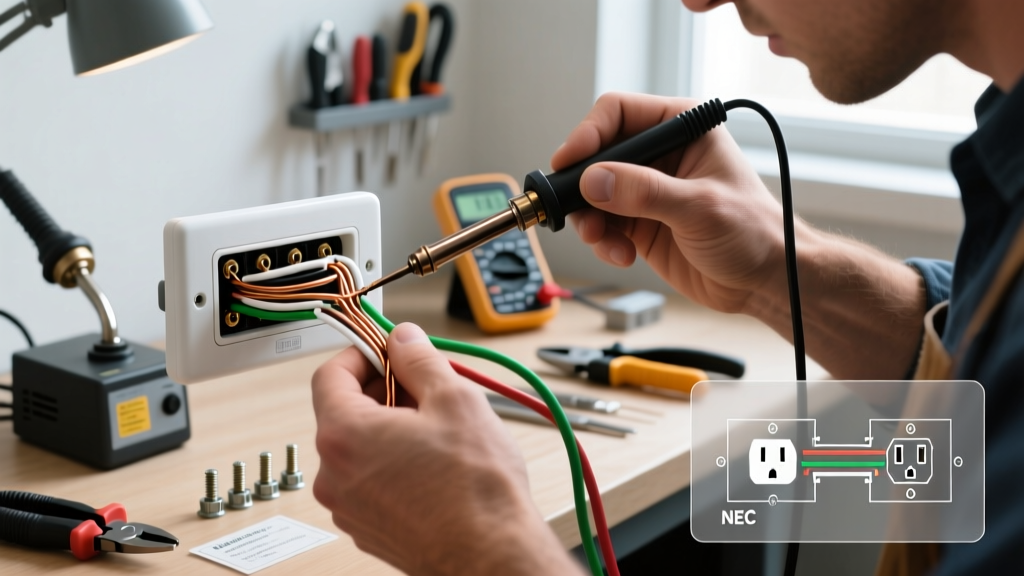
While technically permitted by NEC 110.14(A) for 14 AWG solid copper wire on 15-amp circuits, push-in terminals (commonly called "backstabbing") are universally condemned by master electricians. In electrical outlet pictures where the receptacle is pulled out of the gang box, you can spot this by the lack of wire loops around the brass or silver side screws.
The Failure Mode: The internal spring-metal contacts in push-in terminals lose tension over time, especially under heavy loads like space heaters or window AC units. This leads to micro-arcing, melting the plastic housing. The Fix: Always use the screw terminals, or better yet, pigtail the wires using Wago 221 lever nuts or Ideal 341 yellow wire nuts, leaving only one wire per screw terminal.
3. Incorrect GFCI/AFCI Placement
The NEC strictly mandates Ground Fault Circuit Interrupter (GFCI) protection in areas where water and electricity mix. According to ESFI guidelines and NEC 210.8, GFCI protection is required in kitchens, bathrooms, garages, crawl spaces, unfinished basements, and outdoor locations.
Visual Cue: If an electrical outlet picture shows a standard, non-GFCI receptacle within 6 feet of a kitchen sink or bathroom vanity, it is a direct violation. Furthermore, modern code requires the GFCI reset button to be readily accessible. Hiding a GFCI reset behind a heavy appliance like a refrigerator or microwave is a frequent code violation spotted in kitchen remodel photos.
4. Painted or Damaged Receptacle Faces
Under NEC 110.12 (Mechanical Execution of Work), electrical equipment must be installed in a neat and workmanlike manner. A common sight in DIY renovation pictures is a receptacle that has been painted over along with the walls.
Paint inside the hot and neutral slots prevents the plug blades from making full, flush contact with the internal wipers. This increased electrical resistance generates excess heat, which can melt the plug head or start a fire. If a picture shows paint bridging the gap between the wall plate and the receptacle face, or clogging the slots, the device must be replaced immediately.
5. Missing Grounding Pigtails on Metal Boxes
In older homes with metal junction boxes and armored cable (BX/AC), the grounding path can be unreliable. If an electrical outlet picture shows a modern 3-prong receptacle installed in a metal box without a dedicated green or bare copper grounding pigtail connecting the box to the receptacle's green screw, it is likely an "open ground" violation. Relying solely on the mounting screws for a ground path is not permitted under modern NEC standards unless specific self-grounding clips are used.
Compliant vs. Non-Compliant: A Visual Comparison Matrix
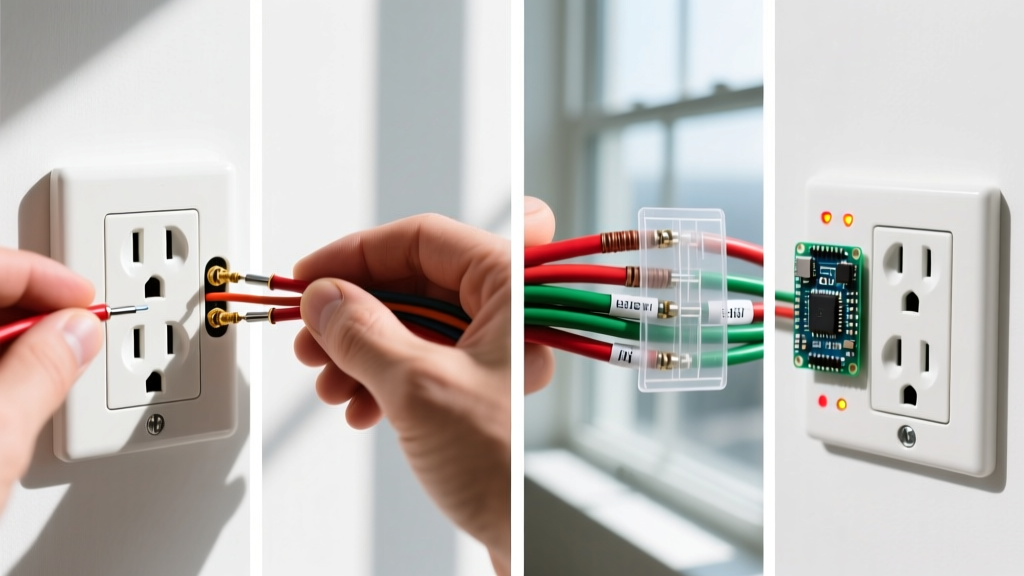
Use this matrix as a mental checklist when reviewing your own installations or analyzing electrical outlet pictures online.
| Feature | Code-Compliant Visual Cue | Violation Visual Cue |
|---|---|---|
| Child Safety | "TR" stamped on the face; tight slot shutters. | No markings; wide-open, unobstructed slots. |
| Termination | Wires looped clockwise under side screws. | Wires shoved into back-hole push-in terminals. |
| Wet Locations | "TEST/RESET" buttons present; in-weather covers outdoors. | Standard flat-face receptacle near sinks or outside. |
| Box Fill & Neatness | Wires folded neatly; no exposed bare copper outside the box. | Bare copper ground wire touching hot brass screws. |
Spacing and Placement Rules (The 6/12 Foot Rule)
While you cannot always see the entire room in electrical outlet pictures, understanding the NEC 210.52 spacing rule is vital for compliance. The code dictates that no point along a continuous wall space can be more than 6 feet from a receptacle. This translates to a maximum of 12 feet between outlets.
Furthermore, any wall space wider than 2 feet requires its own receptacle. When analyzing room photos, count the outlets. If a 15-foot living room wall only has one outlet in the dead center, it fails the 6/12 foot rule and requires the addition of at least one more receptacle to prevent the use of dangerous extension cords.
How to Use a Receptacle Tester to Verify What Pictures Cannot Show
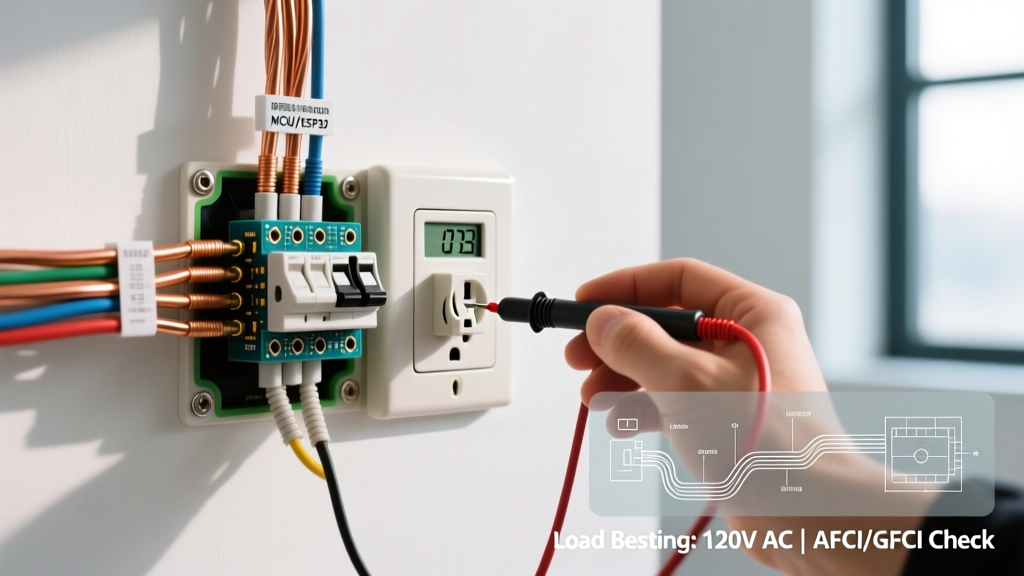
Electrical outlet pictures only tell half the story. A photo cannot reveal internal wiring faults like reverse polarity or an open neutral. To complete your audit, you must pair visual inspection with a digital or analog receptacle tester. The Klein Tools RT210 (approx. $16.00) or the Sperry ET64220 (approx. $12.00) are industry standards for DIYers.
- Test for Open Ground: If the right-most light on the tester fails to illuminate, the ground wire is disconnected somewhere upstream. This is common in pictures of 1960s homes where 2-prong outlets were swapped for 3-prong outlets without running a new ground wire.
- Test for Reverse Polarity: If the hot and neutral wires are swapped on the brass and silver screws, the tester will show a specific yellow/red light combination. This leaves appliances energized even when switched off.
- Test GFCI Tripping: Press the black "GFCI" button on the tester. A compliant GFCI outlet (or a standard outlet protected by a GFCI upstream) should immediately trip and cut power. If it does not, the GFCI mechanism has failed and must be replaced.
Frequently Asked Questions
Can I install a 3-prong outlet without a ground wire?
Under NEC 406.4(D)(2), if no equipment grounding conductor exists in the branch circuit, you may replace a 2-prong outlet with a 3-prong receptacle only if it is GFCI protected. You must apply a sticker reading "GFCI Protected" and "No Equipment Ground" to the faceplate. However, this does not provide a true ground for sensitive electronics; it only provides shock protection.
Are USB wall outlets code-compliant?
Yes, provided they are UL-listed and meet the same TR (Tamper-Resistant) requirements as standard receptacles. When shopping for USB outlets, ensure the internal power supply is rated for at least 3.0A to 5.0A total output to prevent overheating, and verify they carry a valid UL or ETL certification mark on the strap.
Where can I find the official NEC codes for my state?
The National Fire Protection Association (NFPA) publishes the baseline NEC (NFPA 70). However, local municipalities often amend these codes. Always check with your local city or county building department to see which specific NEC edition (2017, 2020, or 2023) is enforced in your area in 2026.