
Understanding the NEC Mandates for Bathroom Receptacles
When wiring an electric outlet for bathroom use, you are navigating one of the most strictly regulated environments in residential electrical work. The combination of water, grounded plumbing fixtures, and high-wattage personal care appliances creates a high-risk zone for electrical shock. To mitigate these hazards, the National Electrical Code (NEC) enforces rigorous standards that dictate everything from circuit sizing and wire gauge to exact placement measurements and ground-fault protection.
As we move through the 2026 adoption cycles of the NEC, local jurisdictions are increasingly cracking down on legacy wiring practices. Upgrading or installing a new bathroom receptacle is no longer just about providing power; it is about strict compliance with life-safety codes. This guide breaks down the exact NEC articles you need to know to ensure your installation is safe, legal, and optimized for modern high-draw appliances like Dyson hair dryers and heated styling tools.
NEC Article 100 Definition: A bathroom is defined as 'an area including a basin with one or more of the following: a toilet, a urinal, a tub, a shower, a bidet, or similar plumbing fixtures.' If the room only has a sink and a toilet, it still legally qualifies as a bathroom under the Code.
GFCI Protection: The Non-Negotiable Safety Standard
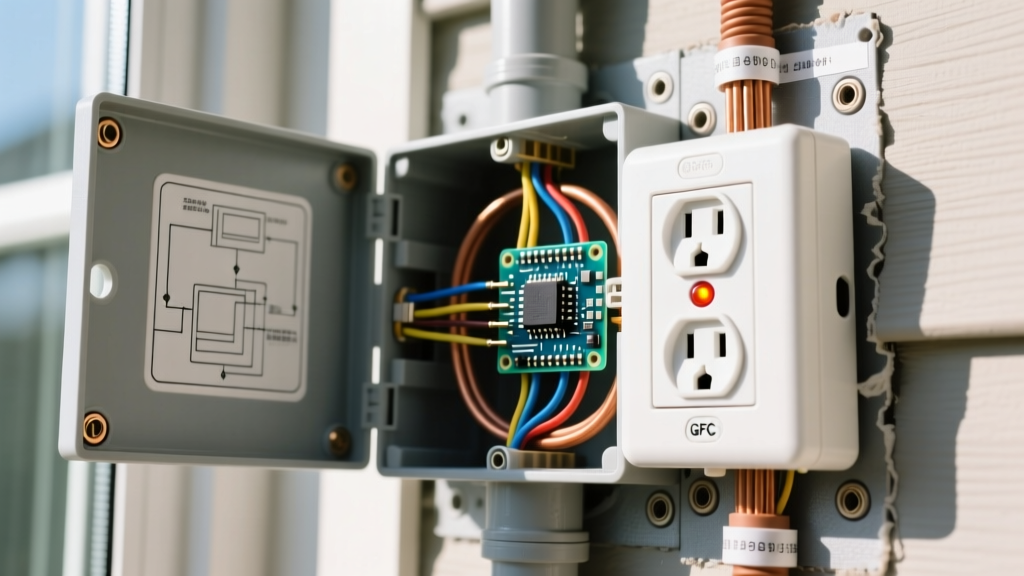
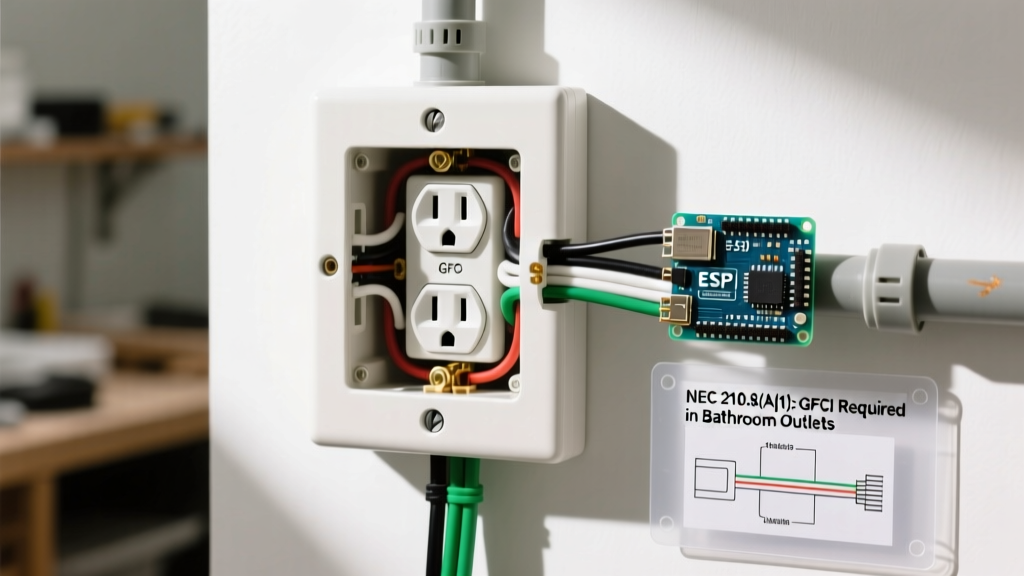
According to National Fire Protection Association (NFPA) guidelines outlined in NEC Section 210.8(A)(1), all 125-volt through 250-volt, single-phase, 15- and 20-ampere receptacles installed in bathrooms must have Ground-Fault Circuit-Interrupter (GFCI) protection. This is not optional. A standard ground wire does not protect against the micro-current leaks that cause fatal ventricular fibrillation in wet environments.
GFCI Receptacle vs. GFCI Breaker
You have two primary methods to achieve compliance. The most common and cost-effective approach is installing a GFCI receptacle at the first outlet in the circuit run, allowing downstream standard receptacles to be protected via the 'LOAD' terminals. Alternatively, you can use a GFCI circuit breaker in the main panel. However, for bathrooms, a GFCI receptacle (such as the Leviton SmartlockPro GFNL1-W or Eaton GFR8352W, typically costing between $22 and $32) is preferred because it allows the user to reset the circuit locally without walking to the basement or garage panel.
| Method | Cost Estimate | Reset Location | Best Use Case |
|---|---|---|---|
| GFCI Receptacle (Local) | $22 - $35 | At the outlet | Standard vanities, easy user access |
| GFCI Circuit Breaker | $45 - $65 | Main electrical panel | Heated floors, hidden junction boxes |
| Dual-Function (AFCI/GFCI) | $55 - $80 | Main electrical panel | Required in specific local jurisdictions combining bedroom/bathroom circuits |
Placement Rules: The 36-Inch Mandate
NEC Section 210.52(D) dictates the precise placement of an electric outlet for bathroom countertops. The code requires that at least one receptacle outlet be installed within 36 inches (3 feet) of the outside edge of each basin. This rule ensures that appliance cords do not have to stretch across sinks or tubs, reducing the risk of an appliance being pulled into water.
Prohibited Locations
Even if it falls within the 36-inch radius, the NEC strictly prohibits installing receptacles in certain orientations and locations:
- Face-Up on Countertops: Receptacles cannot be installed in a face-up position on a horizontal countertop surface. If water spills, it will pool directly into the slots. Use pop-up outlets rated for wet locations or mount them on the vertical backsplash.
- Inside the Tub/Shower Space: No receptacles of any kind are permitted within the footprint of a bathtub or shower stall (NEC 406.9(E)).
- Over the Basin: While not explicitly banned by a single sentence in the NEC, placing an outlet directly over the water bowl violates the spirit of the 3-foot rule and creates a severe drop-hazard for plugged-in appliances.
Circuit Sizing and Dedicated Line Requirements
Bathroom appliances are notoriously power-hungry. A standard hair dryer can pull 1,875 watts (15.6 amps on a 120V circuit), which will instantly trip a standard 15-amp breaker. Therefore, NEC Section 210.11(C)(3) mandates that bathrooms be supplied by a 20-ampere branch circuit.
The 'Dedicated' vs. 'Shared' Circuit Rule
The code allows two distinct wiring topologies for this 20-amp circuit:
- The Dedicated Receptacle Circuit: The 20-amp circuit supplies only the bathroom receptacles. It cannot power the bathroom lights, exhaust fan, or any outlets in other rooms. You can, however, wire receptacles for multiple bathrooms on this single dedicated circuit.
- The Shared Bathroom Circuit: The 20-amp circuit supplies the bathroom receptacles, the bathroom lighting, and the bathroom exhaust fan. However, this circuit must serve only that specific bathroom. It cannot extend to a second bathroom or a hallway light.
Wire Gauge and Terminal Torque
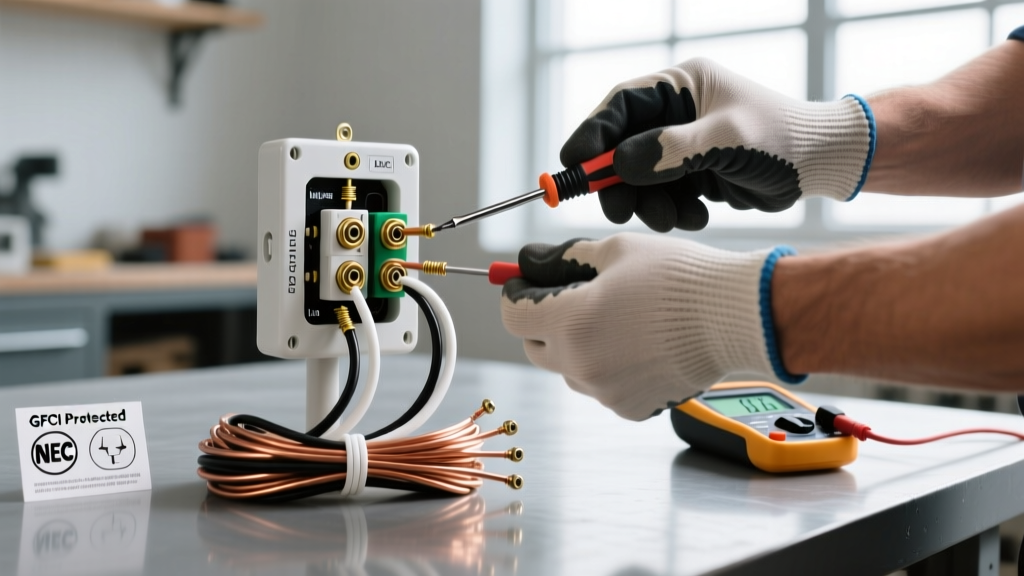
For a 20-amp circuit, you must use 12 AWG copper wire (typically 12/2 NM-B Romex). Do not use 14 AWG wire, even if you are installing a 15-amp rated receptacle on the 20-amp circuit. While NEC 210.21(B)(3) allows 15-amp duplex receptacles on a 20-amp circuit (as long as there is more than one receptacle on the yoke), the wire feeding the circuit must always match the breaker size. When terminating 12 AWG wire, ensure you strip exactly 3/4 inch of insulation and torque the terminal screws to the manufacturer's specification (usually 14 in-lbs for standard 15A/20A devices) to prevent arcing and thermal failure.
Tamper-Resistant (TR) and Weather-Resistant (WR) Specs
Since the 2008 NEC cycle, all 15- and 20-amp receptacles in residential dwellings must be Tamper-Resistant (TR). TR receptacles feature internal spring-loaded shutters that only open when equal pressure is applied to both slots simultaneously, preventing children from inserting foreign objects. Look for the 'TR' stamp on the face of the device.
Furthermore, if the electric outlet for your bathroom is located in a damp location—such as an open shower concept or a wet room where direct spray is possible—NEC 406.9(A) requires the device to be listed as Weather-Resistant (WR). WR receptacles utilize UV-stabilized thermoplastics and nickel-plated brass contacts to resist corrosion from high humidity and chemical cleaning agents commonly used in bathrooms.
Common Code Violations & Troubleshooting Matrix
Even experienced DIYers make mistakes when wiring bathroom outlets. According to data from the U.S. Consumer Product Safety Commission (CPSC), improper GFCI wiring and overloaded circuits remain leading causes of residential electrical fires. Below is a troubleshooting matrix for common failures.
| Symptom | Probable Cause | Code Violation? | Solution |
|---|---|---|---|
| GFCI trips immediately when hair dryer is turned on. | Appliance exceeds 80% continuous load or has internal moisture fault. | No (Safety feature working) | Test appliance in another room; replace GFCI if nuisance tripping persists. |
| Downstream outlets are dead, but GFCI has power. | Wires connected to 'LINE' instead of 'LOAD' terminals on the GFCI. | Yes (Fails 210.8 protection) | Identify downstream cable, move it to LOAD terminals, and torque to 14 in-lbs. |
| Breaker trips when vanity lights and heater are on. | Lighting and heater share a 15A circuit; heater pulls 12A alone. | Yes (Violates 210.11(C)(3)) | Run a new dedicated 20A circuit using 12/2 NM-B for the heater/receptacles. |
| Outlet feels warm to the touch. | 14 AWG wire used on a 20A breaker, or loose terminal connections. | Yes (Severe fire hazard) | Immediately shut off breaker. Verify 12 AWG wire and re-terminate connections. |
Frequently Asked Questions (FAQ)
Can I install a 15-amp receptacle on a 20-amp bathroom circuit?
Yes, but with a major caveat. NEC 210.21(B)(1) states that if there is only a single receptacle on the circuit (a singleplex), it must be rated for 20 amps. However, standard bathroom installations use duplex receptacles (two outlets on one yoke). Because a duplex counts as multiple receptacles, you are legally permitted to use standard 15-amp TR duplex receptacles on a 20-amp circuit. That said, upgrading to a 20-amp rated duplex receptacle provides heavier internal contacts that better handle the heat generated by 1,800-watt styling tools.
Does a bathroom exhaust fan need to be on the GFCI circuit?
Generally, no. NEC 210.8 requires GFCI protection for receptacles. Hardwired lighting and exhaust fans do not require GFCI protection unless they are installed directly over the shower/tub zone, in which case the manufacturer's installation instructions usually mandate it (and NEC 110.3(B) requires following manufacturer instructions). Keeping the fan off the GFCI load side prevents the bathroom from losing ventilation if a hair dryer trips the GFCI receptacle.
What if my bathroom has a double vanity?
NEC 210.52(D) requires at least one receptacle within 36 inches of the outside edge of each basin. For a double vanity, you must install a minimum of two receptacles. You can place one on the far left and one on the far right, or install two separate outlets between the sinks, provided each sink's 36-inch radius is covered. Both receptacles can be on the same 20-amp branch circuit.