
Navigating Electric Outlet Types Through the Lens of NEC Safety Codes
When planning a residential wiring project or upgrading an older home, selecting the correct electric outlet types is not merely a matter of matching plug shapes to appliances. It is a strict legal and life-safety requirement governed by the National Electrical Code (NEC). As of 2026, local jurisdictions across the United States have largely adopted the 2023 NEC standards, with some municipalities already enforcing early 2026 amendments. Understanding the specific safety mechanisms, trip thresholds, and location mandates for various receptacles is critical for preventing electrical fires and fatal shocks.
According to the National Fire Protection Association (NFPA), electrical failures and malfunctions are a leading cause of home structure fires. This guide breaks down the core electric outlet types required by modern code, detailing their internal mechanisms, failure modes, and exact installation parameters.
The Core Electric Outlet Types Dictated by NEC Safety Codes
1. Tamper-Resistant (TR) Receptacles (NEMA 5-15R & 5-20R)
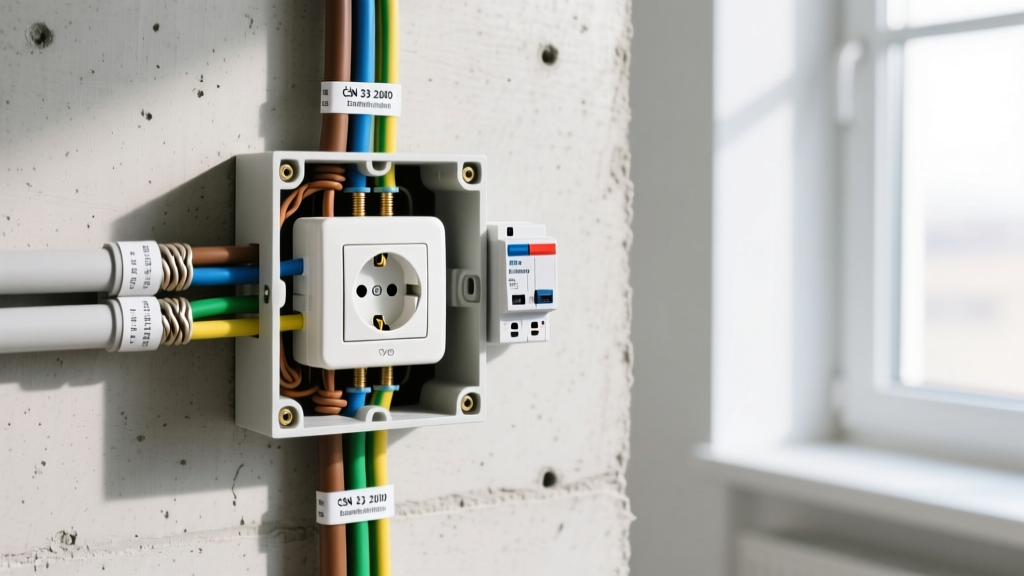
Standard 15-amp and 20-amp duplex receptacles must now feature Tamper-Resistant (TR) technology in almost all residential living spaces. First mandated in the 2008 NEC, TR receptacles feature internal spring-loaded shutter plates that block the insertion of foreign objects (like keys or hairpins) unless a standard two- or three-prong plug applies simultaneous, equal pressure to both slots.
- Code Reference: NEC Article 406.12 requires TR receptacles in all areas specified in 210.52, including kitchens, bedrooms, hallways, and laundry areas.
- Specific Models: The Leviton T5262 (15A) and Leviton T5362 (20A) are industry-standard TR duplex receptacles priced around $3.50 to $5.00 each.
- Failure Mode & Edge Case: Homeowners frequently complain that TR outlets are 'broken' because they refuse to accept a plug. This usually occurs when the user is inserting a plug at an angle, failing to engage both shutters simultaneously, or attempting to use a plug with a bent or damaged prong. Never force a plug or attempt to bypass the shutter with a tool.
2. Ground Fault Circuit Interrupter (GFCI) Outlets
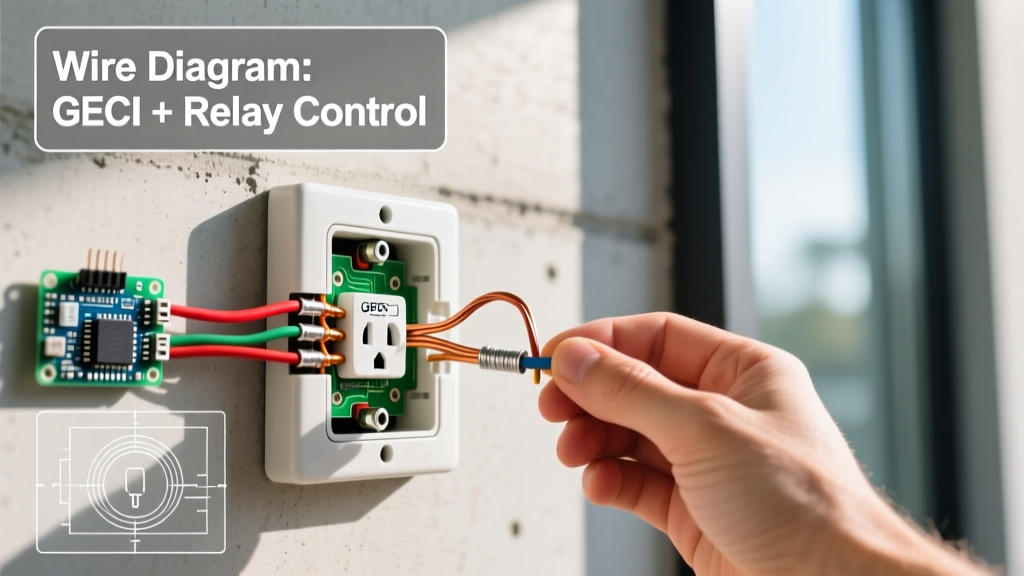
GFCI receptacles are designed to protect human life from fatal electric shock by monitoring the current balance between the hot and neutral conductors. If an imbalance as small as 5 milliamps (±1 mA) is detected—indicating current is leaking to ground, potentially through a human body—the internal solid-state circuit trips in under 25 milliseconds.
The Consumer Product Safety Commission (CPSC) estimates that GFCIs prevent thousands of electrocutions annually. Under current NEC Article 210.8, GFCI protection is mandatory in all damp, wet, or potentially grounded locations.
Safety Callout: GFCI receptacles have a finite lifespan due to the degradation of their internal metal-oxide varistors (MOVs) from minor voltage surges. In 2026, it is best practice to test GFCI outlets monthly using the physical 'TEST' button on the device, not just a plug-in tester, to verify the mechanical trip mechanism is not seized.
3. Arc Fault Circuit Interrupter (AFCI) and Dual Function (DF) Outlets
While GFCIs protect against ground faults (shock), AFCIs protect against parallel and series arcing faults (fire). Arcing occurs when current jumps across a gap in a damaged wire or loose connection, generating temperatures exceeding 10,000°F. Modern AFCI receptacles utilize advanced digital signal processing to distinguish between harmless operational arcs (like those from a vacuum motor) and dangerous fault arcs.
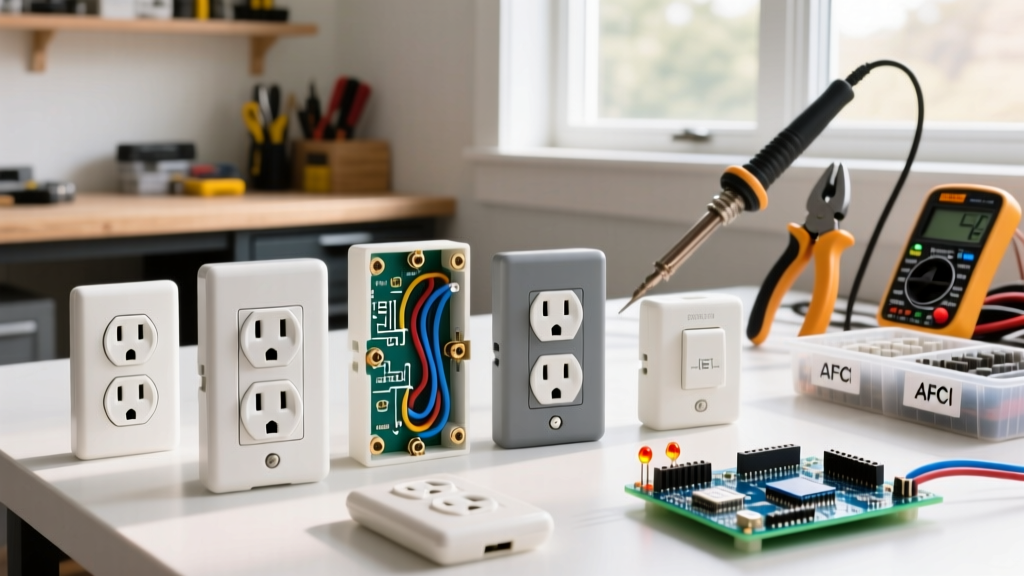
For areas requiring both shock and fire protection (e.g., a kitchen countertop near a sink), the code now heavily favors Dual Function (DF) receptacles, which combine AFCI and GFCI protection in a single device, such as the Square D HOM120DF or Leviton AGFTR. These typically retail between $35 and $45 per unit.
NEC Location Requirements Matrix for Electric Outlet Types
The following matrix outlines the minimum code requirements for specific rooms in a 2026 residential build. Note that local amendments may exceed these baseline NEC requirements.
| Room / Location | Required Receptacle Type | NEC Article Reference | Specific Edge Cases & Notes |
|---|---|---|---|
| Kitchen Countertops | GFCI + AFCI (Dual Function) | 210.8(D) & 210.12 | Must be on 20A small-appliance branch circuits. No more than 24 inches of unbroken counter space without an outlet. |
| Bathrooms | GFCI & Tamper-Resistant | 210.8(A) & 406.12 | Must be within 36 inches of the sink edge. Cannot be on a shared circuit with other rooms' lighting. |
| Bedrooms & Living Rooms | AFCI & Tamper-Resistant | 210.12(A) & 406.12 | Arc-fault protection required for all 120V, 15A/20A branch circuits supplying these habitable spaces. |
| Garages & Crawlspaces | GFCI & Tamper-Resistant | 210.8(A)(2) & (4) | All 125V/250V receptacles up to 50 amps in garages now require GFCI protection, including dedicated EV charger outlets. |
| Unfinished Basements | GFCI & Tamper-Resistant | 210.8(A)(5) | Exceptions exist only for dedicated sump pumps or hardwired security systems, but plug-in receptacles must be GFCI. |
High-Voltage and Specialty Electric Outlet Types: The EV Charging Hazard
As electric vehicle (EV) adoption surges in 2026, the installation of high-amperage electric outlet types has become a major focal point for electrical inspectors. The most common receptacle used for Level 2 home charging is the NEMA 14-50R (50-amp, 125/250-volt, 4-pole).
The NEMA 14-50R Thermal Failure Crisis
Historically, homeowners and contractors installed standard residential-grade NEMA 14-50R receptacles (costing roughly $10-$15) for EV chargers. However, EV charging represents a continuous load—drawing maximum current (40 amps) for 8 to 12 hours straight. Standard residential receptacles are not engineered for sustained thermal dissipation at this level, leading to a documented pattern of melted faceplates, degraded internal wipers, and electrical fires.
2026 Best Practice & Code Compliance:
- Industrial-Grade Receptacles: If a plug-in setup is mandated, inspectors increasingly require commercial/industrial-grade NEMA 14-50R receptacles, such as the Hubbell 9450FR or Bryant 9450FR. These feature heavy-duty phenolic bodies and high-tension internal wipers designed for continuous loads. They cost between $75 and $110.
- Torque Specifications: NEC 110.14(D) strictly mandates the use of a calibrated torque screwdriver for all terminations. For 6 AWG copper wire on a 14-50R, the manufacturer-specified torque is typically between 35 and 50 inch-pounds. Hand-tightening leads to loose connections, increased resistance, and catastrophic thermal failure under continuous EV loads.
- Hardwiring Preference: The safest and most code-compliant method for modern Level 2 EV chargers in 2026 is to bypass the receptacle entirely and hardwire the charger directly to a junction box, eliminating the primary point of mechanical and thermal failure.
Common Code Violations and Dangerous Failure Modes
When auditing older homes or reviewing DIY electrical work, specific violations regarding electric outlet types appear repeatedly. These pose severe safety risks:
- The 'Bootleg Ground': In older homes lacking a true equipment grounding conductor, some individuals illegally install a jumper wire between the neutral terminal and the ground terminal on a standard 3-prong outlet. This tricks cheap plug-in testers into showing a 'correct' reading, but if a hot-to-ground fault occurs, the chassis of any plugged-in appliance becomes energized at 120V, creating a lethal shock hazard. A true ground must be verified with an impedance tester or by pulling the receptacle to inspect the wiring.
- Backstabbing (Push-In Connectors): While modern 2026 code allows listed push-in connectors for specific applications, using the friction-based 'backstab' holes on cheap 15A receptacles for continuous loads is a known failure mode. The internal spring clips lose tension over time due to thermal expansion and contraction, leading to arcing. Always use the side-screw terminals or the screw-loop method for secure terminations.
- Reverse Polarity: Swapping the hot (black) and neutral (white) wires on a receptacle. While a simple lamp will still turn on, the internal switch of the appliance will only interrupt the neutral path, leaving the socket energized at 120V even when the device is 'off'.
2026 Material and Installation Cost Breakdown
Upgrading a home's electric outlet types to meet current NEC safety standards requires budgeting for specialized materials and licensed labor. Below is an estimated cost matrix for 2026 residential upgrades:
| Upgrade Scenario | Material Cost (Per Unit) | Avg. Labor Cost (Per Unit) | Total Estimated Cost |
|---|---|---|---|
| Standard TR Duplex (15A/20A) | $3.00 - $6.00 | $75 - $120 | $78 - $126 |
| Standard GFCI (15A/20A) | $18.00 - $28.00 | $95 - $150 | $113 - $178 |
| Dual Function (AFCI/GFCI) | $35.00 - $50.00 | $110 - $160 | $145 - $210 |
| Industrial NEMA 14-50R (EV) | $85.00 - $120.00 | $150 - $250* | $235 - $370* |
*Labor for NEMA 14-50R assumes an existing 50A circuit and junction box. Running a new 50A/240V circuit from the main panel will add $400 to $1,200 depending on distance and wall penetration requirements.
Final Safety Directives
Compliance with the National Electrical Code is not a bureaucratic hurdle; it is a data-driven framework engineered to prevent property destruction and loss of life. When selecting electric outlet types for any 2026 project, always verify that the devices bear the mark of a Nationally Recognized Testing Laboratory (NRTL) such as UL or CSA. Avoid counterfeit or unlisted receptacles frequently found on third-party online marketplaces, as they lack the internal thermal cutoffs and precise metallurgical tolerances required to safely interrupt fault currents. When in doubt, consult a licensed electrical contractor and reference the latest local amendments to NEC Articles 210, 406, and 511.