
Understanding the NEMA 5-15P Standard and NEC Polarity
When undertaking any electrical repair or custom equipment build, proper 3 pin electrical plug wiring is not just a matter of making the device turn on; it is a strict legal and safety requirement governed by the National Electrical Code (NEC). In North America, the standard 3-pin plug is the NEMA 5-15P, rated for 15 Amps and 125 Volts. As jurisdictions continue to adopt the 2023 and upcoming 2026 NEC cycles, inspectors and safety auditors are cracking down on improper cord terminations, which remain a leading cause of residential and industrial electrical fires.
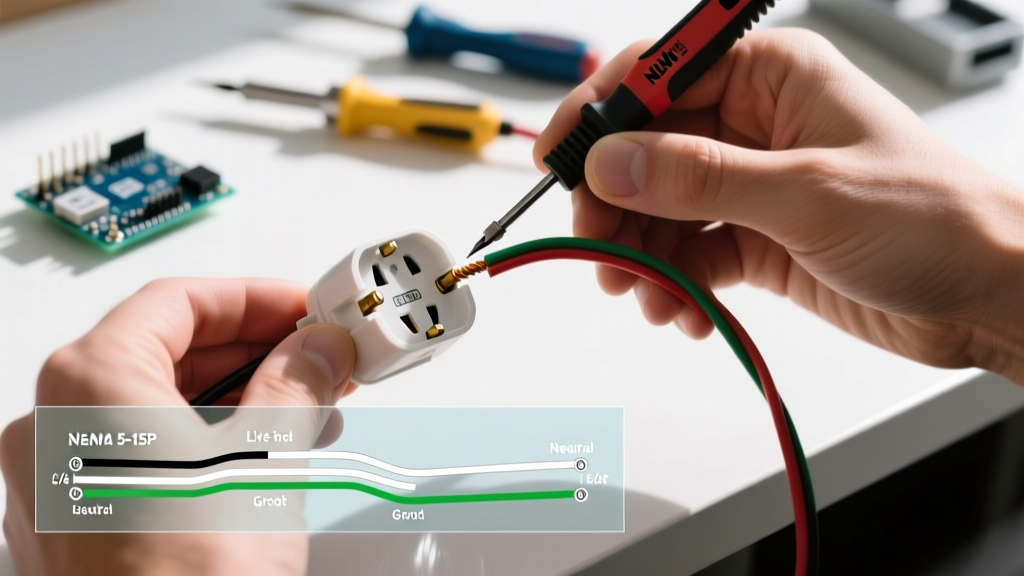
The 3-pin configuration consists of three distinct conductors: the ungrounded (hot), the grounded (neutral), and the equipment grounding conductor (EGC). The NEC mandates strict adherence to polarity and color-coding to ensure that overcurrent protection devices function correctly and that chassis faults have a low-impedance path back to the source.
Terminal Identification and Color Coding
According to NFPA 70 (National Electrical Code), specifically Article 250.118 and Article 406, the wiring of an attachment plug must follow these rigid color and terminal assignments:
- Hot (Ungrounded): Connects to the Brass terminal. The wire insulation must be Black (or Red/Blue in specific multi-wire setups). This connects to the narrower vertical blade on the plug face.
- Neutral (Grounded): Connects to the Silver terminal. The wire insulation must be White or Grey. This connects to the wider vertical blade on the plug face.
- Ground (Equipment Grounding Conductor): Connects to the Green terminal. The wire insulation must be Bare Copper or Green. This connects to the rounded U-shaped pin.
Expert Insight: Reversing the hot and neutral wires (reverse polarity) is a severe NEC violation. While the connected appliance may still operate, the internal fuse or single-pole switch of the device will only interrupt the neutral path. This leaves the internal circuitry energized at 120V even when the device is switched off, creating a lethal shock hazard during servicing.
NEC Article 400: Flexible Cord and Plug Ratings
A common failure point in 3 pin electrical plug wiring is the mismatch between the flexible cord's ampacity and the plug's rating. You cannot simply attach a heavy-duty SOOW cable to a standard 15A plug, nor can you use a lightweight lamp cord for a 15A power tool. NEC Article 400.5 outlines the allowable ampacities for flexible cords.
Cord Gauge and Jacket Type Matrix
Selecting the correct cord ensures the plug terminals are not subjected to thermal overload. Below is the code-compliant matrix for standard 15A (NEMA 5-15P) plug wiring:
| Cord Type (Jacket) | AWG Size | Max Ampacity (NEC 400.5) | Typical Application |
|---|---|---|---|
| SPT-2 (Light Duty) | 16 AWG | 10 Amps | Lamps, radios (Requires 10A plug, not 15A) |
| SJT (Standard Vinyl) | 14 AWG | 15 Amps | General appliances, PC power cords, shop vacs |
| SJTW (Weather Resistant) | 14 AWG | 15 Amps | Outdoor equipment, temporary site lighting |
| SOOW (Heavy Rubber) | 14 AWG (or 12 AWG) | 15 Amps (or 20 Amps) | Industrial machinery, heavy-duty extension cords |
Note: If you are wiring a 20A NEMA 5-20P plug, you must step up to a minimum of 12 AWG cord, as 14 AWG is strictly limited to 15A under NEC Table 400.5(A)(2).
The Critical Role of Strain Relief (NEC 400.16)
Perhaps the most frequently cited violation during OSHA workplace electrical inspections is the lack of proper strain relief. NEC Article 400.16 dictates that flexible cords must be connected to devices and fittings so that strain relief is provided. This prevents mechanical pull from being transmitted directly to the terminal screws, which could loosen the connection, cause arcing, and ignite the plug housing.
How to Achieve Code-Compliant Strain Relief
- Jacket Clamping: The plug's internal cord grip (strain relief clamp) must clamp down securely on the outer jacket of the flexible cord, not just the individual insulated conductors.
- Jacket Penetration: The outer jacket must extend at least 1/4 inch inside the plug housing past the strain relief bar. If the jacket stops outside the plug, the internal wires will bear the brunt of any physical tug.
- The Pull Test: While not explicitly quantified in the NEC text, UL 498 standards (which the NEC references for product listing) require the cord to withstand a 35-pound static pull for one minute without the jacket slipping or the terminal connections shifting.
Code-Compliant Step-by-Step Wiring Guide
Follow this precise methodology to ensure your 3 pin electrical plug wiring meets both NEC and UL standards. This procedure assumes the use of a standard industrial-grade replacement plug, such as the Leviton 515-P or Pass & Seymour 5266.
Step 1: Precision Stripping
Use a calibrated wire stripper (e.g., Klein Tools 11063W). Strip the outer jacket back exactly 2 inches. Next, strip the individual conductor insulation. Most high-quality plugs feature a built-in 'strip gauge' molded into the thermoplastic housing. Generally, this requires stripping exactly 5/8 inch (16mm) of insulation from the hot, neutral, and ground wires. Stripping too little results in the screw clamping onto the insulation (high resistance, heat). Stripping too much leaves exposed bare copper outside the terminal (shock and short-circuit hazard).
Step 2: Forming the Terminal Loops
Using needle-nose pliers, bend the exposed copper into a tight, clockwise hook (shepherd's hook). The clockwise orientation is vital: as you tighten the terminal screw (which turns clockwise), the loop will close tighter around the screw shaft. A counter-clockwise loop will be pushed outward and expelled from the terminal as the screw tightens.
Step 3: Termination and Torque
Seat the hook under the brass, silver, and green terminal screws. Ensure no stray copper 'whiskers' are protruding, as these can bridge the gap between the hot and ground terminals. Tighten the screws firmly. While the NEC does not specify exact torque values for standard 15A attachment plugs, manufacturer specifications for commercial-grade plugs (like Hubbell or Pass & Seymour) typically call for 12 to 14 inch-pounds of torque. Use a calibrated inch-pound screwdriver if available to prevent stripping the brass threads.
Step 4: Assembly and Clamping
Route the wires neatly into the designated channels inside the plug housing. Ensure the green ground wire does not cross over the brass hot terminal. Tighten the strain relief screws over the cord jacket until the jacket is visibly compressed but not pierced or severely deformed.
Top 4 NEC Code Violations in 3 Pin Electrical Plug Wiring
Electrical inspectors and safety officers look for specific edge cases and shortcuts. Avoid these common pitfalls:
- Violation 1: Using Solid Core Wire. NEC Article 400 applies to flexible cords. Solid core building wire (like THHN or Romex) must never be used to wire a portable attachment plug. The repeated bending of a plug will cause solid copper to work-harden, snap, and arc inside the housing.
- Violation 2: Tinning (Soldering) the Wire Ends. Soldering the tips of stranded wires before placing them under a mechanical screw terminal is a major code violation. Solder is a soft metal that 'creeps' and deforms under the pressure of the screw and thermal cycling, leading to a loose connection and eventual arcing. Wires must be bare stranded copper or fitted with a crimped ferrule.
- Violation 3: Undersized Grounding Conductors. The equipment grounding conductor must be the same gauge as the current-carrying conductors for 15A and 20A circuits. Using a 16 AWG ground wire on a 14 AWG hot/neutral circuit violates NEC 250.122.
- Violation 4: Splicing Inside the Plug. The plug housing is not a junction box. NEC 314.16 requires adequate volume for splices. You cannot shorten a cord by coiling the excess wire and stuffing it into the plug housing.
Frequently Asked Questions on Plug Wiring Codes
Can I wire a 15A plug onto a 20A circuit?
Yes, but with caveats. The NEC allows a 15A receptacle or plug on a 20A circuit provided it is part of a multi-outlet branch circuit (NEC 210.21(B)(3)). However, the cord attached to the 15A plug must be sized for the actual load of the appliance, and the appliance itself cannot draw more than 12A continuously (80% rule for continuous loads). If the device draws 18A, you must use a 20A NEMA 5-20P plug and a 20A receptacle.
Does the ground wire need to be insulated?
For flexible cords (like SJT or SOOW), the internal ground wire is typically bare copper. The NEC permits bare equipment grounding conductors inside a manufactured, listed flexible cord assembly. However, if you are pulling individual wires through a conduit to a rigid plug or junction box, the ground must be insulated green or left bare as per NEC 250.119.
Where can I find official safety guidelines for cord maintenance?
The U.S. Consumer Product Safety Commission (CPSC) provides extensive guidelines on the inspection and maintenance of flexible cords and attachment plugs, emphasizing that any plug showing signs of thermal deformation, cracked housing, or loose strain relief must be immediately destroyed and replaced, not merely taped or glued.