
Understanding the UK Electric Outlet: Beyond the BS 1363 Standard
When discussing a UK electric outlet, most people immediately think of the ubiquitous BS 1363 13-amp fused plug and socket system. However, from a code compliance and electrical engineering perspective, the outlet is merely the termination point of a highly regulated circuit topology. In 2026, all domestic and commercial installations in the United Kingdom must adhere to BS 7671:2018+A2:2022 (the 18th Edition of the IET Wiring Regulations, incorporating Amendment 2). This comprehensive guide breaks down the exact code requirements, circuit topologies, and safety mandates for installing and modifying UK socket-outlets.
Ring Final vs. Radial Circuits: BS 7671 Circuit Topologies
The UK is unique in its widespread use of the Ring Final Circuit (RFC), a topology born out of post-WWII copper shortages. However, modern electrical codes heavily regulate how these circuits are deployed to prevent cable overloading and thermal degradation.
Ring Final Circuit (RFC) Requirements
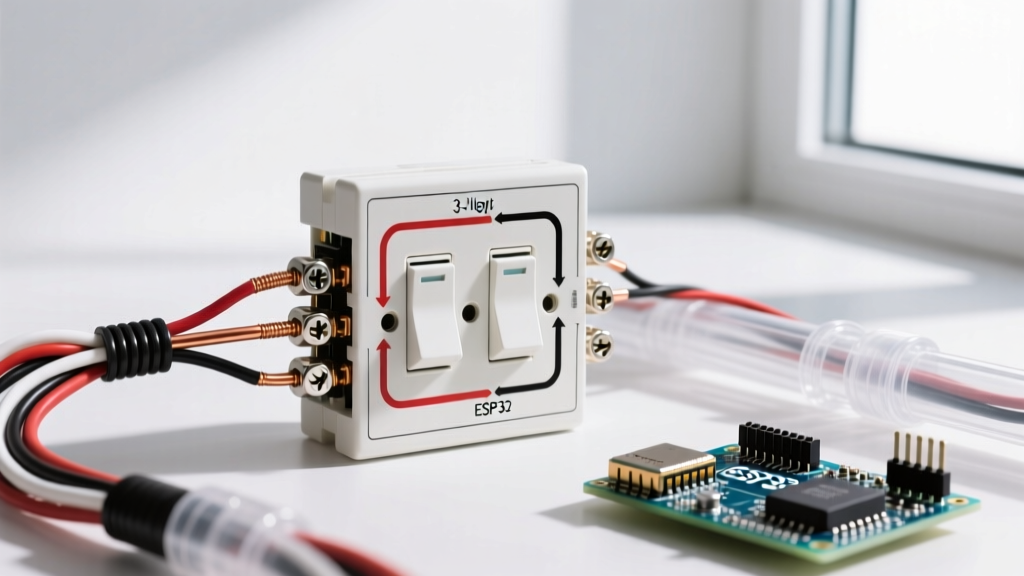
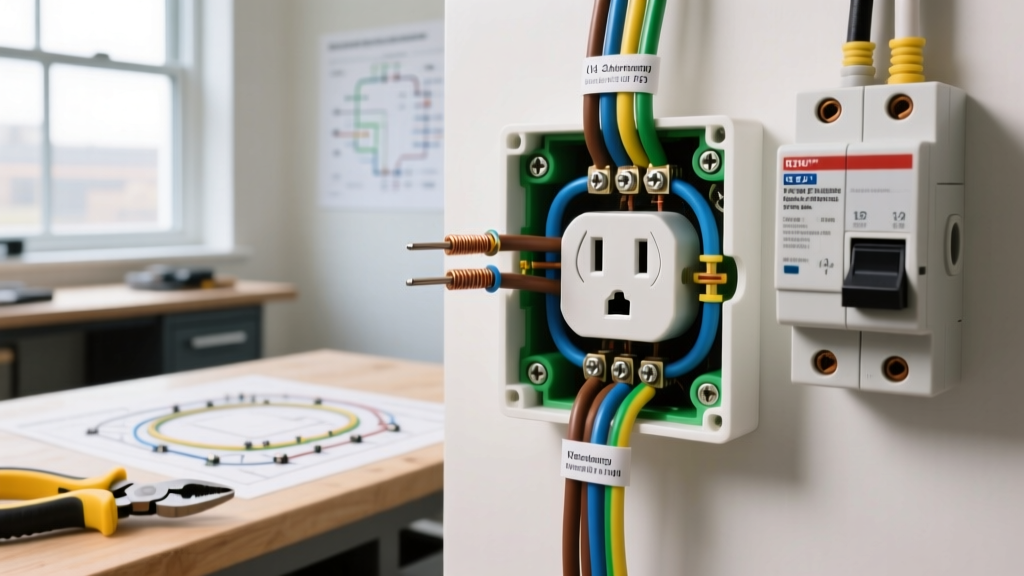
Under BS 7671 Regulation 433.1, an RFC must be wired using a minimum of 2.5mm² twin and earth (T&E) PVC-insulated cable and protected by a 32A Type B or Type C miniature circuit breaker (MCB). The fundamental rule of the ring is that the circuit must start at the consumer unit, loop through every socket, and return to the exact same MCB terminal, forming a continuous loop.
- Spurring Limits: You may install an unfused spur (a branch off the main ring) to feed a maximum of one single or one double socket. If you need to feed more outlets from a single spur point, you must install a 13A Fused Connection Unit (FCU) to protect the downstream 2.5mm² cable.
- Floor Area Restriction: A single 32A RFC should ideally not serve a floor area exceeding 100m² to prevent excessive voltage drop and load imbalance.
Radial Circuit Alternatives
Many modern electricians prefer radial circuits due to the elimination of 'broken ring' risks (where a severed ring forces a 2.5mm² cable to carry the full 32A load, creating a severe fire hazard).
| Circuit Type | Minimum Cable Size | MCB Rating & Type | Max Floor Area (Approx) | Code Reference |
|---|---|---|---|---|
| Ring Final | 2.5mm² T&E | 32A (Type B or C) | 100m² | BS 7671 Reg 433.1 |
| Radial (Standard) | 2.5mm² T&E | 20A (Type B or C) | 50m² | BS 7671 Reg 433.1 |
| Radial (High Load) | 4.0mm² T&E | 32A (Type B or C) | 75m² | BS 7671 Reg 433.1 |
RCD and RCBO Protection Mandates (Amendment 2 Updates)
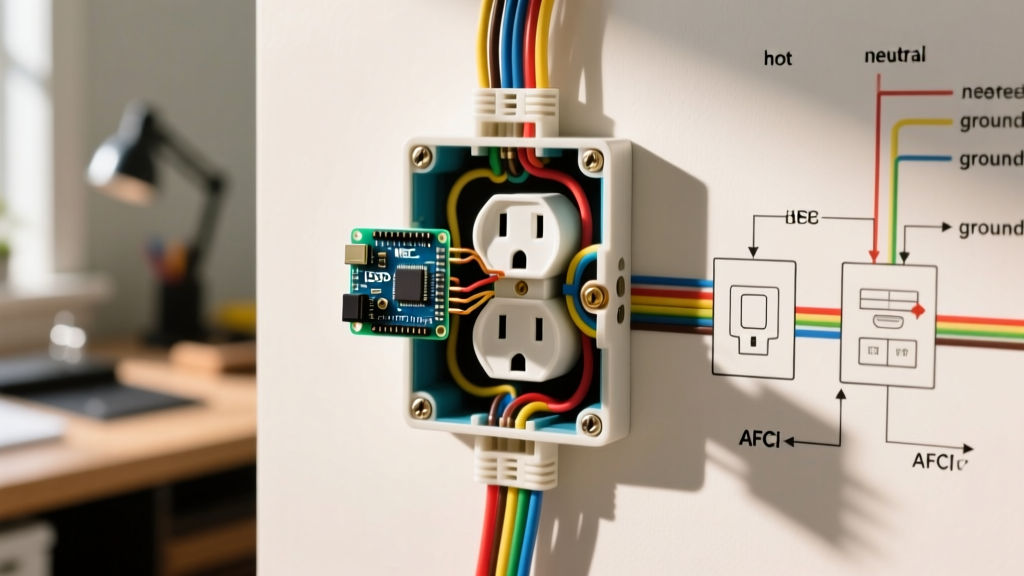
One of the most critical safety updates in recent iterations of the wiring regulations is the mandatory requirement for additional protection via Residual Current Devices (RCDs). Under Regulation 411.3.3, all socket-outlets rated up to 32A that are intended for use by ordinary persons (BA1) must be protected by an RCD with a maximum residual operating current of 30mA.
The Shift to RCBOs and Type A/F Protection
While a main RCD protecting the entire consumer unit was standard practice a decade ago, modern best practice and code compliance strongly favor Residual Current Breakers with Overcurrent protection (RCBOs) on every individual socket circuit. This prevents a single earth fault on a kitchen appliance from plunging the entire home into darkness.
Furthermore, with the proliferation of modern electronics, LED drivers, and smart home hubs, standard Type AC RCDs are no longer sufficient. The IET strongly recommends Type A or Type F RCBOs for socket circuits, as they can detect pulsating direct current (DC) fault components and composite frequencies that standard Type AC devices will completely miss.
USB and Smart Socket Outlets: Modern Code Considerations
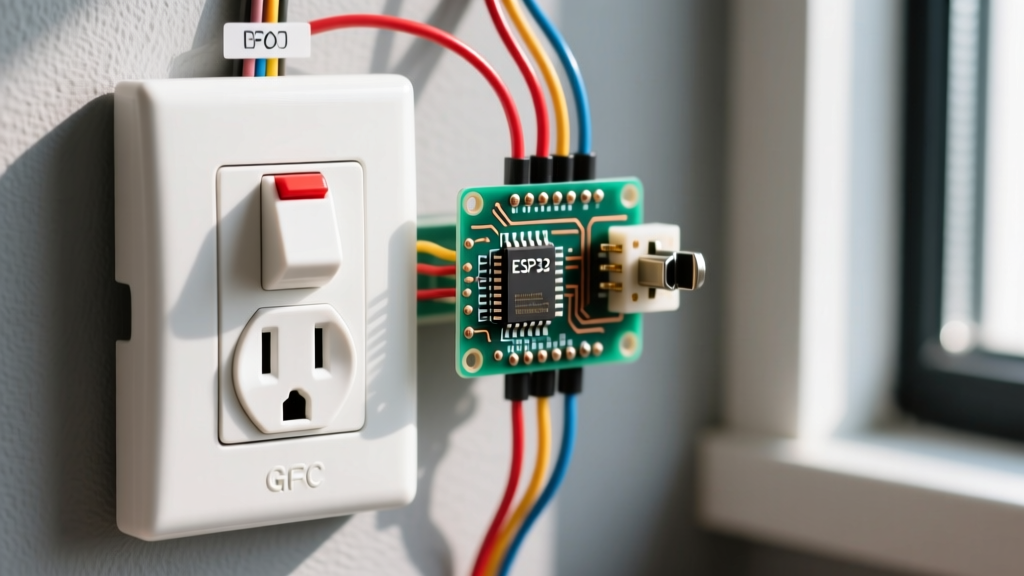
The integration of USB charging ports and Wi-Fi smart relays directly into the UK electric outlet faceplate introduces new thermal management challenges that inspectors strictly enforce.
Thermal Derating and Backbox Depth
A standard 13A socket generates minimal heat. However, a USB-C PD (Power Delivery) socket outlet stepping down 240V AC to 20V DC generates significant heat inside the wall cavity. If installed in a shallow 25mm or 35mm backbox, the heat cannot dissipate, leading to premature failure of the internal switch-mode power supply and potential thermal degradation of the PVC cable insulation.
Expert Directive: When installing USB-integrated socket outlets (such as the MK Logic Plus USB-C range or Schneider Electric Lisse USB models), you must use a minimum 47mm deep backbox (preferably 50mm). This provides the necessary air volume for convective cooling and ensures the internal temperature remains within the limits specified by the BS EN 62368-1 standard for audio/video and IT equipment safety.
Cable Installation Methods and Derating Factors
The current-carrying capacity of your 2.5mm² or 4.0mm² cable is not static; it changes based on how the cable is routed to the outlet. BS 7671 Appendix 4 outlines specific 'Reference Methods' that dictate derating factors.
- Reference Method 100 (Clipped Direct): Cable clipped directly to a masonry wall before plastering. A 2.5mm² cable can safely carry 27A.
- Reference Method 103 (Enclosed in Conduit in an Insulated Wall): If the cable is run inside a stud wall lined with thermal insulation (e.g., Kingspan or Rockwool), the cable's ability to shed heat is severely compromised. The current-carrying capacity of a 2.5mm² cable drops to approximately 21A. In these scenarios, upgrading to 4.0mm² cable for 32A radial circuits is not just best practice; it is a code requirement to prevent thermal runaway.
Part P and Building Regulations: What DIYers Must Know
In England and Wales, electrical work in domestic properties is governed by Part P of the Building Regulations. Understanding what constitutes 'notifiable' work is crucial for legal and insurance compliance.
According to Electrical Safety First's Part P guidance, replacing a damaged UK electric outlet faceplate with an identical model (like-for-like) is considered minor works and is non-notifiable. However, installing a new socket circuit, extending an existing circuit into a 'special location' (such as a bathroom or sauna), or completely rewiring a property requires notification to your Local Authority Building Control (LABC) or must be signed off by a registered competent person (e.g., NICEIC or NAPIT certified).
For comprehensive details on when building regulations approval is required for electrical modifications, refer to the official UK Government Building Regulations portal. Failure to comply can result in enforcement notices and invalidated home insurance policies.
Step-by-Step: Wiring a 13A UK Socket to Code
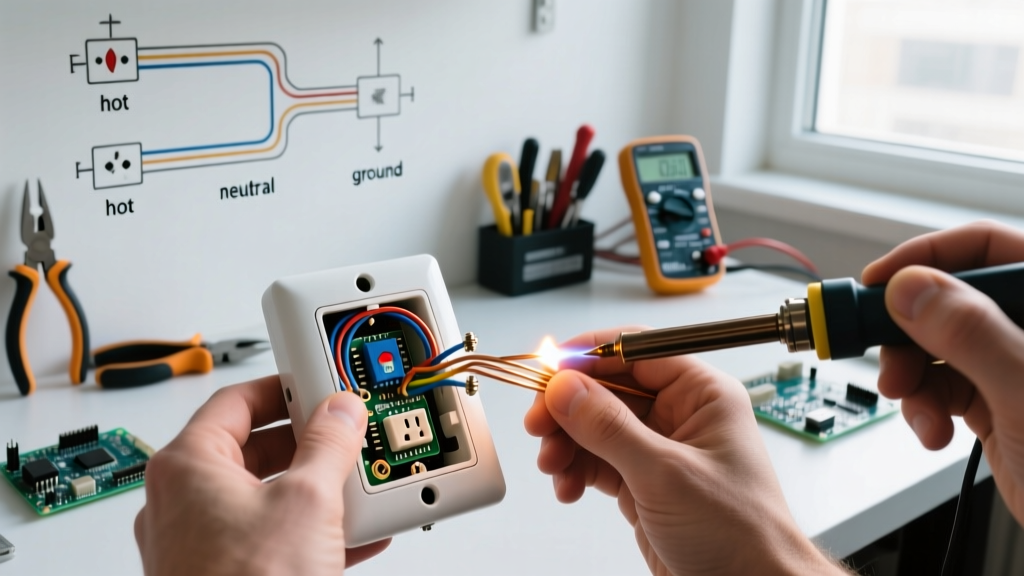
Proper termination is where many DIY installations fail. Loose connections increase contact resistance, leading to localized heating, arcing, and eventually, electrical fires. Follow these exact steps for a compliant termination:
- Strip the Outer Sheath: Remove exactly enough of the grey PVC outer sheath so that it enters the backbox but does not crowd the terminal connections. The inner cores should have roughly 15mm of slack.
- Sleeve the Earth: The bare CPC (Circuit Protective Conductor) must be sleeved with green/yellow PVC. Bare earth wires inside a backbox are a direct violation of BS 7671 Regulation 543.4.
- Strip the Cores: Strip exactly 10mm to 12mm of insulation from the brown (Live), blue (Neutral), and green/yellow (Earth) cores. Do not nick the copper strands.
- Insert and Torque: Insert the wires into the correct terminals (Earth at the top, Neutral on the left, Live on the right when facing the front of the socket). Tighten the terminal screws using a calibrated torque screwdriver. For premium brands like MK or Crabtree, the recommended torque is typically between 1.4Nm and 2.0Nm. Overtightening strips the brass threads; undertightening causes high-resistance hot spots.
- Faceplate Fixing: Ensure no bare copper is visible outside the terminal block. Secure the faceplate, ensuring the earth fly-lead (if required by the specific backbox and socket design) is firmly attached to the backbox earth lug.
Summary of Authoritative Standards
Compliance with the IET BS 7671 Wiring Regulations is not merely a bureaucratic hurdle; it is the culmination of decades of forensic electrical engineering and fire investigation. Whether you are designing a new radial circuit for a kitchen island or simply replacing a cracked faceplate in a living room, respecting the topology, protection, and thermal limits of the UK electric outlet system ensures long-term safety and operational reliability.