
The Role of the Electric Outlet Checker in Modern Electrical Safety
When evaluating the safety and compliance of a residential or commercial electrical system, the electric outlet checker (often called a receptacle tester) is the most vital diagnostic tool in an electrician's pouch. As of 2026, with the 2023 National Electrical Code (NEC) fully adopted across the vast majority of U.S. jurisdictions, the requirements for grounding, polarity, and ground-fault protection have never been stricter. While the NFPA 70 National Electrical Code does not mandate the use of a specific brand of testing device, it strictly mandates the conditions that these devices verify.
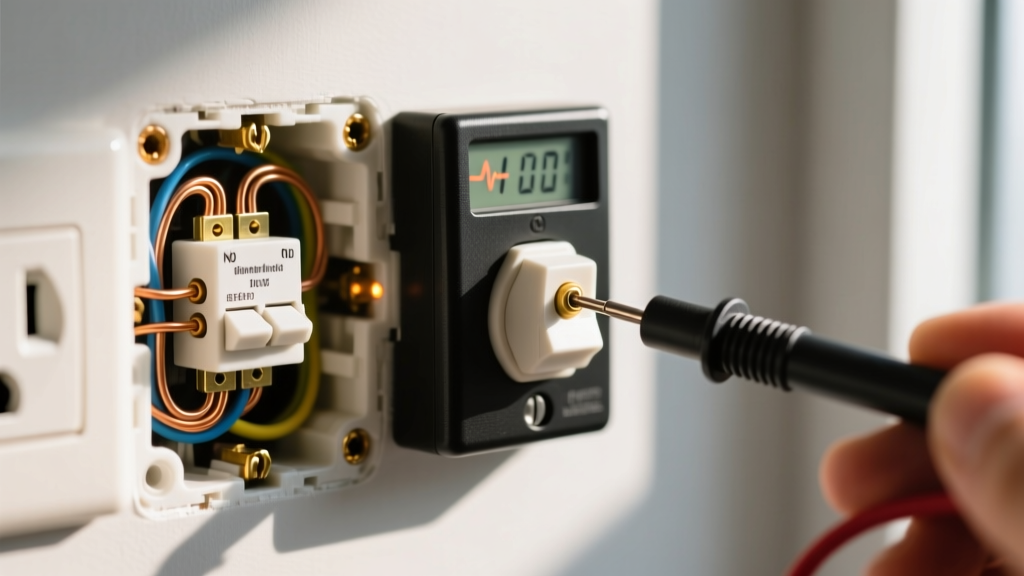
An electric outlet checker bridges the gap between theoretical code requirements and real-world field verification. By inserting this compact device into a 15-amp or 20-amp, 120-volt receptacle, you instantly map the internal wiring topology, identifying lethal faults like reversed polarity, open neutrals, and missing equipment grounding conductors (EGC). According to the U.S. Consumer Product Safety Commission (CPSC), improperly wired receptacles are a leading cause of residential electrical shocks and fires, making routine verification a critical maintenance task.
Decoding the Lights: What Your Tester is Actually Measuring
Standard three-light electric outlet checkers use a network of neon lamps and current-limiting resistors to indicate wiring conditions. When you plug the tester in, the lights illuminate in specific patterns based on the voltage potential between the hot, neutral, and ground slots.
| Light Pattern (Left-Middle-Right) | Condition | NEC Code Implication |
|---|---|---|
| Off - On - On | Correct Wiring | Compliant with NEC 250.148 and 200.11 |
| On - Off - On | Open Ground | Violation of NEC 250.118 (Missing EGC path) |
| Off - Off - On | Open Neutral | Violation of NEC 200.11 (Disconnected neutral) |
| On - On - Off | Hot/Neutral Reversed | Violation of NEC 200.11 (Polarity reversed) |
| On - Off - Off | Hot/Neutral Reversed & Open Ground | Severe multi-code violation; immediate shock hazard |
Critical NEC Code Sections Verified by Outlet Checkers
To understand the true value of an electric outlet checker, you must understand the specific NEC articles it enforces in the field.
1. Receptacle Polarity (NEC 200.11 & 210.23)
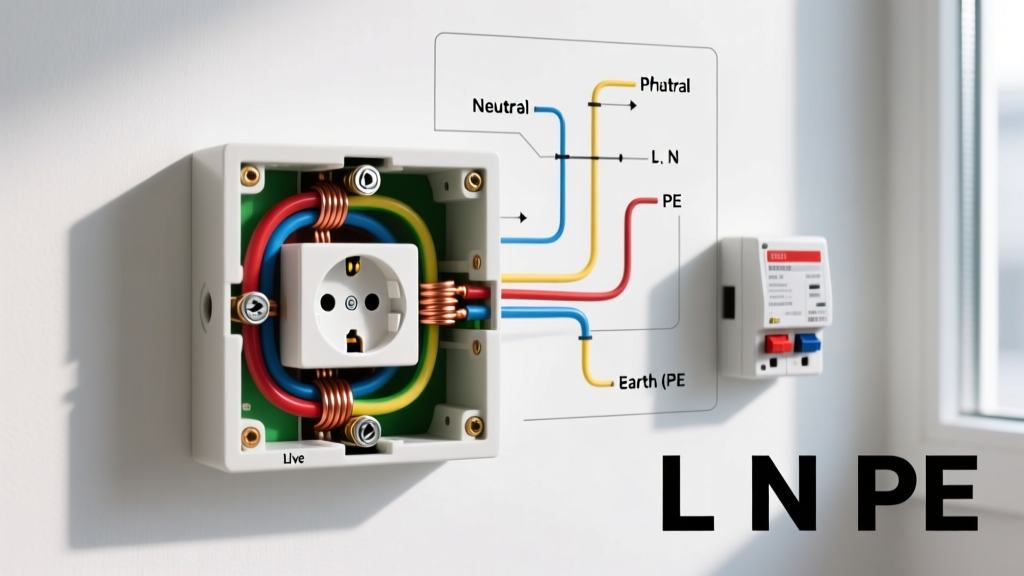
The NEC requires that the grounded (neutral) conductor be connected to the silver terminal and the ungrounded (hot) conductor to the brass terminal. Reversed polarity means the internal switch of a plugged-in appliance might only disconnect the neutral wire, leaving the appliance's internal components energized at 120V even when turned "off." A standard outlet checker instantly flags this by illuminating the outer two lights while leaving the center light dark.
2. Equipment Grounding (NEC 250.118 & 250.148)
The equipment grounding conductor (EGC) provides a low-impedance fault current path back to the main panel to trip the breaker during a short circuit. If a receptacle shows an "Open Ground," the metal chassis of any plugged-in device could become energized if an internal wire frays and touches it. The tester verifies continuity between the receptacle's grounding slot and the system ground.
3. GFCI Protection (NEC 210.8)
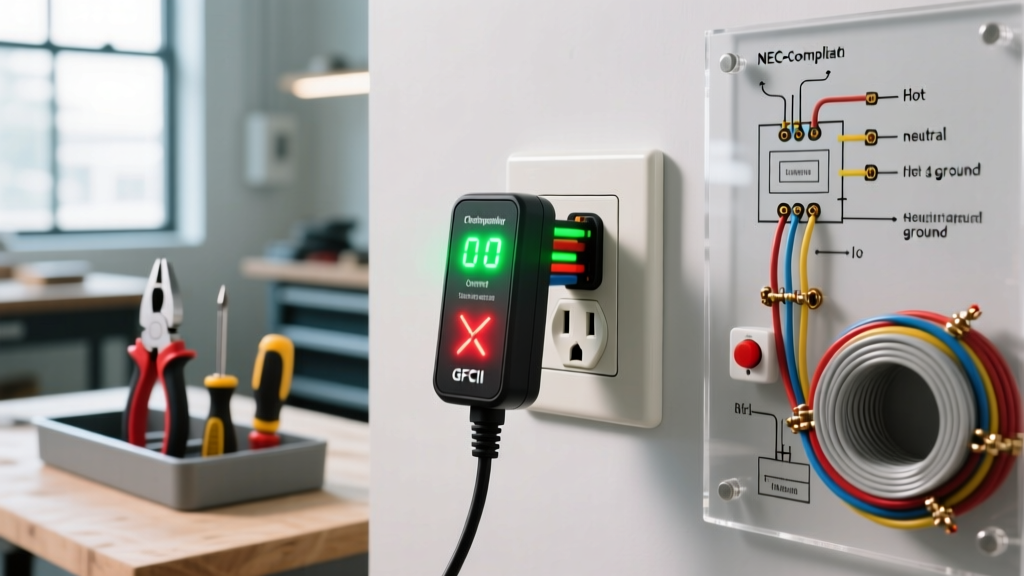
The 2023 NEC (active in 2026) expanded Ground-Fault Circuit Interrupter (GFCI) requirements to virtually all 125V through 250V receptacles in residential areas, including kitchens, bathrooms, garages, and outdoor spaces. An electric outlet checker equipped with a black "GFCI Test" button injects a precise 5-to-6 milliamp current from the hot slot to the ground slot, bypassing the neutral. This simulates a ground fault, forcing the GFCI's internal toroidal transformer to detect the imbalance and trip the circuit within 25 milliseconds, per the UL 943 standard.
Tool Spotlight: Top Electric Outlet Checkers for Code Verification
Not all testers are created equal. While a basic $10 tester is fine for a quick check, professionals require advanced diagnostics to pass modern inspections.
- Klein Tools RT210 (Standard GFCI Receptacle Tester): Priced around $16, this is the industry baseline. It features a rugged build, standard 3-light diagnostics, and a reliable GFCI trip button. Ideal for quick residential audits.
- Sperry Instruments ET64220 (SureTest Circuit Analyzer): Retailing for $35–$45, this advanced tool doesn't just check for continuity; it measures actual circuit impedance and wire gauge distances. Crucially, it can detect "bootleg grounds" and verify the exact trip time of GFCI and AFCI breakers.
- Amprobe INSL-33 (Heavy-Duty Receptacle Tester): At roughly $25, this model offers a durable, drop-resistant housing and a highly visible LED display, making it perfect for dimly lit commercial basements and crawlspaces.
The "Bootleg Ground" Trap: Why Cheap Testers Fail Code Inspections
Warning: A standard three-light electric outlet checker can be easily fooled by a "bootleg ground." This is a dangerous, illegal wiring hack where a jumper wire is installed between the neutral terminal and the ground terminal on the back of the receptacle.
When you plug a basic tester into a bootleg-grounded outlet, the tester sees continuity between neutral and ground and lights up "Correct Wiring." However, under a real fault condition, the metal chassis of your appliance will become energized with 120V, because the fault current has no dedicated low-impedance path back to the panel's ground bar.
To defeat this trap, professionals use advanced testers like the Sperry SureTest. These devices send a high-frequency pulse or measure the specific impedance of the grounding path. If the ground is merely jumpered to the neutral at the receptacle (rather than running all the way back to the main panel), the impedance will be too low or the signal will reflect incorrectly, and the advanced tester will flag the bootleg ground.
Step-by-Step: Conducting a Code-Compliant Receptacle Audit
Follow this systematic approach to ensure every outlet in your facility or home meets current safety standards:
- Visual Inspection First: Before plugging in the electric outlet checker, look for physical damage, cracked faceplates, or signs of thermal melting (browning around the slots). Replace any physically damaged receptacles immediately.
- Baseline Power Check: Plug the tester into the receptacle. Verify the lights indicate "Correct Wiring" (usually the two rightmost lights on a standard 3-light tester).
- GFCI Verification: If the receptacle is in a location mandated by NEC 210.8 (e.g., within 6 feet of a sink), press the black GFCI test button on the tester. The receptacle should trip with an audible click. If it does not trip, the GFCI mechanism has failed and the receptacle must be replaced.
- Downstream Testing: If the GFCI trips, walk to all downstream receptacles on the same circuit to verify they have also lost power, confirming proper line/load wiring.
- Document Faults: Use masking tape to label any receptacle showing an open ground, open neutral, or reversed polarity. Do not rely on memory when auditing a 50-receptacle floor plan.
A Note on AFCI Protection
It is critical to note that standard electric outlet checkers cannot test Arc-Fault Circuit Interrupter (AFCI) protection. AFCI breakers and receptacles look for specific high-frequency electrical signatures (arcs) caused by damaged wires or loose connections. To test an AFCI, you must physically press the "Test" button located directly on the AFCI breaker in the main panel or on the face of the AFCI receptacle itself. For comprehensive circuit analysis that includes AFCI trip-testing, you must upgrade to a dedicated AFCI/GFCI circuit analyzer, which typically costs between $150 and $250.
Final Thoughts on Receptacle Compliance
The electric outlet checker is more than a simple continuity device; it is your primary shield against electrical liability and a direct verifier of NEC compliance. Whether you are a homeowner checking the work of a handyman or a master electrician signing off on a new commercial build, relying on accurate, high-quality testing equipment ensures that the invisible forces within your walls remain safely contained. Always pair your field testing with a thorough understanding of the latest OSHA and NEC wiring regulations to maintain the highest standards of electrical safety.