
Understanding the '220V' Misnomer: What the NEC Actually Says
When homeowners search for a 220 volt outlet for electric car charging, they are using a legacy colloquialism. In North America, residential electrical service is a split-phase 240V system. While older appliances and early electrical grids operated closer to 220V, modern utility transformers deliver 240V (often measuring between 235V and 245V at the panel). The National Electrical Code (NEC) strictly references 240V circuits for Level 2 Electric Vehicle Supply Equipment (EVSE). However, the installation principles, wire sizing, and safety mandates remain identical regardless of the terminology used at the hardware store.
Code Insight: The NEC governs EV charging installations primarily under Article 625 (Electric Vehicle Charging System Equipment). Ignoring the specific amendments in this article is the leading cause of failed municipal electrical inspections in 2026.
Installing a Level 2 EVSE receptacle is not as simple as swapping a standard 15-amp duplex outlet for a high-amperage alternative. It requires strict adherence to continuous load calculations, specific grounding topologies, and updated Ground Fault Circuit Interrupter (GFCI) mandates. Below is a comprehensive code explainer for wiring a compliant, safe, and future-proof EV charging outlet.
NEC Article 625: The Core EVSE Code Requirements
The 80% Continuous Load Rule (NEC 210.20 & 625.41)
The most critical code concept for EV charging is the definition of a 'continuous load.' The NEC defines a continuous load as any load where the maximum current is expected to continue for three hours or more. Because charging an electric vehicle routinely takes 4 to 10 hours, EVSE circuits are strictly classified as continuous.
Under NEC 210.20(A) and NEC 625.41, branch circuit conductors and overcurrent protection devices (breakers) must be sized at 125% of the continuous load. This is universally known as the 80% rule.
- Example: If you purchase a 40-amp EV charger (like the popular ChargePoint Home Flex configured for 40A), you cannot use a 40-amp breaker. You must multiply 40A by 1.25, requiring a 50-amp breaker and wire sized for 50 amps.
- Conversely: If you install a standard 50-amp breaker and NEMA 14-50 receptacle, the maximum continuous EVSE amperage you can legally plug into it is 40 amps (50A x 0.80 = 40A).
Receptacle Selection: NEMA Configurations Compared
While hardwiring is increasingly preferred by EV manufacturers to bypass certain code traps (detailed below), receptacle installations remain popular for their flexibility. The NEC requires that the receptacle rating match the branch circuit rating. Here is how the most common 240V configurations stack up for EV charging.
| NEMA Type | Amps / Volts | Neutral Wire? | EVSE Use Case & Code Notes |
|---|---|---|---|
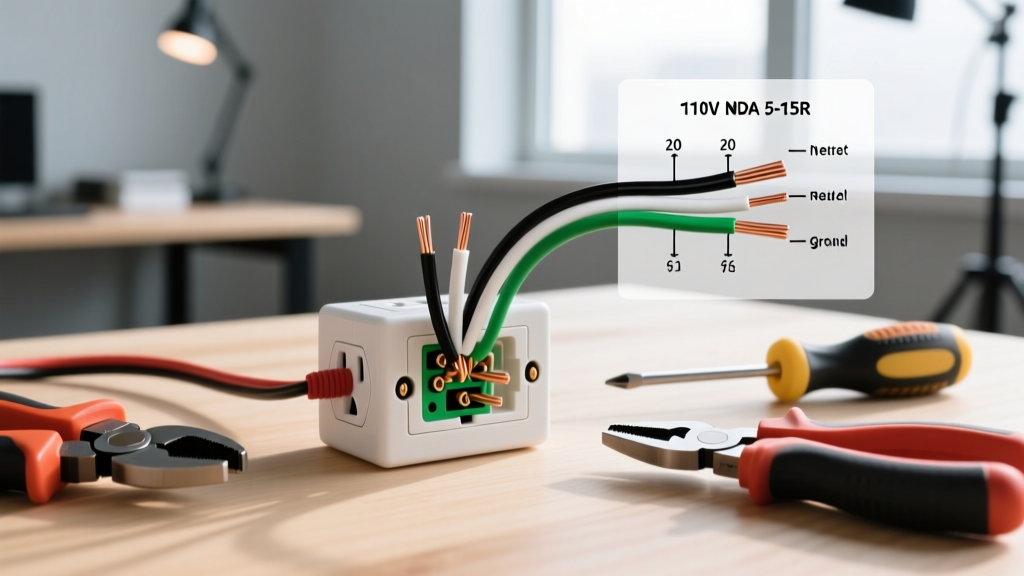
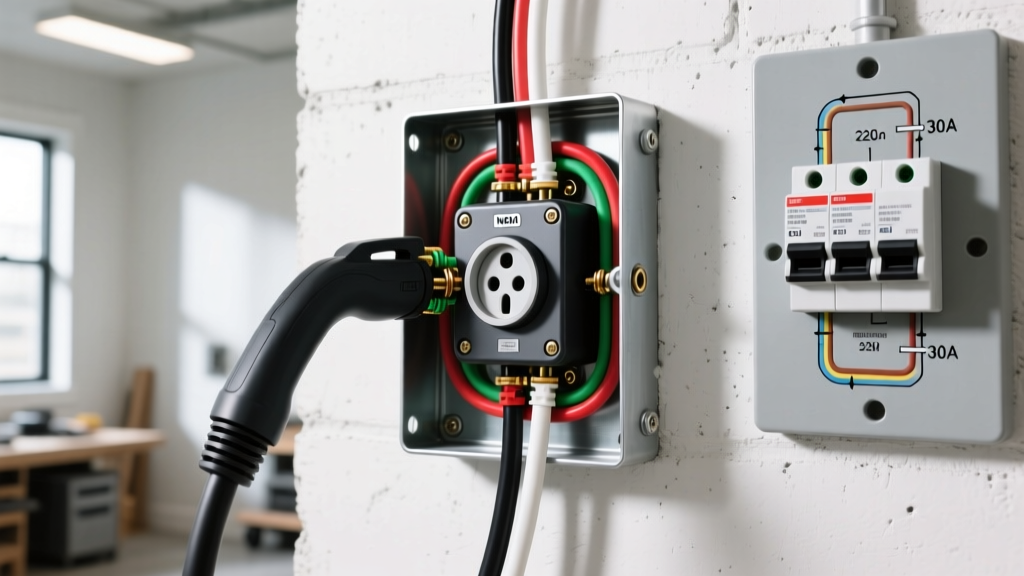
| NEMA 14-50R | 50A / 240V | Yes (4-prong) | The gold standard for EV charging. Required if the EVSE utilizes a neutral for internal 120V electronics. Requires 6 AWG copper + ground + neutral. |
| NEMA 6-50R | 50A / 240V | No (3-prong) | Used for older or strictly 240V EVSEs. Lacks a neutral. Less common in modern residential installs but fully code-compliant if the EVSE does not require a neutral. |
| NEMA 14-30R | 30A / 240V | Yes (4-prong) | Commonly found in older dryer hookups. Limits continuous charging to 24A. Good for PHEVs or smaller battery packs, but too slow for modern 100kWh+ EVs. |
The GFCI Trap: NEC 210.8(A)(11) vs. Internal EVSE Protection
If there is one code requirement that trips up DIYers and even veteran electricians, it is the GFCI mandate for EV receptacles. Under NEC 210.8(A)(11), all 240V receptacles installed for the purpose of charging electric vehicles must be protected by a Ground Fault Circuit Interrupter.
This creates a well-documented engineering conflict. High-quality EVSE units (like the Tesla Wall Connector, Emporia Vue, or Grizzl-E) already contain highly sensitive internal GFCI and ground-monitoring circuitry. When you plug an EVSE with an internal GFCI into a wall outlet protected by a GFCI breaker, the two systems often interfere with one another, leading to 'nuisance tripping' where the charger randomly shuts off in the middle of the night.
How to Navigate the GFCI Requirement in 2026
- Use a GFCI Breaker: If you install a NEMA 14-50 receptacle, you must use a 50-amp GFCI breaker (e.g., Square D HOM250GFIC or Eaton CHFGFB250). These breakers are expensive, often costing between $150 and $250 just for the breaker.
- The Hardwire Bypass (NEC 625.44): The NEC recognizes the nuisance tripping issue. If you hardwire the EVSE directly to the junction box (eliminating the receptacle entirely), the GFCI breaker requirement is waived, provided the EVSE is listed and contains its own internal ground-fault protection. This is why most manufacturers now strongly recommend hardwiring.
For deeper insights into EV infrastructure safety standards, the National Fire Protection Association (NFPA) provides the definitive text on Article 625 updates.
Wire Sizing, Routing, and Termination Torque
Conductor Sizing for a 50-Amp Circuit
For a standard 50-amp NEMA 14-50 installation, wire sizing depends on the insulation type and installation method, governed by NEC Article 310.
- THHN/THWN in Conduit: 6 AWG copper wire is rated for 75°C terminations and can safely carry 65 amps, easily covering the 50-amp breaker requirement. You will need four conductors: two hots (Black, Red), one neutral (White), and one ground (Green/Bare).
- NM-B (Romex) Cable: 6 AWG NM-B is rated for 55 amps. While this technically covers a 50-amp breaker, some strict local jurisdictions in 2026 require 4 AWG copper for 50-amp continuous EV loads due to voltage drop concerns over long runs. Always check with your local AHJ (Authority Having Jurisdiction).
- Aluminum SER Cable: If running a feeder from a subpanel, 4 AWG aluminum SER cable is the standard, cost-effective choice, as aluminum requires a larger gauge to carry the same amperage as copper.
The Torque Requirement (NEC 110.14(D))
One of the most heavily enforced code updates in recent years is NEC 110.14(D). This code mandates that all electrical connections must be tightened to the manufacturer's specified torque using a calibrated torque tool. EV chargers draw massive, sustained current; a loose connection on a 14-50 receptacle will generate immense heat, leading to melted plastic and potential electrical fires. Inspectors now routinely ask to see your torque screwdriver and the manufacturer's spec sheet (usually requiring between 35 to 50 inch-pounds for standard 50A lugs).
Voltage Drop and Distance Considerations
While the NEC only strictly mandates voltage drop limits for feeders (Informational Note in NEC 210.19), the Alternative Fuels Data Center (AFDC) and EV manufacturers strongly recommend keeping voltage drop below 3% for optimal charging efficiency. If your electrical panel is on the opposite side of the house from your garage or driveway, a 100-foot run of 6 AWG wire will experience noticeable voltage drop. In runs exceeding 75 feet, upsizing to 4 AWG copper is highly recommended to prevent the EVSE from throttling down amperage or throwing under-voltage error codes.
2026 Cost Expectations and Permitting
Installing a 220/240V outlet for an electric car requires a permit in almost all municipalities. The U.S. Department of Energy emphasizes that permitted, inspected installations are critical for maintaining home insurance validity and warranty coverage on the EVSE.
Typical Pricing Breakdown (2026 Estimates)
- Materials (50A GFCI Breaker, 14-50R Receptacle, 30ft 6 AWG Wire, Conduit): $250 - $450. (Note: Industrial-grade receptacles like the Hubbell 9450A or Bryant 9450FR are highly recommended over cheap hardware store brands, which are prone to thermal failure under EV loads).
- Labor (Standard Install near Panel): $400 - $800.
- Labor (Complex Install requiring trenching, subpanel upgrade, or drywall repair): $1,200 - $3,500+.
- Permit Fees: $75 - $250 depending on the local municipality.
By understanding the intersection of NEC Article 625, continuous load mathematics, and modern GFCI requirements, you can ensure your EV charging setup is not only code-compliant but engineered for decades of safe, high-amperage operation.