
Understanding the Thai Electrical Outlet Landscape
Thailand operates on a 220V, 50Hz alternating current (AC) electrical supply. For decades, the country's receptacle infrastructure was a fragmented mix of Type A, B, and C sockets, leading to widespread reliance on unsafe, ungrounded universal adapters. Today, installing a modern thai electrical outlet requires strict adherence to the Electrical Engineering Institute of Thailand (EIT) standards and the Thai Industrial Standards Institute (TISI) mandates. As of 2026, compliance is no longer optional for new builds or major renovations; it is a critical safety baseline.
This comprehensive safety and code compliance guide details the technical specifications, wiring color codes, grounding mandates, and hardware requirements for installing compliant Type O receptacles in residential and commercial Thai properties.
The Type O Standard: TIS 166-2549 Explained
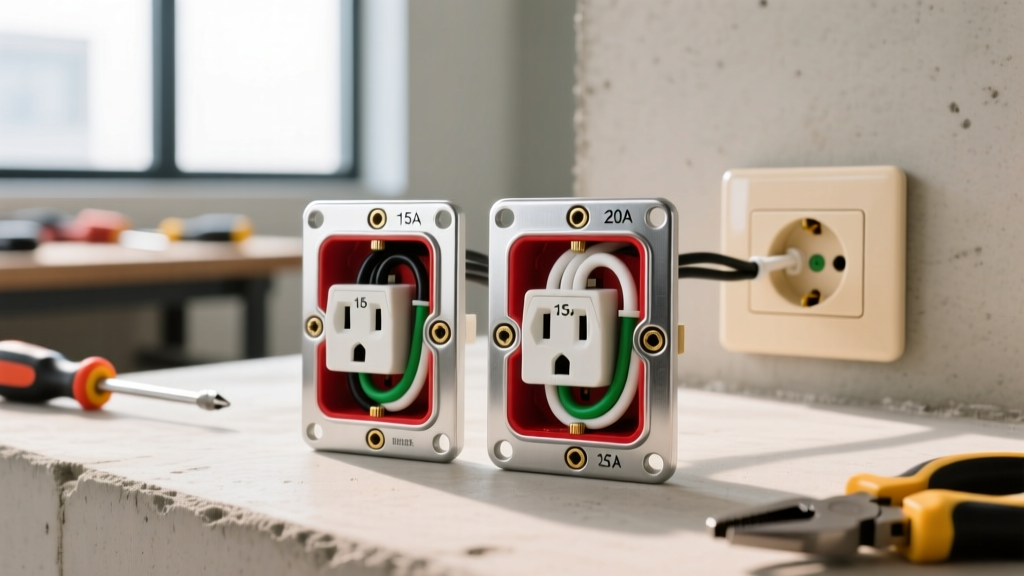
The official standard for a compliant thai electrical outlet is the Type O plug and socket system, governed by TIS 166-2549. This standard was introduced to provide a dedicated, grounded, and uniquely Thai receptacle that eliminates the hazards of loose-fitting universal sockets. The Type O socket features three round pins (two power, one earth) arranged in a triangular pattern, rated for 16 Amperes.
Code Mandate: Under the EIT Standard 2002 (and subsequent 2018/2026 revisions), all newly installed socket outlets in residential and commercial buildings must be Type O or a certified universal socket that physically accepts the Type O plug with proper earth contact.
Receptacle Types in Thailand: Compliance Matrix
| Plug/Socket Type | Pin Configuration | Rated Current | Grounding | 2026 Code Compliance Status |
|---|---|---|---|---|
| Type A (NEMA 1-15) | 2 Flat Parallel | 15A | No | Non-Compliant (Legacy Only) |
| Type B (NEMA 5-15) | 2 Flat, 1 Round | 15A | Yes | Non-Compliant (Legacy Only) |
| Type C (Europlug) | 2 Round | 2.5A | No | Non-Compliant (Illegal for fixed wiring) |
| Type F (Schuko) | 2 Round + Earth Clips | 16A | Yes | Restricted (Specific commercial use) |
| Type O (TIS 166) | 3 Round (Triangular) | 16A | Yes | Fully Compliant (Mandatory Standard) |
For authoritative reference on global plug configurations and Thailand's specific adoption, consult the IEC World Plugs database.
EIT Wiring Standards & Color Codes
One of the most common failure modes for foreign electricians or DIYers working in Thailand is applying US or UK wiring color codes to a Thai circuit. Thailand strictly follows the IEC 60446 color code standard, which was formally adopted into the EIT Standard 2002-2556.
Mandatory Wire Color Identification
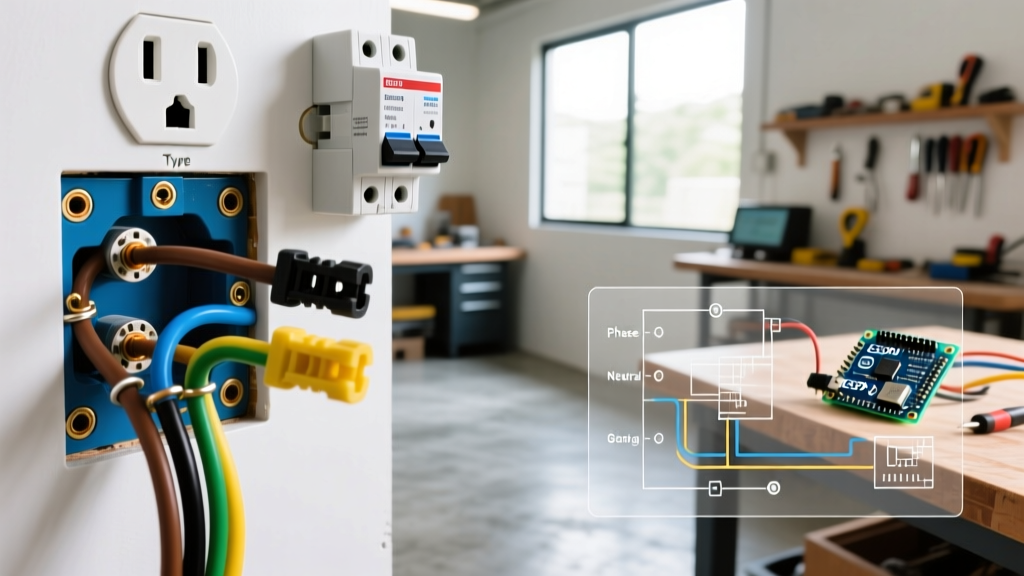
- Phase (Live): Brown (Single-phase) or Brown/Black/Grey (Three-phase). Note: Older legacy installations may still use Black or Red for Phase, but new work must use Brown.
- Neutral: Blue. Legacy installations sometimes used White or Light Blue.
- Earth (Ground): Green-and-Yellow striped. This is non-negotiable for safety.
Wire Sizing and Conduit Requirements
For a standard 16A thai electrical outlet circuit, the minimum permissible wire cross-section is 2.5 mm² (approximately 13 AWG). Using 1.5 mm² wire, which is strictly reserved for lighting circuits, on a receptacle circuit is a severe code violation that risks thermal overloading and insulation meltdown.
Wiring must be routed through approved conduits. In residential masonry walls, rigid PVC conduit (JIS standard) is standard. For commercial or exposed installations, galvanized steel EMT (Electrical Metallic Tubing) or RSC (Rigid Steel Conduit) is required. The standard wire type used inside these conduits is THW (Thermoplastic High Heat-resistant Water-resistant) rated for 600V.
Grounding & Earth Electrode Systems
A thai electrical outlet is only as safe as its grounding system. The EIT mandates that all socket outlets must be connected to a reliable earth ground. The TT (Terra-Terra) earthing system is the most common in Thailand, where the consumer provides their own local earth electrode.
Earth Rod Specifications
- Material: Copper-bonded steel rod, minimum 16mm (5/8 inch) diameter.
- Depth: Must be driven a minimum of 2.4 meters (8 feet) into the native soil to reach the moisture table.
- Connection: Must use a listed, bolted copper grounding clamp. Cadweld (exothermic welding) is preferred for permanent, corrosion-resistant connections.
- Resistance Testing: The earth resistance must measure less than 5 ohms when tested with a fall-of-potential earth tester (e.g., Kyoritsu 4140). In dry, sandy regions of Thailand (like parts of Isan), achieving < 5 ohms may require driving multiple rods spaced 3 meters apart or using bentonite clay enhancement.
Hardware Selection: Receptacles and RCBOs
To ensure longevity and compliance, specify hardware from manufacturers that explicitly test to TIS 166-2549 and IEC 60884-1 standards.
Recommended Type O Receptacles (2026 Market)
- Panasonic Wide Series (Model WCS1102): The industry workhorse in Thailand. Features a robust polycarbonate faceplate, brass internal contacts, and a wide 25mm profile that accommodates the thicker 2.5 mm² THW wires easily. Pricing averages 120–180 THB ($3.50–$5.00 USD).
- Schneider Electric AvatarOn (Model E84T16/2/1): A premium option offering superior arc-chamber isolation and a sleek, flat-panel aesthetic. Ideal for high-end residential builds. Pricing averages 250–350 THB ($7.00–$10.00 USD).
Mandatory RCD / RCBO Protection
The EIT standard strictly requires Residual Current Device (RCD) protection for all socket outlet circuits. Standard Miniature Circuit Breakers (MCBs) only protect against overloads and short circuits; they will not trip during a lethal ground fault.
For a thai electrical outlet circuit, you must install a 30mA RCBO (Residual Current Breaker with Overcurrent) at the distribution board. A 30mA trip threshold ensures the breaker cuts power within 40 milliseconds if a human touches a live component, preventing ventricular fibrillation. The Electrical Engineering Institute of Thailand (EIT) provides explicit guidelines on RCBO coordination in their wiring installation manuals.
Common Code Violations & Troubleshooting
When auditing existing properties or inspecting new contractor work in Thailand, watch for these critical safety failures:
- Bootleg Grounds: Jumping a wire between the Neutral and Earth terminals on the back of the receptacle to trick a tester. This is highly lethal; if the neutral wire breaks upstream, the metal casing of any plugged-in appliance becomes energized at 220V.
- Undersized Branch Wiring: Contractors using 1.5 mm² wire for socket loops to save money. This wire will overheat under a sustained 16A load (e.g., running a space heater or large microwave).
- Missing Conduit Earth Continuity: In metal conduit systems, failing to install copper bonding jumpers across conduit couplings, breaking the equipment grounding path.
- Improper Terminal Torque: Hand-tightening terminal screws without a torque screwdriver. Panasonic and Schneider specify a terminal torque of 0.8 Nm to 1.2 Nm. Under-torquing leads to micro-arcing, which melts the receptacle faceplate over time.
Frequently Asked Questions (FAQ)
Can I install a US-style Type B outlet in my Thai home?
While physically possible, it is non-compliant with current TISI and EIT codes for new installations. Furthermore, US appliances designed for 110V/60Hz will be destroyed if plugged into a 220V/50Hz Thai circuit without a step-down transformer. Always install Type O outlets and use appropriate travel adapters for foreign devices.
Who is legally permitted to wire a thai electrical outlet?
Under Thai law, electrical installation work must be performed or supervised by an electrician holding a valid license issued by the Department of Public Works and Town & Country Planning (DPT). DIY mains wiring is strongly discouraged and can void property insurance in the event of an electrical fire.
How do I test if my existing Thai outlet is properly grounded?
Use a digital multimeter set to AC Voltage. Measure Phase-to-Neutral (should read ~220V). Then measure Phase-to-Earth (should also read ~220V). Finally, measure Neutral-to-Earth (should read < 2V). If Phase-to-Earth reads 0V, your outlet lacks a functional ground, requiring immediate remediation by a licensed electrician. For comprehensive testing standards, refer to the Thai Industrial Standards Institute (TISI) equipment certification guidelines.
Conclusion
Ensuring the safety and compliance of every thai electrical outlet in a property requires moving beyond legacy practices and embracing the Type O standard, proper IEC color coding, and mandatory 30mA RCBO protection. By specifying 2.5 mm² THW wiring, verifying earth resistance below 5 ohms, and utilizing certified hardware from manufacturers like Panasonic and Schneider Electric, you guarantee a resilient, shock-proof electrical infrastructure capable of handling modern 220V loads safely.