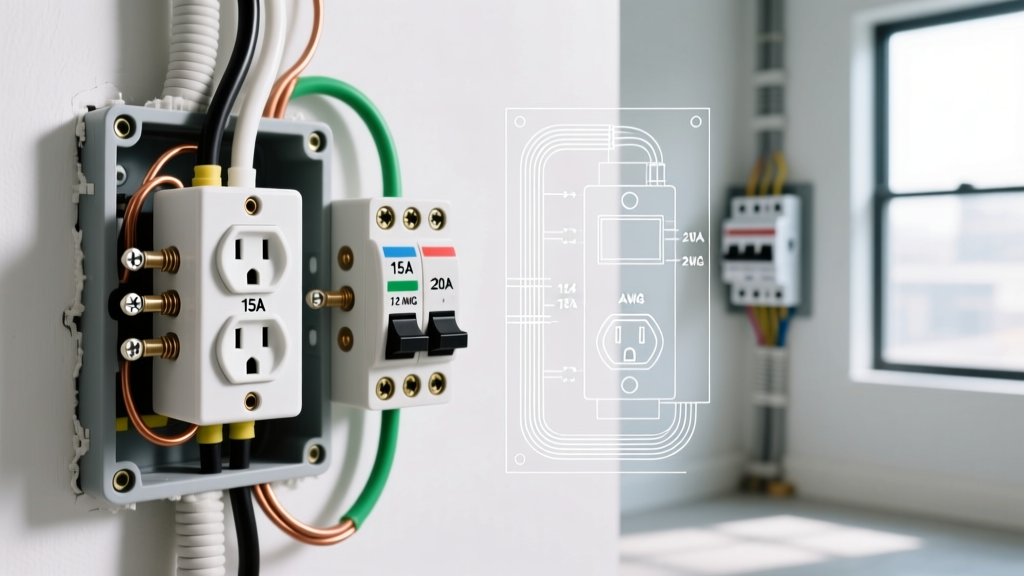

Understanding Electrical Outlet Amperage in Residential Wiring
When tackling common wiring scenarios, understanding electrical outlet amperage is the single most critical factor in preventing electrical fires and ensuring code compliance. Amperage dictates the volume of electrical current a circuit can safely carry. If the receptacle rating, wire gauge, and circuit breaker are mismatched, you risk overheating the conductors, melting the receptacle contacts, or creating a severe arc-flash hazard.
As of the 2026 construction cycle, material costs for copper wiring and brass-contact receptacles have shifted, making it more important than ever to buy the exact components you need without over-purchasing. A standard 15-amp duplex receptacle (like the Leviton 5320-W) costs roughly $1.85 to $2.50, while a commercial-grade 20-amp receptacle (like the Leviton T5320-W) runs between $3.40 and $4.75. But price is secondary to safety. The National Electrical Code (NEC) has strict, non-negotiable rules about how these components interact.
The Golden Rule of Amperage: A circuit breaker protects the wire, not the receptacle. Therefore, the wire gauge must be rated for the breaker size, and the receptacle amperage must be legally permitted on that specific circuit configuration according to NEC Article 210.21.
Amperage Matching Matrix: Breakers, Wires, and Receptacles
Before pulling any wire through a stud bay, consult this compatibility matrix. This table outlines the standard 120-volt residential branch circuits you will encounter in 95% of DIY and professional wiring scenarios.
| Breaker Size | Min. Copper Wire Gauge (NM-B) | Max Receptacle Amperage | NEMA Configuration | Common Application Scenarios |
|---|---|---|---|---|
| 15 Amp | 14 AWG | 15 Amp | 5-15R | Bedrooms, living rooms, hallways, general lighting |
| 20 Amp | 12 AWG | 20 Amp | 5-20R | Kitchen countertops, bathrooms, garages, laundry rooms |
| 20 Amp (Individual) | 12 AWG | 20 Amp (Single) | 5-20R | Dedicated microwave, refrigerator, or window AC unit |
| 30 Amp | 10 AWG | N/A (No standard duplex) | L14-30R / 14-30R | Electric dryers, RV shore power (240V/120V split) |
Scenario 1: General Purpose 15-Amp Circuits
In living rooms, bedrooms, and home offices, the standard is a 15-amp circuit protected by a 15-amp breaker (e.g., Eaton BR115 or Square D HOM115). The minimum wire size is 14 AWG copper (14/2 NM-B Romex), which costs approximately $0.50 to $0.60 per foot in 2026.
Receptacle Selection and NEC Limits
According to NFPA NEC Article 210.21(B)(3), if you are wiring a multi-outlet branch circuit (meaning more than one receptacle is on the 15A breaker), you are strictly limited to 15-amp rated receptacles. You cannot install a 20-amp receptacle on a 15-amp multi-outlet circuit. Physically, a 15-amp NEMA 5-15R receptacle features two parallel vertical slots. The internal brass contacts are engineered to dissipate heat effectively up to 15 amps of continuous draw.
- Recommended Product: Leviton 5320-W (15A, 125V, Duplex, Residential Grade).
- Wiring Method: Use the side-terminal screws rather than back-stab (push-in) connections. Side-screw terminations with 14 AWG wire provide a superior mechanical bond and reduce the risk of high-resistance arcing over time.
Scenario 2: High-Draw 20-Amp Circuits (Kitchens and Bathrooms)
Kitchens, bathrooms, garages, and outdoor spaces require 20-amp circuits to handle high-draw appliances like hair dryers, toaster ovens, and power tools. This requires a 20-amp breaker and 12 AWG copper wire (12/2 NM-B), which is noticeably thicker and stiffer than 14 AWG, costing around $0.65 to $0.80 per foot.
The Physical Difference: Identifying 20-Amp Receptacles
How do you visually confirm electrical outlet amperage? A 20-amp NEMA 5-20R receptacle features a distinctive T-shaped neutral slot. This horizontal cross-slot allows plugs with a horizontal neutral blade (found on heavy-duty commercial equipment) to be inserted. However, standard 15-amp plugs (with two vertical blades) will also fit into a 20-amp receptacle.
The NEC allows 15-amp receptacles to be installed on a 20-amp multi-outlet circuit, provided there is more than one receptacle on the circuit. However, as a best practice for DIYers and pros alike, installing 20-amp rated receptacles (like the Leviton T5320-W) on 20-amp kitchen circuits is highly recommended. The internal contacts on a 20A receptacle are thicker, providing better grip and superior heat dissipation when running high-wattage kitchen appliances.
GFCI Requirements for 20A Wet Areas
NEC Article 210.8 mandates Ground Fault Circuit Interrupter (GFCI) protection for all 125V through 250V receptacles supplied by single-phase branch circuits rated 150 volts or less to ground in kitchens and bathrooms. When wiring a 20A kitchen countertop circuit, you must use a 20A GFCI receptacle (e.g., Leviton GFNT2-W, approx. $18.50). Ensure the LINE and LOAD terminals are correctly identified; reversing them will leave downstream outlets unprotected while the GFCI test button will still falsely appear to function.
Scenario 3: Dedicated Individual Appliance Circuits
When wiring a dedicated circuit for a single appliance—such as a built-in microwave, a refrigerator, or a large window air conditioner—the rules change. This is known as an 'individual branch circuit.'
Under OSHA electrical safety guidelines and NEC 210.21(B)(1), a single receptacle installed on an individual branch circuit must have an ampere rating not less than that of the branch circuit. Therefore, if you run a dedicated 12 AWG wire on a 20-amp breaker for a microwave, you must use a single 20-amp receptacle. You cannot use a 15-amp receptacle on a dedicated 20-amp circuit. Doing so is a direct code violation because the appliance could draw up to 20 amps before the breaker trips, potentially melting the 15-amp receptacle contacts.
Troubleshooting Common Amperage Mismatches
When auditing older homes or troubleshooting existing panels, you will inevitably find amperage mismatches. Here is how to handle the most common edge cases:
Edge Case A: 20A Receptacle on a 15A Breaker
Is it safe? Yes. Is it code-compliant? Technically no for multi-outlet circuits, but it poses no fire hazard. The receptacle is over-rated for the circuit. The breaker will trip at 15 amps, long before the 20-amp receptacle reaches its thermal limit. However, it can confuse future homeowners who might plug in a heavy 20A load expecting the circuit to handle it, only to have the 15A breaker trip immediately.
Edge Case B: 15A Receptacle on a 20A Breaker (Multi-Outlet)
Is it safe? Yes, and it is explicitly permitted by NEC 210.21(B)(3) as long as there is more than one receptacle on the circuit. The logic is that a single 15A plug cannot physically draw 20A, and it is highly unlikely that multiple 15A plugs will simultaneously draw a combined 20A without the user noticing the strain. However, if the circuit serves only a single duplex receptacle, this is a severe violation and must be corrected by either upgrading the receptacle to 20A or downgrading the breaker and wire to 15A.
Edge Case C: 12 AWG Wire on a 15A Breaker
Is it safe? Absolutely. You can always use a larger wire (lower gauge number) than the minimum required. 12 AWG wire on a 15A breaker results in less voltage drop over long distances (e.g., runs exceeding 75 feet). The only drawback is the increased material cost and the physical difficulty of bending 12 AWG wire into the smaller terminal boxes of standard 15A receptacles.
Frequently Asked Questions
Can I replace a 15-amp outlet with a 20-amp outlet to stop my breaker from tripping?
No. Replacing the receptacle does not increase the capacity of the circuit. If your 15-amp breaker is tripping, it means the total load on the circuit exceeds 15 amps (or 12 amps for continuous loads running 3+ hours). Upgrading the receptacle to 20A while leaving 14 AWG wire and a 15A breaker in place will not solve the issue and may create a false sense of security. You must install a new 20A circuit with 12 AWG wire and a 20A breaker to safely increase capacity.
Why do some 20-amp receptacles not have the T-shaped slot?
They do. If a receptacle is rated for 20 amps and is a standard NEMA 5-20R duplex, it must have the T-shaped neutral slot. If you see a receptacle with two parallel vertical slots but it is stamped '20A' on the yoke, it is likely a specialized locking receptacle, a 250V configuration, or a counterfeit/mislabeled import that should be removed immediately. Always verify the NEMA configuration and look for the UL (Underwriters Laboratories) listing mark on the device.
Do smart receptacles support 20-amp circuits?
Most Wi-Fi and Zigbee smart receptacles on the market in 2026 (such as the Leviton Decora Smart Wi-Fi 2nd Gen) are rated for 15 amps. If you are wiring a 20-amp kitchen circuit and wish to use a smart receptacle for a specific plug-in appliance, you must ensure the smart device is rated for 20A, or you must split the circuit so the smart receptacle is protected by a 15A breaker. Always check the manufacturer's spec sheet for the exact amperage rating before installation.


