
Understanding the Kenya Electrical Outlet Landscape
Working with electrical systems in East Africa requires a precise understanding of local infrastructure and standards. The standard Kenya electrical outlet operates on a 240V, 50Hz AC supply and utilizes the British Standard BS 1363 (Type G) plug and socket configuration. Whether you are an expatriate outfitting a new home in Nairobi, a contractor wiring a commercial space in Mombasa, or a DIYer replacing a damaged receptacle, using the correct tools and materials is non-negotiable for safety and compliance.
As of 2026, the Kenya Bureau of Standards (KEBS) and the Energy and Petroleum Regulatory Authority (EPRA) continue to strictly enforce BS 1363 compliance, heavily penalizing the use of substandard, un-fused, or non-shuttered sockets. This guide provides a comprehensive, professional-grade breakdown of the exact tools, materials, and wiring methodologies required to install, maintain, and troubleshoot Kenyan electrical outlets.
The BS 1363 Standard: Why It Matters in Kenya
Kenya adopted the UK-style BS 1363 system due to historical infrastructure ties. This standard is globally recognized for its robust safety features, most notably the integrated fuse within the plug and the shuttered socket holes that prevent foreign object insertion. According to the International Electrotechnical Commission (IEC), Type G plugs feature three rectangular pins in a triangular pattern, with the top pin serving as the earth connection and physically acting as a mechanical key to open the internal shutters for the live and neutral pins.
Essential Tool Kit for Kenyan Outlet Installation
Standard household toolkits are insufficient for professional 240V terminations. The following tools are specifically selected for the rigors of Kenyan masonry construction (where outlets are typically embedded in brick or blockwork) and the strict torque requirements of BS 1363 terminals.
1. Diagnostic & Testing Equipment
- Fluke T5-600 Electrical Tester: A non-contact and open-fork voltage tester capable of reading up to 600V AC. Essential for verifying the 240V supply and identifying reverse polarity before touching any terminal. (Approx. $180 USD).
- Socket Tester (e.g., Martindale EZ150): Specifically wired for Type G. This plugs directly into the Kenya electrical outlet to instantly verify correct wiring, earth continuity, and RCD trip functionality.
2. Hand Tools for Termination
- VDE Insulated Screwdrivers (1000V Rated): Wiha or Wera Kraftform VDE sets are mandatory. BS 1363 earth terminals require firm torque to ensure low-resistance grounding; standard uninsulated drivers pose a severe shock risk if a live wire strands escape the terminal.
- Knipex MultiStrip 10 (12 62 180): Automatic wire stripper calibrated for 2.5mm² and 1.5mm² solid copper conductors. Clean stripping without nicking the copper is vital to prevent hotspots under heavy Kenyan appliance loads (like kettles or space heaters).
- Cable Sheath Stripper (e.g., Jokari 20050): For safely slitting the outer PVC sheath of Twin & Earth cables without scoring the inner insulation.
3. Masonry & Mounting Tools
Because most Kenyan residential and commercial walls are solid stone, brick, or concrete block, drywall saws and standard plastic anchors are useless. You will need:
- SDS-Plus Rotary Hammer Drill: For chasing walls and drilling 35mm backbox cavities.
- Masonry Chisels and Stanley Fatmax Claw Hammer: For cleaning out chased channels for PVC conduit runs.
Material Checklist: Sockets, Backboxes, and Cables
Sourcing high-quality materials in Kenya requires vigilance against counterfeit electrical goods, which are prevalent in some local hardware markets. Always purchase from authorized distributors of major brands.
Approved Socket Brands & Pricing (2026 Estimates)
| Brand & Model | Type | Features | Avg. Price (KES / USD) |
|---|---|---|---|
| MK Electric Logic Plus (K1172WHI) | Double 13A Switched | Neon indicators, child-proof shutters, high-impact white PVC. | 1,400 KES / $10.50 |
| Schneider Electric Odyssey | Single 13A Switched | Sleek profile, robust brass terminals, UV resistant. | 950 KES / $7.15 |
| Crabtree Classic (White Gold) | Double 13A Unswitched | Premium finish, ideal for high-end residential interiors. | 2,200 KES / $16.50 |
Wiring & Containment Materials
- Cable: 2.5mm² Twin and Earth (T&E) PVC insulated cable for standard socket ring or radial circuits. Local Sourcing Tip: East African Cables (EAC) or Prysmian Group cables are the most trusted, KEBS-certified brands in the region. Expect to pay roughly 120 KES ($0.90) per meter.
- Backboxes: 35mm deep galvanized steel backboxes for masonry walls. BS 1363 sockets are physically deep due to the internal wiring space and switch mechanisms; a standard 25mm box will result in crushed wires and failed inspections.
- Conduit: 20mm heavy-duty PVC conduit for surface or chased wall runs, secured with saddle clips every 300mm.
Wiring Color Codes & Legacy System Mapping
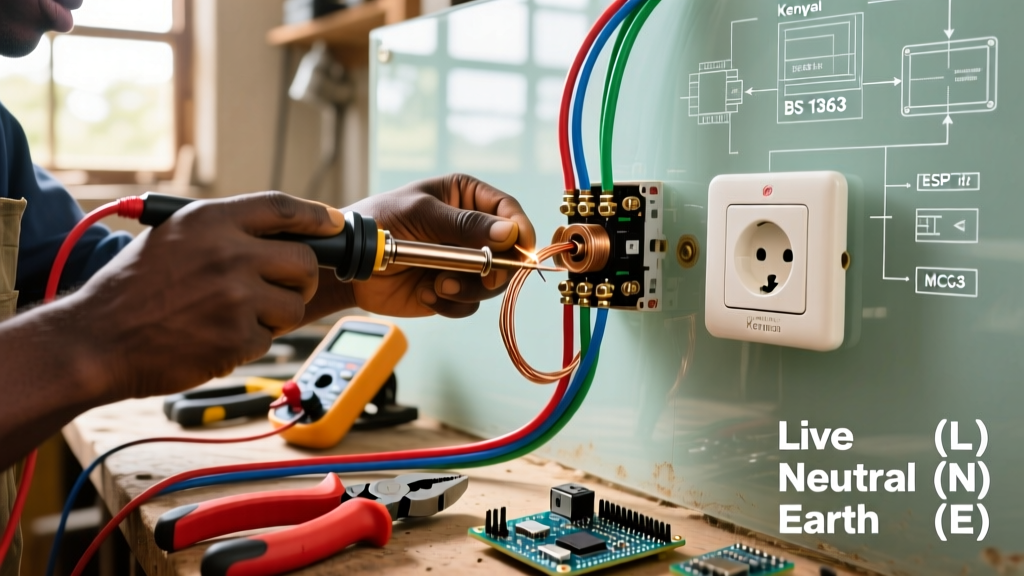
Kenya officially harmonized its wiring color codes with the UK and European IEC standards in 2004. However, DIYers and electricians frequently encounter older properties in areas like Kilimani, Westlands, or Mombasa's Old Town that still utilize the legacy color codes. Proper identification is critical when extending old circuits into new Kenya electrical outlet installations.
| Function | Current Standard (Post-2004) | Legacy Standard (Pre-2004) | BS 1363 Terminal |
|---|---|---|---|
| Live (Phase) | Brown | Red | L (Right pin, fused side) |
| Neutral | Blue | Black | N (Left pin) |
| Earth (Ground) | Green/Yellow Stripe | Green (or bare copper) | E (Top pin) |
Expert Insight: When transitioning from legacy red/black wiring to a modern brown/blue socket, always sleeve the old black neutral wire with blue heat-shrink tubing at the termination point, and sleeve the old red live wire with brown tubing. This prevents future maintenance electricians from misidentifying the conductors, a requirement strictly outlined in the IET BS 7671 Wiring Regulations, which Kenyan electrical codes closely mirror.
Step-by-Step Termination Workflow
- Isolate and Verify: Turn off the MCB (Miniature Circuit Breaker) at the distribution board. Use the Fluke T5-600 to confirm 0V at the existing outlet or cable ends.
- Prepare the Cable: Use the Jokari sheath stripper to remove 150mm of the outer PVC. Strip 12mm of insulation from the 2.5mm² solid copper cores using the Knipex MultiStrip.
- Sleeve the Earth: Slide a piece of green/yellow PVC earth sleeving over the bare earth wire. Never leave the earth wire bare inside a BS 1363 backbox.
- Terminate: Insert the Brown wire into the 'L' terminal, Blue into 'N', and Green/Yellow into 'E'. Tighten the terminal screws firmly (approx. 1.2 Nm torque). Give each wire a gentle tug to ensure it is fully seated and clamped by the screw head, not just resting under it.
- Mount and Test: Secure the socket faceplate to the 35mm backbox using the provided M3.5 machine screws. Restore power and test with the Martindale socket tester to verify correct polarity and earth continuity.
Edge Cases: Troubleshooting Common Kenyan Grid Issues
Missing Earth in Informal or Older Builds
In some older rural builds or informal urban settlements, you may open an existing outlet to find only Live and Neutral wires, with no Earth conductor present. Do not install a standard BS 1363 metal-clad or standard plastic socket in this scenario. Without an earth wire, a fault to the chassis of a plugged-in appliance will leave the appliance energized at 240V. The solution is to install a specialized RCBO (Residual Current Breaker with Overcurrent) at the distribution board for that specific circuit, or use a plug-in RCD adapter, though hardwired protection is the only code-compliant permanent fix.
Voltage Fluctuations and Surges
The Kenya Power and Lighting Company (KPLC) grid, while vastly improved in recent years, can still experience voltage spikes during heavy rains or grid-switching events. For outlets powering sensitive electronics (home offices, entertainment centers), specify surge-protecting sockets (such as the MK Sentry range with integrated neon-lit surge suppression) rather than relying solely on cheap power-strip surge protectors, which often fail catastrophically after a single major spike.
Reverse Polarity Hazards
Reverse polarity (Live and Neutral swapped) is a frequent defect found in DIY-wired Kenyan homes. While an appliance will still function, the internal switch of the appliance (and the switch on the BS 1363 socket) will only isolate the Neutral wire, leaving the internal components of the appliance live and dangerous to touch. Always mandate a socket tester verification before signing off on any installation.
Final Thoughts on Compliance and Safety
Installing a Kenya electrical outlet is not merely about making a physical connection; it is about integrating safely into a 240V system that demands respect and precision. By investing in VDE-rated tools, sourcing KEBS-approved BS 1363 materials from reputable suppliers, and adhering strictly to modern color-code mapping, you ensure a safe, durable, and legally compliant electrical installation. Always consult a licensed EPRA-registered electrician for final inspection and certification of any new circuit runs.