
Understanding the Italy Electricity Outlet Infrastructure
When working with or traveling to the Italian peninsula, understanding the local electrical infrastructure is critical for both safety and equipment compatibility. The standard italy electricity outlet operates on a 230V supply voltage and 50Hz frequency, adhering to the CEI 23-50 standard. Unlike the unified Type G (BS 1363) system in the UK or the Type A/B NEMA standards in North America, Italy features a unique historical bifurcation in its receptacle designs, though modern installations have largely converged.
For electrical inspectors, DIY enthusiasts, and expatriates retrofitting older properties, testing these outlets requires specific knowledge of Italian wiring codes—specifically the Comitato Elettrotecnico Italiano (CEI) 64-8 standard, which governs low-voltage electrical installations in Italy. This guide provides a comprehensive, step-by-step inspection and testing protocol for Italian receptacles.
Anatomy of Italian Receptacles: Type L and Bipasso
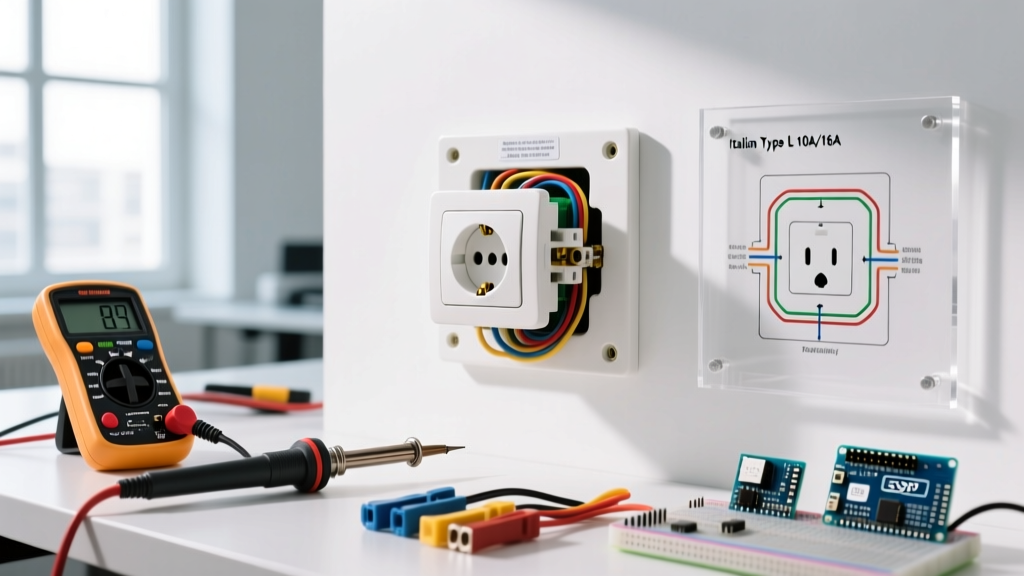
Before inserting a multimeter probe, you must identify the physical topology of the outlet. The International Electrotechnical Commission (IEC) classifies the italy electricity outlet as Type L. However, Type L is not a single monolithic design; it is split into two distinct amperage ratings with incompatible pin spacing.
| Receptacle Type | Standard Designation | Pin Diameter | Pin Spacing | Max Current |
|---|---|---|---|---|
| Type L (10A) | CEI 23-50 S10 | 4.0 mm | 19.0 mm | 10 Amps |
| Type L (16A) | CEI 23-50 S16 | 4.8 mm | 26.0 mm | 16 Amps |
| Bipasso / Multistandard | S10/S16 + Schuko | 4.0 / 4.8 mm | 19.0 / 26.0 mm | 16 Amps |
The Modern Bipasso and Schuko Integration
In modern 2026 installations, pure S10 or S16 sockets are rare in residential builds. Electricians predominantly install Bipasso (dual-gauge) or Multistandard receptacles (often branded by Vimar, Bticino, or Gewiss). These faceplates feature a complex internal shutter mechanism that accepts both 10A and 16A Type L plugs, as well as the German CEE 7/4 "Schuko" (Type F) plug. When inspecting these, ensure the internal shutters are not jammed by debris, a common failure mode in high-dust environments like workshops.
Required Testing Equipment
Testing a 230V European system demands CAT-rated equipment. Do not use cheap, uncalibrated voltage sniffer pens for definitive safety verification.
- Digital Multimeter (DMM): Must be rated CAT III 600V or CAT IV 600V (e.g., Fluke 117 True-RMS or Klein Tools MM700).
- Receptacle Tester: A European-standard RCD/GFCI tester (e.g., Beha-Amprobe ST-101) equipped with a Type L or Schuko adapter.
- Loop Impedance Tester: Required for verifying the earth fault loop impedance (Zs) to ensure the breaker will trip under a short-circuit condition.
- Insulated Hand Tools: VDE-certified screwdrivers (rated to 1000V) for removing faceplates.
Step-by-Step Inspection and Testing Protocol
Step 1: Visual and Mechanical Inspection
Before applying power, conduct a mechanical review. Older Italian homes (pre-1990s) may still feature ceramic-faced Type L outlets. Inspect the thermoplastic or ceramic faceplate for micro-fractures or thermal discoloration (brown/yellow burn marks), which indicate historical overloading. Insert a dummy plug to test the mechanical tension of the internal brass contacts. If the plug slides in with less than 5 Newtons of resistance, the contacts are fatigued and the receptacle must be replaced to prevent arc faulting.
Step 2: Voltage Verification (L-N, L-PE, N-PE)
Set your multimeter to AC Voltage (V~). According to European EN 50160 standards, the nominal 230V supply has a tolerance of +10% / -10% (207V to 253V).
- Line to Neutral (L-N): Insert probes into the left and right holes. Expected reading: 225V - 235V.
- Line to Protective Earth (L-PE): Insert probes into the Line (left/right) and the center Ground pin. Expected reading: 225V - 235V.
- Neutral to Earth (N-PE): Measure between Neutral and the center Ground pin. Expected reading: 0V to 2V. A reading above 5V indicates a loose neutral connection upstream or an overloaded neutral bus bar in the distribution panel.
Step 3: Polarity and Ground Continuity
While the italy electricity outlet does not strictly enforce a "left-neutral, right-line" rule in older installations (Type L is technically reversible for ungrounded appliances), modern CEI 64-8 compliance strongly dictates standard polarity for single-pole switching safety. Use a plug-in circuit analyzer to verify that the Line and Neutral have not been swapped. Furthermore, verify that the center pin is actually bonded to the earth ground bus, not a "bootleg ground" tied back to the neutral wire—a dangerous and illegal practice sometimes found in amateur DIY renovations.
Step 4: RCD (Residual Current Device) Trip Testing
In Italy, the equivalent of a GFCI is the interruttore differenziale (RCD). Since the 2025/2026 updates to Italian wiring codes, residential circuits require Type A or Type F RCDs to handle the DC leakage components from modern inverter-driven appliances (like heat pumps and EV chargers).
Safety Note: When testing the RCD trip time via your receptacle tester, ensure you are testing on a 30mA circuit. The breaker must trip within 300 milliseconds at 1x fault current (30mA), and within 40 milliseconds at 5x fault current (150mA). Failure to trip within these windows indicates a faulty RCD module in the main panel.
Common Failure Modes in Italian Electrical Systems
The "Missing Ground" in Historic Buildings
If you are inspecting an italy electricity outlet in a building constructed before 1980, you will frequently encounter 2-pin ungrounded variants or outlets where the center pin is physically present but not wired. Occupational Safety and Health Administration (OSHA) guidelines and international safety standards dictate that any equipment requiring a ground (Class I appliances with metal chassis) must never be plugged into these unverified circuits. Always test L-PE voltage; if it reads 0V or floats erratically, the ground is absent.
Overloaded 10A Circuits
A frequent edge case occurs when homeowners use a cheap adapter to plug a 16A appliance (like a portable air conditioner or heavy-duty space heater) into a 10A Bipasso socket. While the adapter bypasses the physical pin spacing restriction, the upstream wiring is often 1.5mm² copper, rated only for 10A-16A depending on the installation method. This causes thermal degradation of the receptacle's internal brass clamps over time. During inspection, look for melted thermoplastic around the center ground pin, which is the first point of thermal failure.
Adapter vs. Transformer: A Critical Warning
For North American travelers or expats bringing 110V/60Hz equipment, a simple plug adapter (converting NEMA 1-15 to Type L) is not a voltage converter. Plugging a 110V device into a 230V italy electricity outlet will result in immediate catastrophic failure, often causing a localized fire or destroying the appliance's power supply unit. Always verify the appliance's input rating label; modern switching power supplies (laptops, phone chargers) read "100-240V ~ 50/60Hz" and only require a physical Type L adapter. Resistive loads (hair dryers, kettles) require a heavy, expensive step-down transformer.
Frequently Asked Questions
Can I plug a Schuko (Type F) plug into a standard Type L outlet?
No. A pure CEI 23-50 S10 or S16 Type L socket will not accept the thicker 4.8mm pins or the wider spacing of a German Schuko plug. You must use a Multistandard/Bipasso socket or a physical "Schuko-to-Italy" adapter (often rated for 10A max). Never force a plug, as this will destroy the internal safety shutters.
Why does my multimeter read 115V on both Line and Neutral to ground?
If you measure approximately 115V L-PE and 115V N-PE, but 230V L-N, the outlet's center ground pin is completely floating (unconnected). You are reading capacitive coupling from the adjacent Line and Neutral wires. This confirms a missing earth ground, requiring an immediate electrician visit to pull a new ground wire from the distribution board.