
Navigating Bathroom Electrical Outlet Wiring in 2026
Wiring a bathroom electrical outlet requires navigating a unique intersection of high-moisture environments, heavy appliance loads (like hair dryers and space heaters), and strict National Electrical Code (NEC) mandates. Unlike standard living room receptacles, bathroom circuits demand rigorous ground-fault protection and dedicated amperage capacity to prevent lethal shocks and nuisance tripping.
Whether you are upgrading an outdated 1980s master bath or roughing in a new powder room, understanding the physical constraints and code requirements is non-negotiable. According to the National Fire Protection Association (NFPA), bathroom electrical fires and shock incidents are heavily correlated with improper GFCI terminations and overloaded shared neutrals. Below, we break down three of the most common wiring scenarios electricians and advanced DIYers face, complete with exact product specifications, box-fill calculations, and NEC-compliant solutions.
Code Alert: Under NEC Article 210.8(A)(1), all 125-volt through 250-volt receptacles installed in bathrooms must be GFCI-protected. Furthermore, NEC 210.11(C)(3) requires at least one 20-ampere branch circuit to supply bathroom receptacle outlets, with no other outlets (like lighting or exhaust fans) permitted on this specific circuit if it serves more than one bathroom.
Scenario 1: Upgrading a Legacy 15A Circuit to a 20A GFCI Receptacle
The Problem: Undersized Wiring in Older Homes
In homes built before the 1990s, it is common to find bathrooms wired with 14 AWG copper wire on a 15-amp breaker. Homeowners often attempt to simply swap the standard 15A duplex receptacle for a 20A GFCI model to meet modern appliance demands. This is a severe code violation and a fire hazard. You cannot protect 14 AWG wire with a 20A breaker, and a 20A receptacle requires a 20A circuit.
The Compliant Solution
To properly install a 20A bathroom electrical outlet, you must verify the wire gauge. If you have 12 AWG copper wire, you can upgrade the breaker to a 20A standard or a 20A Dual-Function (AFCI/GFCI) breaker like the Eaton BR220DF (approx. $55), and install a 20A GFCI receptacle such as the Leviton GFNT2-W (approx. $24).
If the existing wire is 14 AWG, you have two legal paths:
- Pull New Wire: Fish new 12 AWG THHN/THWN-2 conductors through the walls to support a true 20A dedicated circuit.
- Downgrade the Receptacle (If 15A Breaker Remains): If pulling new wire is structurally impossible, you must keep the 15A breaker. You can install a 15A GFCI receptacle (like the Leviton GFNT1-W, approx. $18). While the NEC requires a 20A *circuit* for new construction, retrofitting a 15A GFCI on an existing 15A circuit is generally accepted by local AHJs (Authority Having Jurisdiction) as a safety upgrade for existing installations, provided the circuit only serves that single bathroom.
Scenario 2: Wiring Multiple Outlets Downstream (Line vs. Load Dynamics)
The Problem: His-and-Hers Vanity Configurations
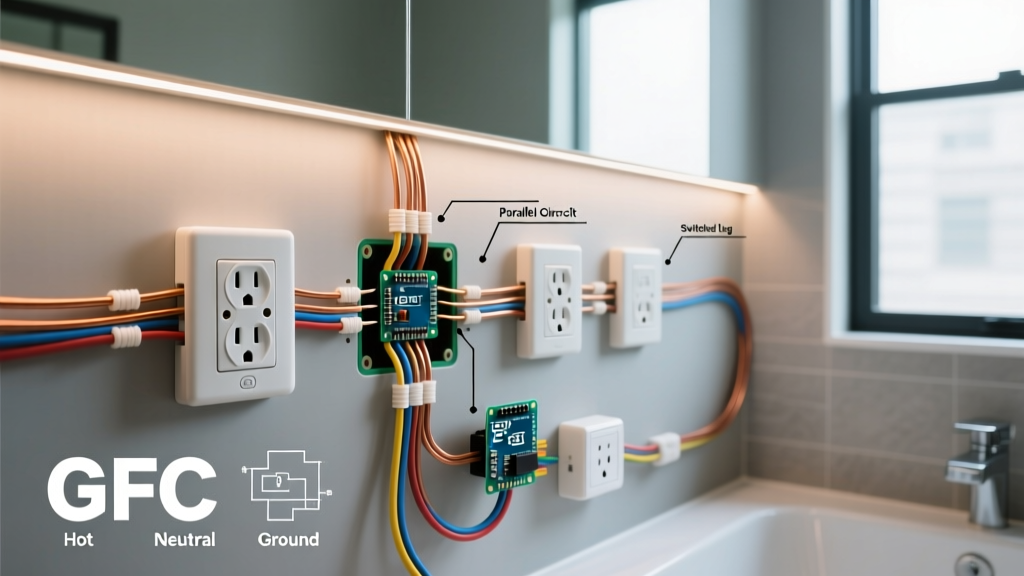
In large master bathrooms, you often need two receptacles—one on each side of a double vanity. The most cost-effective and code-compliant method is to wire the first outlet as a GFCI and use its LOAD terminals to protect a standard, less expensive duplex receptacle downstream.
However, misidentifying the LINE (power source) and LOAD (downstream protection) terminals is the number one cause of GFCI failure. If you wire the power source into the LOAD terminals, the outlet will function, but it will provide zero ground-fault protection to the user or the downstream devices.
Terminal Wiring Matrix
| Terminal Type | Function | Connection Source | Wire Color/Type |
|---|---|---|---|
| LINE (Hot) | Receives incoming power | Main Panel / Breaker | Black (12 AWG) |
| LINE (Neutral) | Completes incoming circuit | Main Panel / Breaker | White (12 AWG) |
| LOAD (Hot) | Sends protected power downstream | Second Vanity Outlet | Black (12 AWG) |
| LOAD (Neutral) | Sends protected neutral downstream | Second Vanity Outlet | White (12 AWG) |
| Ground | Equipment grounding path | Pigtailed to both boxes | Bare Copper / Green |
Edge Case: The Shared Neutral Trap
If your bathroom shares a Multi-Wire Branch Circuit (MWBC) with an adjacent room (e.g., a hallway), the neutral is shared between two hot legs. You cannot wire standard downstream receptacles off the LOAD side of a GFCI on an MWBC. The GFCI monitors the exact current imbalance between its LINE hot and LINE neutral. If a downstream device returns current via a shared neutral from another circuit, the GFCI will instantly detect an imbalance and trip. In MWBC scenarios, you must use a 2-pole GFCI breaker at the panel or install independent GFCI receptacles at each location.
Scenario 3: Integrating Exhaust Fans and Lighting on the GFCI Circuit
The Problem: Nuisance Tripping and Code Violations
When roughing in a new bathroom, DIYers often attempt to save wire by feeding the exhaust fan and vanity lights from the LOAD side of the GFCI receptacle. While the NEC does not explicitly forbid putting a hardwired exhaust fan on the load side of a GFCI (unless local amendments dictate otherwise), it is a terrible practical decision.
Exhaust fan motors generate inductive kickback and electromagnetic interference (EMI) when they start up or shut down. This transient voltage spike can trick the highly sensitive GFCI sensor (which trips at a mere 4mA to 6mA leakage) into a nuisance trip. If the GFCI trips, your bathroom loses its lights and ventilation, and the user is left in the dark needing to reset an outlet behind a vanity cabinet.
The Expert Solution
Always isolate the lighting and ventilation circuits from the receptacle circuit. Per NEC 210.11(C)(3), if a 20A circuit supplies only a single bathroom, it is permitted to feed the lighting and exhaust fan in that same room. However, the best practice for 2026 smart homes is to wire the fan and lights on a completely separate 15A lighting circuit. Connect the fan's power source to the LINE side of the GFCI (or bypass the GFCI box entirely via a separate junction), ensuring that a ground fault at the vanity does not plunge the shower into darkness.
Crucial Installation Metrics: Box Fill and Torque
Beyond the wiring logic, the physical installation of a bathroom electrical outlet requires strict adherence to volume and torque specifications.
1. Box Fill Calculations (NEC Article 314.16)
GFCI receptacles are physically massive. The internal electronics require deep clearance, and the yoke counts heavily against box fill limits. Under NEC Table 314.16(B), a single strap-mounted device counts as two conductor volumes. For 12 AWG wire, each conductor volume is 2.25 cubic inches.
- Device Fill: 2 x 2.25 = 4.50 cu. in.
- Conductors (2 hots, 2 neutrals, 2 grounds): Approx. 11.25 cu. in.
- Total Minimum Required: ~16 to 18 cubic inches.
Recommendation: Abandon standard 14.4 cu. in. metal boxes. Use deep 22.5 cu. in. old-work boxes like the Carlon B620R-UPC (approx. $4.50) to accommodate the bulky GFCI body and stiff 12 AWG conductors without crimping wires against the internal test/reset circuitry.
2. Torque Specifications (NEC 110.14(D))
The 2020 and 2023 NEC updates (carrying forward into 2026 enforcement) strictly mandate that terminations must be torqued to the manufacturer's specifications using a calibrated tool. The Consumer Product Safety Commission (CPSC) notes that loose connections are a leading cause of residential electrical fires.
Most 20A GFCI receptacles (such as models from Leviton and Hubbell) require a tightening torque of 14 to 16 inch-pounds. Using a standard screwdriver by 'feel' often results in under-torquing (leading to arcing) or over-torquing (stripping the brass terminal threads). Invest in a dedicated electrical torque screwdriver, such as the Klein Tools 32500 or the Wiha 645P, to ensure compliant, fire-safe terminations.
Troubleshooting Common GFCI Failure Modes
If your newly wired bathroom electrical outlet is tripping immediately or refusing to reset, consult this diagnostic checklist before tearing open the drywall:
- Reversed Line/Load: The outlet works, but the 'Test' button does nothing, or it trips and won't reset. Use a non-contact voltage tester to identify the live feed and move it to the LINE brass terminals.
- Bootleg Ground / Open Ground: Older homes may lack an equipment grounding conductor. While the NEC allows replacing a 2-prong ungrounded outlet with a GFCI (marked 'No Equipment Ground'), a GFCI will not function correctly if it is wired to a false ground or if the neutral is bonded to ground downstream.
- Moisture Ingress: If the outlet is within 3 feet of the shower edge or sink basin, condensation can infiltrate the receptacle face. Ensure you are using a weather-resistant (WR) rated GFCI model (e.g., Leviton GFNT2-KW) paired with an extra-duty while-in-use cover if it is exposed to direct splash zones.
For comprehensive safety guidelines and the latest product standards, always refer to the Leviton GFCI technical literature and your local municipality's adopted version of the NEC. Properly wiring a bathroom outlet is not just about passing inspection; it is about ensuring a fail-safe environment in the most electrically hazardous room in the home.