
Navigating the I.S. 10101:2020 Standard for Socket-Outlets
When planning a residential or commercial renovation in the Republic of Ireland, understanding the specific code requirements for an Ireland electrical outlet installation is critical to passing inspection and ensuring long-term safety. Unlike the United Kingdom, which operates under the IET Wiring Regulations (BS 7671), Ireland is governed by its own national standard: I.S. 10101:2020 (National Rules for Electrical Installations). While heavily harmonized with European HD 60364 standards and sharing many similarities with the UK framework, I.S. 10101 contains distinct legal mandates, specific earthing arrangements, and rigorous certification pathways overseen by Safe Electric Ireland.
Whether you are a homeowner looking to upgrade your kitchen worktop receptacles or an apprentice electrician reviewing placement rules, this guide breaks down the exact dimensional, protective, and zoning codes you must follow in 2026.
The Physical Standard: BS 1363 Type G Receptacles
The physical design of the standard Ireland electrical outlet is dictated by the BS 1363 standard (commonly known as the Type G plug and socket system). This is a 13-amp, 230V AC system renowned globally for its robust safety features. Under I.S. 10101, any replacement or new-installation socket-outlet must comply with BS 1363 or the equivalent I.S. 401 standard.
Critical Dimensional and Safety Specifications
- Pin Dimensions: The Line and Neutral pins must be exactly 17.5mm long, while the Earth pin is 22.5mm. This 5mm difference ensures the Earth connection is made first, opening the internal safety shutters before the live pins can make contact.
- Integrated Fusing: Unlike most European systems, the Irish/UK system requires the fuse to be located within the plug top (typically 3A, 5A, or 13A BS 1362 ceramic or glass fuses), protecting the flexible appliance cord rather than just the fixed wiring.
- Shutter Mechanisms: Code strictly mandates that Line and Neutral apertures be blocked by insulating shutters. These shutters must only open via the insertion of the longer Earth pin or a specialized three-pin simultaneous actuation mechanism.
- Cost Expectations (2026): A standard, high-quality 13A double switched socket-outlet (e.g., MK Logic Plus or Crabtree) costs between €18 and €35 per unit, excluding installation labor.
Mandatory RCD Protection: The 30mA Rule
One of the most heavily enforced aspects of I.S. 10101:2020 is the mandate for Residual Current Device (RCD) protection. According to Regulation 411.3.3, all socket-outlets rated up to 32A that are intended for general use by ordinary persons must be protected by an RCD with a residual operating current not exceeding 30mA.
Expert Insight: In older Irish homes (pre-2008), it is common to find 13A sockets protected only by standard MCBs (Miniature Circuit Breakers) or older RCCBs. If you are adding a new Ireland electrical outlet circuit to an existing consumer unit, you cannot simply use a standard Type B or C MCB. You must install an RCBO (Residual Current Breaker with Overcurrent protection) or ensure the entire circuit is covered by a 30mA RCD module. Upgrading a standard consumer unit to feature full RCBO protection typically costs between €850 and €1,400 in the current market.
Room-by-Room Placement and Spacing Codes
I.S. 10101 does not just dictate how an outlet is wired, but where it can be placed. Improper spacing is a frequent cause of failed RECI (Registered Electrical Contractor of Ireland) completion inspections.
Kitchen Worktops and Islands
The modern Irish kitchen features high-wattage appliances like air fryers, stand mixers, and instant boiling water taps. The code requires that no point along a continuous kitchen worktop should be more than 1 meter away from a socket-outlet. For kitchen islands exceeding 1.5 meters in length, at least one double socket-outlet must be integrated into the island structure. Pop-up island sockets are permitted, provided they carry an IP44 rating when retracted and are fed from an RCD-protected 20A radial circuit.
Bathroom Zoning and IP Ratings
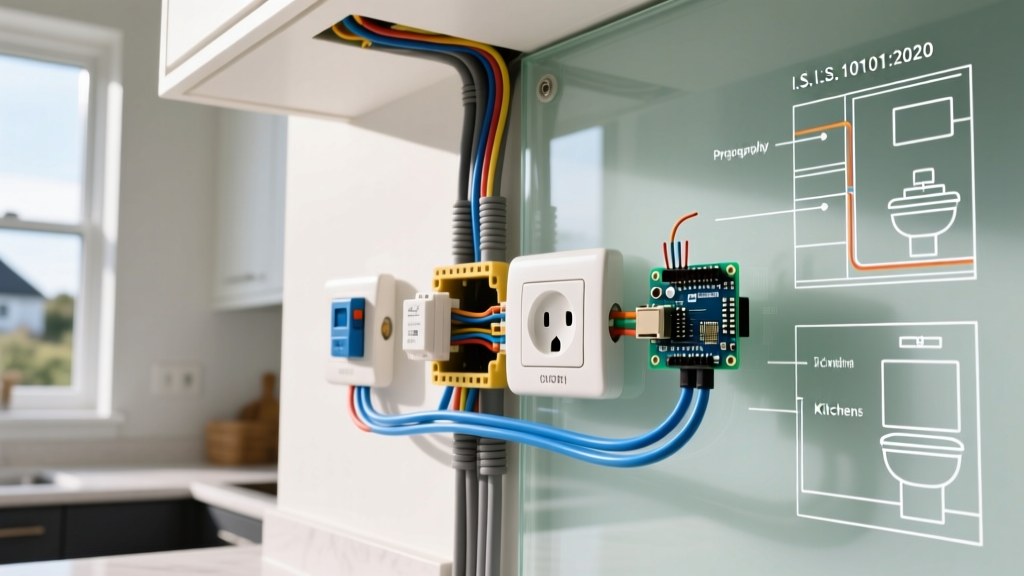
Bathrooms present the highest risk for electrical shock, leading to strict volumetric zoning rules. Standard 13A Ireland electrical outlet receptacles are almost never permitted in Irish bathrooms due to spatial constraints and moisture risks. Instead, specialized shaver supply units are used.
| Bathroom Zone | Definition | Permitted Outlet Types | Minimum IP Rating |
|---|---|---|---|
| Zone 0 | Inside the bath or shower tray | None (Only SELV lighting permitted) | IPX7 |
| Zone 1 | Directly above Zone 0 up to 2.25m | No socket-outlets permitted | IPX4 |
| Zone 2 | 0.6m outside Zone 1 perimeter | Shaver sockets (BS EN 61558-2-5) | IPX4 |
| Outside Zones | Beyond Zone 2 (>3m from Zone 1) | Standard 13A sockets (Rare in IE) | IP20 (Standard) |
Note: Shaver sockets must incorporate an isolating transformer compliant with BS EN 61558-2-5 and are restricted to a maximum VA rating (usually 20VA to 50VA) to prevent the use of high-draw appliances like hairdryers.
The 2026 Shift: USB-C PD Integrated Outlets
As of 2026, the demand for integrated USB charging outlets has surged. When specifying an Ireland electrical outlet with integrated USB-A or USB-C ports, electricians must verify compliance with BS 1363-4. The latest generation of these outlets features USB-C Power Delivery (PD) chips capable of outputting 45W to 65W directly from the wall.
However, I.S. 10101 requires that the internal switch-mode power supply (SMPS) within the socket faceplate must not compromise the thermal integrity of the backbox. Installers must use deep backboxes (minimum 35mm, preferably 47mm) to allow for adequate heat dissipation. Furthermore, the USB circuitry must be internally fused or electronically protected against short circuits independently of the main 13A plug fuse.
Certification: Safe Electric and the REC Mandate
A crucial distinction in Irish electrical law is the oversight of who performs the work. While minor repairs (like replacing a damaged faceplate with an identical model) can be performed by a competent homeowner, any new circuit, consumer unit upgrade, or addition of socket-outlets in a new extension falls under restricted works.
According to the Safe Electric Ireland regulatory framework, these works must be carried out by a Registered Electrical Contractor (REC). Upon completion, the REC must issue an Electrical Completion Certificate. Without this certificate, homeowners may face severe difficulties with insurance claims in the event of an electrical fire, and the installation will not comply with building regulations.
For grid connections and supply capacity upgrades required to support heavy outlet loads (such as adding multiple 32A EV charging sockets alongside standard 13A outlets), coordination with ESB Networks is mandatory to ensure the local transformer and service fuse (typically 63A or 80A in Ireland) can handle the diversified maximum demand.
Frequently Asked Questions (FAQ)
Can I use German (Schuko) or French style sockets in Ireland?
No. Under I.S. 10101 and national safety regulations, the standard Ireland electrical outlet must be the BS 1363 / I.S. 401 Type G 13A switched socket. Installing unswitched Schuko (Type F) sockets in a fixed domestic installation is non-compliant, as it lacks the mandatory local isolation switch and the integrated plug-top fusing required for flexible cord protection in the Irish system.
Do outdoor garden sockets require a specific IP rating?
Yes. Any socket-outlet installed outdoors in Ireland must have a minimum rating of IP54 (protected against dust and splashing water) when the cover is closed, and must be protected by a 30mA RCD. In 2026, most RECI-registered electricians specify IP66-rated weatherproof enclosures (such as the MK Masterseal or Contactum ranges, costing €25-€40) to withstand driving rain and hosepipe exposure.
What is the maximum number of 13A sockets allowed on a single radial circuit?
Unlike the UK's traditional ring final circuit (which allows unlimited sockets within a 100m² floor area), Ireland heavily favors radial circuits. For a 20A radial circuit wired in 2.5mm² copper cable, the floor area served is typically limited to 50m², and the number of outlets is determined by the calculated maximum demand rather than a strict numerical limit. However, standard practice limits a 20A radial to roughly 8 to 12 double socket-outlets to prevent nuisance tripping and voltage drop.
For the most up-to-date amendments and technical bulletins regarding wiring rules, always consult the National Standards Authority of Ireland (NSAI) before commencing any major electrical design work.