
Navigating Colombia Electrical Outlet Standards and Safety Codes
For traveling electricians, expats managing property renovations, or advanced DIYers, understanding the nuances of a colombia electrical outlet installation is critical. While Colombia shares the same physical plug configurations as the United States and Canada, the underlying electrical codes, enforcement mechanisms, and local installation practices are governed by a distinct regulatory framework. Ignoring these local codes—specifically the RETIE (Reglamento Técnico de Instalaciones Eléctricas)—can result in severe shock hazards, failed property inspections, and legal liabilities.
This comprehensive safety guide breaks down the exact specifications, code mandates, and practical installation steps required to wire receptacles safely in Colombia in 2026. Whether you are upgrading ungrounded outlets in a legacy Bogotá apartment or wiring a new commercial space in Medellín, strict adherence to local standards is non-negotiable.
Baseline Electrical Specifications in Colombia
Before touching a wire, you must understand the fundamental electrical parameters of the Colombian grid. The country operates on a standardized alternating current (AC) system that closely mirrors North American standards, but with specific local tolerances.
| Parameter | Colombia Standard | Notes & Tolerances |
|---|---|---|
| Nominal Voltage | 120V | Utility tolerance is typically ±10% (108V - 132V). |
| Frequency | 60 Hz | Standard across all national and regional grids. |
| Plug/Receptacle Types | Type A (NEMA 1-15) & Type B (NEMA 5-15) | Type B (grounded) is strictly mandated for all new installations. |
| Governing Code | RETIE & NTC 2050 | NTC 2050 is the Colombian adaptation of the NFPA 70 (NEC). |
| Standard Breaker Size | 15A or 20A | 20A circuits require 12 AWG wire; 15A requires 14 AWG. |
According to the International Electrotechnical Commission (IEC), Colombia officially utilizes Type A and Type B outlets. However, from a safety and code compliance perspective, Type A (ungrounded, two-prong) receptacles are considered obsolete for new construction and major renovations. The physical compatibility with North American devices makes sourcing parts easy, but the internal wiring topology requires strict attention to local color codes and grounding mandates.
RETIE Compliance and CONTE Certification
The most critical difference between wiring an outlet in the US versus Colombia is the legal framework. In Colombia, electrical installations are governed by RETIE. This regulation mandates that all electrical work must be designed, installed, and inspected by qualified personnel.
Safety Warning: Under Colombian law, any new electrical installation or major modification must be signed off by an electrician certified by CONTE (Consejo Nacional de Normalización y Certificación de la Calidad de la Energía Eléctrica). DIY electrical work that bypasses CONTE-certified inspection can void property insurance and result in fines.
The Grounding Mandate
One of the most common safety violations in older Colombian buildings (pre-2000s) is the presence of ungrounded Type A outlets or Type B outlets with a "fake" ground (a jumper wire from the neutral to the ground screw). RETIE strictly prohibits this practice, known as a "bootleg ground." All new 120V, 15A, and 20A receptacles must be connected to a true equipment grounding conductor that traces back to the main service panel's grounding electrode system.
GFCI vs. RCD: The 5mA Threshold
When protecting wet areas (kitchens, bathrooms, outdoor patios), RETIE requires differential protection. While European-influenced systems often use 30mA Residual Current Devices (RCDs) at the breaker panel, RETIE aligns with the NFPA 70 National Electrical Code standard for specific wet-location receptacles, mandating a 5mA trip threshold (Class A GFCI). When purchasing components in Colombia, ensure you are buying true 5mA GFCI receptacles (often branded locally as Interruptor de Falla a Tierra or Tomacorriente con Protección Diferencial) from reputable manufacturers like Schneider Electric, Bticino, or Leviton, rather than relying solely on a 30mA panel-breaker RCD for point-of-use shock protection.
Wire Color Codes: NTC 2050 vs. US NEC
Colombia's technical standard, NTC 2050 (Norma Técnica Colombiana), is heavily based on the US NEC, but there are practical deviations in how local electricians apply color codes, especially in multi-wire branch circuits or older conduit pulls. Always verify wires with a multimeter; never trust color alone.
| Wire Function | NTC 2050 Standard Color | Common Local Variations / Legacy Colors |
|---|---|---|
| Equipment Ground | Green, or Green with Yellow Stripe | Bare Copper (THHN/THWN in conduit) |
| Grounded (Neutral) | White or Natural Gray | White (Standard), occasionally Black with white tape in older pulls |
| Ungrounded (Phase/Hot) | Black, Red, or Blue | Black (Standard). Note: Blue is sometimes used for 120V phases in LatAm, whereas US NEC reserves blue for 277V/480V systems. |
Step-by-Step Installation: Safety and Torque Specs
Follow this exact procedure to install a standard 15A Type B (NEMA 5-15) receptacle in a Colombian residential setting. This assumes a standard metallic or PVC conduit system with THHN/THWN-2 copper conductors.
- Lockout/Tagout (LOTO): Turn off the corresponding breaker (locally referred to as the pastilla or taco) in the distribution panel. Apply a physical lockout if working in a shared or commercial space.
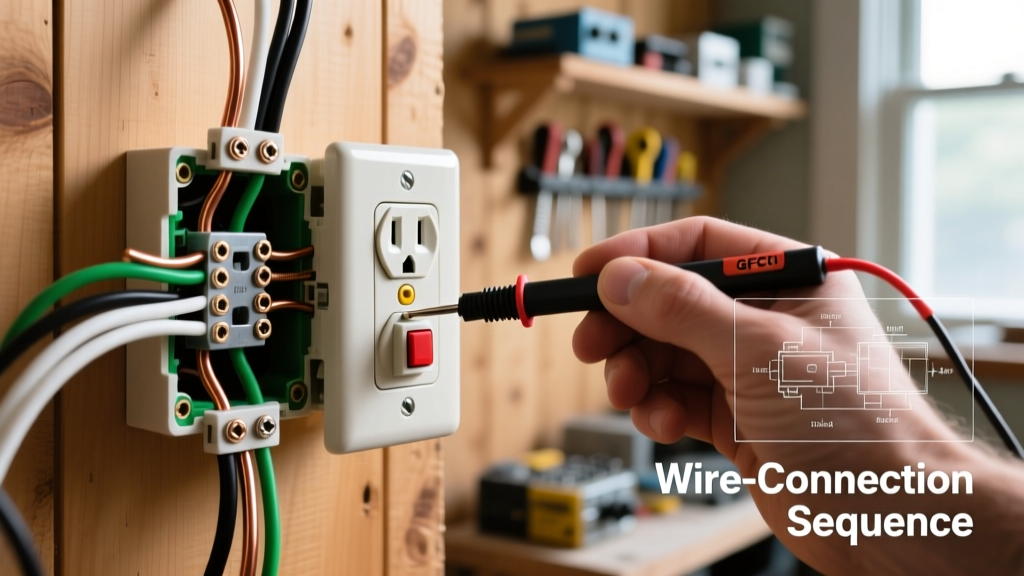
- Verify Zero Energy: Use a CAT III or CAT IV rated non-contact voltage tester, followed by a digital multimeter (e.g., Fluke 117) to test between Phase-to-Neutral, Phase-to-Ground, and Neutral-to-Ground. All readings must be 0.0V.
- Conductor Preparation: Strip exactly 3/4 inch (19mm) of insulation from the 12 AWG or 14 AWG solid copper wires. Do not nick the copper conductor, as this creates a weak point prone to thermal failure.
- Termination Method: Prefer the screw-terminal method over back-stab (push-in) connections. Back-stab connections are notorious for high-resistance failures and are heavily frowned upon in RETIE compliance inspections.
- Apply Torque: This is where most DIYers fail. Use a calibrated torque screwdriver (such as the Klein Tools 32500) set to the manufacturer's specification, typically 12 to 14 inch-pounds for standard 15A receptacles. Under-torqued wires cause arcing; over-torqued wires strip the brass threads or shear the conductor.
- Grounding Verification: Ensure the bare/green ground wire is pigtailed to the metal outlet box (if applicable) and securely fastened to the receptacle's green grounding screw.
Troubleshooting Common Colombian Outlet Faults
When inspecting or retrofitting existing outlets in Colombia, you will frequently encounter specific failure modes born from historical code laxity or improper DIY repairs. Use the matrix below to diagnose and correct these issues.
| Fault Condition | Symptoms / Tester Reading | Root Cause & RETIE-Compliant Fix |
|---|---|---|
| Open Ground | Tester shows "Open Ground". Devices with 3-prong plugs feel like they have a slight "tingle" (leakage current). | Cause: Missing ground wire or disconnected ground in the conduit. Fix: Pull a new 12 AWG green ground wire through the conduit to the panel, or install a 5mA GFCI receptacle and label it "No Equipment Ground" as a temporary safety mitigation. |
| Reverse Polarity | Tester shows "Hot/Neutral Reversed". Appliances switch on but internal fuses blow or chassis becomes energized. | Cause: Electrician swapped the black (hot) and white (neutral) wires at the terminal screws. Fix: Swap wires. Ensure the black (hot) wire connects to the brass screw (shorter slot) and white (neutral) to the silver screw (longer slot). |
| Shared Neutral Overload | Neutral wire melting or breaker tripping when two adjacent rooms use high-draw appliances simultaneously. | Cause: Multi-wire branch circuit (MWBC) wired on the same phase leg, causing neutral to carry the sum of both hots instead of the difference. Fix: Reconfigure panel breakers to ensure the two hot legs are on opposite phases (240V across them), and install a handle tie. |
| Voltage Drop / Sag | Multimeter reads 105V-110V at the outlet under load. Lights dim when AC compressor kicks on. | Cause: Wire gauge too small for the run length, or loose connections at the panel. Fix: Check panel terminations with a thermal camera (e.g., FLIR). If tight, upgrade the branch circuit from 14 AWG to 12 AWG or 10 AWG to mitigate voltage drop over long conduit runs. |
Final Inspection and Certification
Once the physical installation is complete, the work is not legally finished. In Colombia, RETIE requires that the installation undergoes a formal inspection. The certified CONTE electrician will use a calibrated loop impedance tester and a precision torque verifier to ensure every outlet meets the strict safety margins outlined in NTC 2050. Only after passing this inspection will the local utility or municipal authority issue the final certificate of compliance (Certificado de Conformidad de Instalaciones Eléctricas).
By respecting the local terminology, adhering to the 5mA GFCI requirements for wet zones, and utilizing proper torque specifications, you ensure that your colombia electrical outlet installations are not only functional but inherently safe and legally compliant for decades to come.