
Understanding Dubai's Electrical Grid and DEWA Regulations
When planning to install or replace an electrical outlet in Dubai, it is crucial to understand that the emirate operates on a 230V/50Hz alternating current (AC) system. The regulatory framework is strictly governed by the Dubai Electricity and Water Authority (DEWA), which heavily aligns its local wiring regulations with the UK's BS 7671 (IET Wiring Regulations) while implementing specific regional amendments to account for the harsh desert climate and high cooling loads.
Unlike North American systems that utilize 120V and NEMA configurations, Dubai exclusively uses the BS 1363 Type G standard for general-purpose socket outlets. This means every standard 13A outlet features three rectangular pins and integrated safety shutters. Furthermore, the plug itself contains a replaceable cartridge fuse (typically 3A, 5A, or 13A), providing an additional layer of localized overcurrent protection right at the appliance level.
DEWA Compliance Warning: While homeowners are generally permitted to swap out a damaged socket faceplate on an existing circuit, extending a circuit, adding a new spur, or modifying the Distribution Board (DB) legally requires a DEWA-approved electrical contractor. Unauthorized modifications can result in failed annual inspections and voided property insurance.
Ring Final vs. Radial Circuits in UAE Properties
Before cutting into any drywall or pulling new cables, you must identify the circuit topology. The wiring scenario for your electrical outlet in Dubai will depend heavily on the age and type of the property:
1. Ring Final Circuits (Older Apartments & Pre-2010 Villas)
Borrowed from British standards, a ring final circuit starts at a 32A Miniature Circuit Breaker (MCB) in the DB, loops through all the 13A sockets in a specific zone (like a living room), and returns to the same 32A MCB. This topology uses 2.5mm² PVC-insulated copper cables (commonly sourced from local giants like Ducab or Elsewedy Cables). Because the current can flow in two directions, the 2.5mm² cable effectively handles the load of a 32A breaker.
2. Radial Circuits (Modern Dubai Villas & Post-2015 Builds)
In recent years, DEWA and local consultants have shifted toward radial circuits for socket outlets to eliminate the risk of a broken ring conductor causing silent cable overloads. A standard radial circuit for general sockets is protected by a 20A Type B or Type C MCB using 2.5mm² cable, or a 32A MCB using 4.0mm² cable. When adding a new outlet to a radial circuit, you are simply extending the end of the line (a spur) or daisy-chaining into the middle of the run, provided the total connected load does not exceed the breaker's rating.
Required Tools and Materials (2026 Pricing Guide)
To ensure a safe, code-compliant installation, you must use rated materials. Below is a breakdown of the specific tools and components required for a standard Type G outlet installation in Dubai, along with current market pricing in AED (United Arab Emirates Dirham).
| Item / Component | Recommended Brand / Model | Specification | Est. Price (AED) |
|---|---|---|---|
| 13A Switched Socket | Schneider Electric Easy9 or MK Logic Plus | BS 1363, DP Switched, White | 25 - 55 AED |
| Twin & Earth Cable | Ducab or Elsewedy | 2.5mm² (Brown, Blue, Green/Yellow) | 280 AED / 100m roll |
| Circuit Breaker (If new) | Schneider Acti9 iC60N | 20A or 32A, Type B or C, 10kA | 45 - 85 AED |
| Voltage Tester | Fluke T5-1000 or T6-1000 | Non-contact & OpenJaw voltage/continuity | 650 - 800 AED |
| Insulated Screwdrivers | Wera VDE Slimline Set | 1000V rated, Pozidriv #1 and #2 | 180 - 250 AED |
| Torque Screwdriver | Wera Kraftform Micro | Adjustable up to 1.2 Nm | 450 AED |
Step-by-Step: Wiring a Standard 13A Type G Outlet
Follow this precise procedure to ensure your installation meets IET Wiring Regulations (BS 7671) and local DEWA safety expectations.
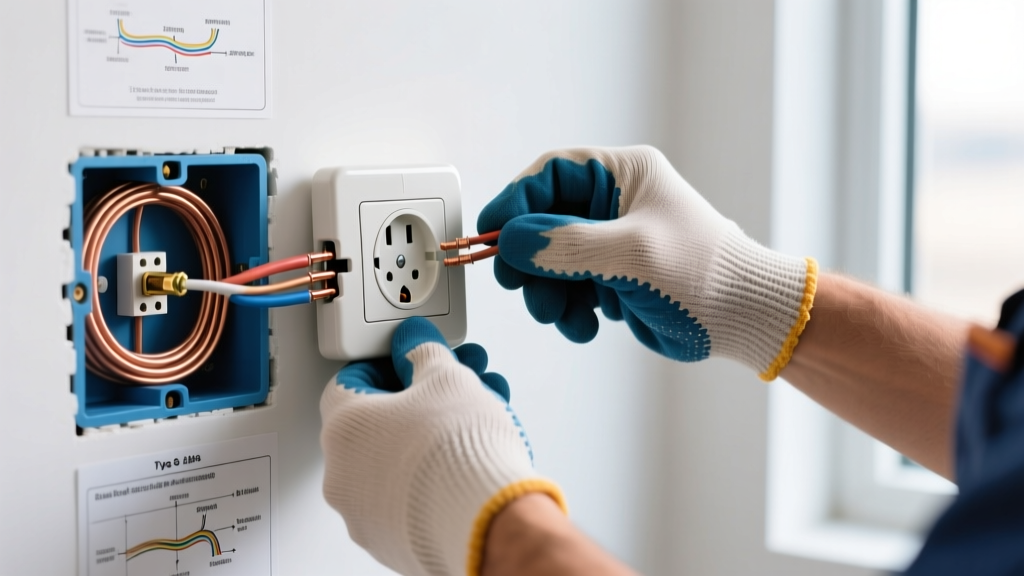
- Isolate and Verify: Turn off the specific MCB and the 30mA RCD/RCBO protecting the circuit at the main Distribution Board. Use your Fluke voltage tester to confirm zero voltage at an existing socket on the same circuit before touching the target wires.
- Prepare the Cable: If extending a circuit, route the 2.5mm² Twin & Earth cable through the wall cavity. Strip back the outer grey or white PVC sheath by about 30mm, exposing the three insulated cores. Do not nick the copper strands.
- Strip the Cores: Using a precision wire stripper, remove exactly 12mm to 15mm of insulation from the Brown (Line), Blue (Neutral), and Green/Yellow (Earth) wires. Over-stripping leaves exposed copper outside the terminal, creating a severe shock hazard.
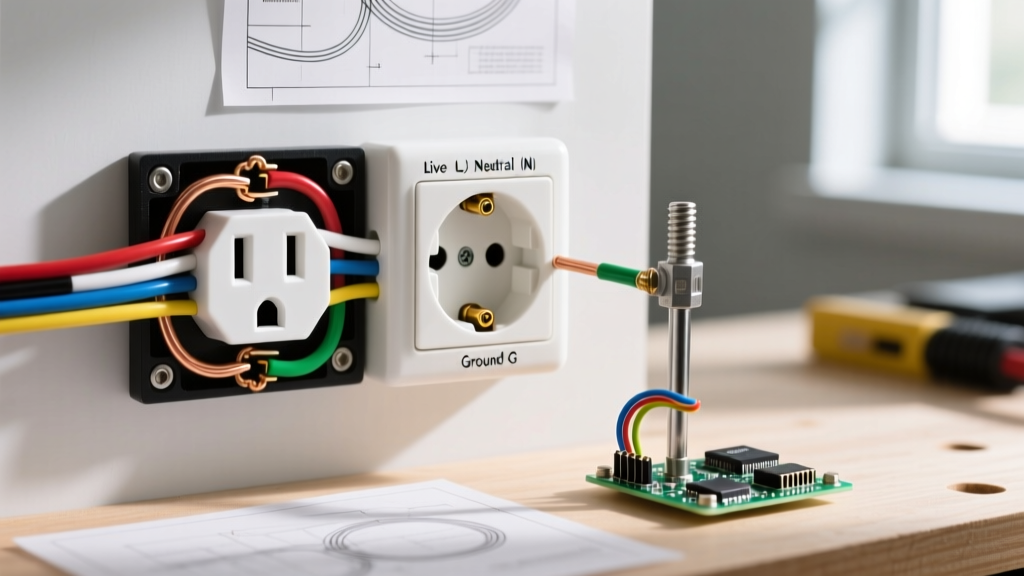
- Terminate the Earth First: Connect the Green/Yellow earth wire to the top terminal marked 'E' or the earth symbol. In older Dubai properties, you may encounter bare copper earth wires; you must slide a green/yellow PVC sleeving over the bare wire before termination to meet modern inspection standards.
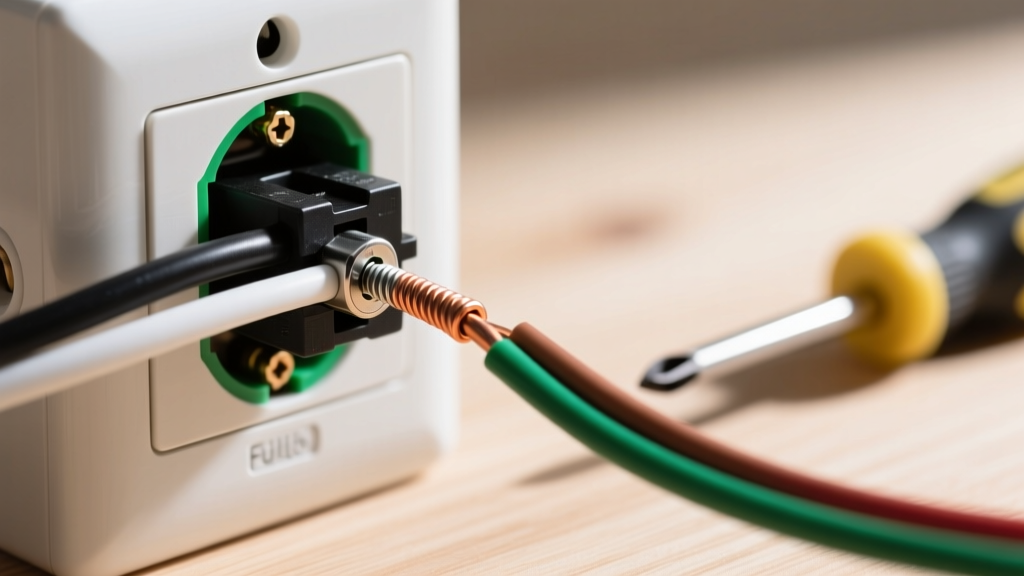
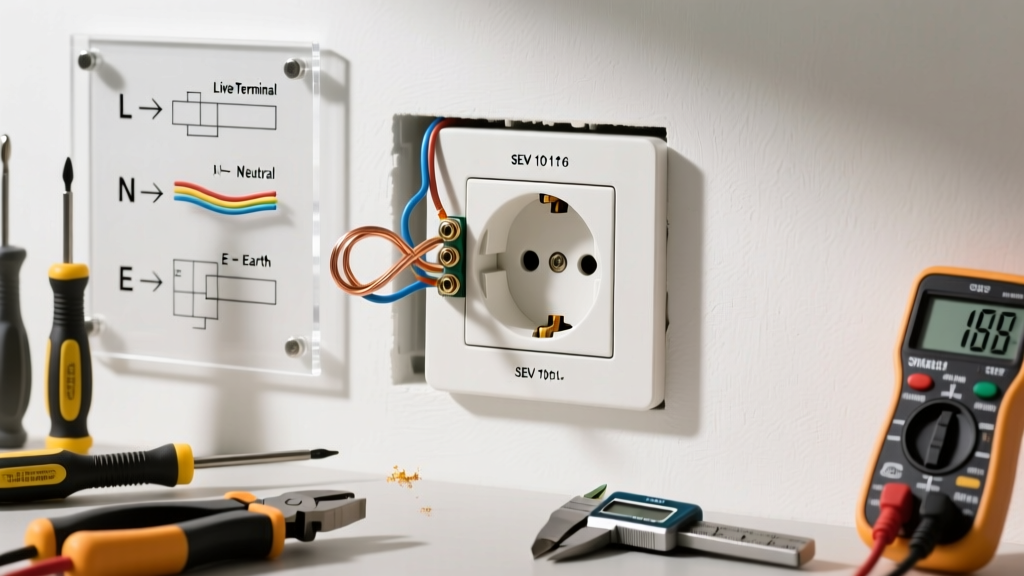
- Connect Line and Neutral: Insert the Brown wire into the 'L' (Line) terminal and the Blue wire into the 'N' (Neutral) terminal. Ensure no stray copper whiskers are protruding.
- Apply Correct Torque: Tighten the terminal screws. For high-quality sockets like the MK Logic Plus, the manufacturer specifies a torque of 0.8 Nm. Under-tightening causes high-resistance faults and arcing; over-tightening can shear the copper strands.
- Secure and Test: Mount the socket faceplate into the 35mm deep galvanized steel or PVC backbox. Restore power at the DB and use a dedicated BS 1363 socket tester (e.g., Megger RCDT) to verify correct polarity, earth continuity, and RCD trip times (must trip within 40ms at 150mA and 300ms at 30mA).
Troubleshooting Common Wiring Scenarios in Dubai
The extreme summer heat in the UAE (often exceeding 45°C / 113°F) can accelerate the degradation of electrical components, especially in older villas. Below are common failure modes encountered when working with electrical outlets in Dubai.
| Symptom | Probable Cause | Technical Solution |
|---|---|---|
| RCD trips immediately when plugging in an appliance | Earth leakage in the appliance or a shared neutral/earth fault in the wiring. | Perform an insulation resistance test (Megger) at 500V DC. Ensure Line-Neutral, Line-Earth, and Neutral-Earth readings are all >1.0 MΩ. |
| Socket faceplate feels warm to the touch under load | Loose terminal connections causing high resistance, or back-stabbed wires (if using non-UK spec sockets). | Isolate power, open the faceplate, and re-terminate wires using the proper torque settings. Replace the socket if the brass contacts show signs of thermal bluing. |
| Voltage reads 210V-225V instead of 230V | Voltage drop due to excessively long cable runs or undersized cables (common in large Dubai villas with distant DBs). | Calculate voltage drop. For a 2.5mm² cable, the drop is roughly 18mV/A/m. If the run exceeds 30 meters on a 20A radial, upgrade the feed to 4.0mm² cable. |
| Plugs fit loosely and fall out of the socket | Worn internal phosphor-bronze contacts due to heat cycling and mechanical fatigue. | Replace the socket immediately. Loose contacts increase electrical resistance and are a primary cause of residential electrical fires. |
Upgrading to Smart Outlets in the UAE Market
As of 2026, smart home integration is a standard expectation in Dubai's real estate market. When upgrading a standard electrical outlet to a smart socket, compatibility with local network frequencies and smart home ecosystems is critical.
Most modern smart sockets in the UAE utilize Zigbee 3.0 or Wi-Fi (2.4GHz). Brands like Schneider Electric Wiser and Legrand with Netatmo offer Type G smart sockets that fit seamlessly into standard 35mm backboxes. However, smart sockets require a permanent neutral wire to power their internal radios. If you are working in an older Dubai apartment where the switch leg was pulled without a neutral (common in lighting, but occasionally miswired in spurs), you must either pull a new neutral from the DB or utilize a specialized smart relay module behind a standard socket.
Furthermore, ensure any smart socket purchased locally carries the ESMA (Emirates Authority for Standardization and Metrology) certification mark. Importing uncertified smart plugs via international shipping sites often results in devices that lack the mandatory 13A BS 1363 fuse, creating a severe fire hazard if a connected appliance develops a short circuit.
Frequently Asked Questions (FAQ)
Can I install a US-style 120V NEMA outlet in my Dubai villa?
Yes, but it requires a dedicated step-down transformer (230V to 120V) installed at the Distribution Board, along with a completely separate, isolated circuit wired specifically for 120V. You must use distinctively colored faceplates (often red or black) to warn users that the outlet is not 230V. This is a common scenario in Dubai for expatriates importing high-end US audio equipment or specialized kitchen appliances.
What is the DEWA requirement for RCD protection on socket outlets?
Following recent updates aligning with the 18th Edition of the IET Wiring Regulations, DEWA mandates that all general-purpose socket outlets rated up to 32A must be protected by a 30mA Residual Current Device (RCD) or RCBO. Type A RCDs are now the minimum standard to handle modern appliances with inverter-driven motors and switching power supplies, which can introduce pulsating DC fault currents that older Type AC RCDs cannot detect.
Can I use a standard 13A socket to charge my Electric Vehicle (EV)?
While technically possible using a portable 'granny charger' plugged into a Type G outlet, it is highly discouraged for regular use. A 13A socket delivers roughly 3kW of power, meaning a full charge for a modern EV could take over 24 hours. More importantly, continuous 13A draw for 20+ hours will cause standard socket contacts to overheat, especially in un-airconditioned Dubai garages where ambient temperatures can reach 50°C. DEWA strongly recommends installing a dedicated Type 2 EV wallbox on its own 6.0mm² or 10.0mm² radial circuit protected by a 40A Type A RCBO.
For more information on local electrical safety standards and approved contractor lists, always refer to the official Dubai Electricity and Water Authority (DEWA) consumer portal before undertaking major electrical modifications.