
Navigating Residential Wiring in Dousman, Wisconsin
When homeowners search for how to install electrical outlet Dousman WI properties present a unique set of challenges. Located in Waukesha County, the Village of Dousman features a diverse housing stock ranging from early 1900s farmhouses near downtown Main Street to modern subdivisions built in the 2010s. Because of this architectural timeline, a one-size-fits-all approach to electrical wiring simply does not work. Whether you are upgrading a historic property or adding a dedicated circuit to a newer build, understanding the underlying wiring era is the critical first step.
In this comprehensive guide, we break down the three most common wiring scenarios Dousman homeowners face when installing new receptacles, complete with 2026 National Electrical Code (NEC) standards, specific product recommendations, and local permitting insights.
Assessing Your Home's Electrical Era
Before cutting into any drywall or stripping wire insulation, you must identify the type of wiring currently feeding your electrical boxes. Waukesha County homes generally fall into three distinct wiring eras.
| Construction Era | Common Wiring Type | Installation Considerations |
|---|---|---|
| Pre-1950s (Historic Village Homes) | Knob-and-Tube or Early BX (Armored Cable) | No equipment ground; brittle insulation; requires GFCI retrofitting and careful handling to avoid damaging asbestos or cloth wrappers. |
| 1960s - 1980s (Mid-Century Expansions) | Aluminum Branch Wiring or Early NM (Romex) | Aluminum requires CO/ALR rated devices or Alumiconn pigtailing; early NM may lack a ground wire. |
| 1990s - Present (Modern Subdivisions) | Copper NM-B (Romex) with Equipment Ground | Standard installation; must comply with current AFCI/GFCI arc-fault and ground-fault mandates. |
Scenario 1: Retrofitting Ungrounded 2-Prong Outlets (Pre-1965 Homes)
Many older homes in Dousman still feature ungrounded 2-prong receptacles. While replacing a 2-prong outlet with a standard 3-prong outlet without a ground wire is a direct NEC violation, you can legally and safely install a 3-prong receptacle by utilizing a Ground Fault Circuit Interrupter (GFCI). According to the NFPA NEC Article 406.4(D)(2)(b), a GFCI provides personnel protection even in the absence of an equipment grounding conductor.
Step-by-Step GFCI Retrofit
- Power Down & Verify: Turn off the breaker and use a non-contact voltage tester (like the Klein Tools NCVT-2) to confirm the circuit is dead.
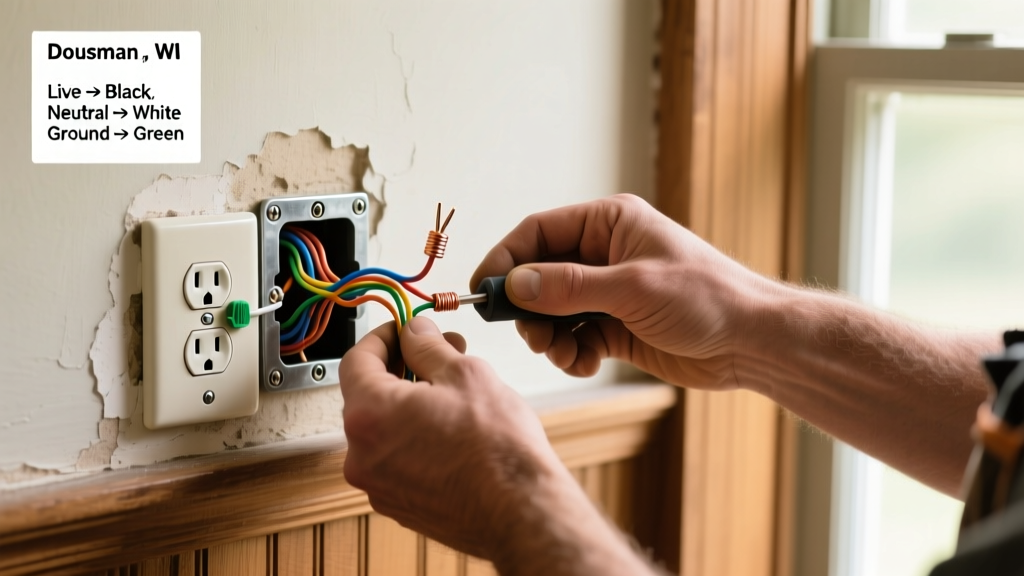
- Remove the Old Receptacle: Unscrew the 2-prong outlet. You will likely see only two wires: a black (hot) and a white (neutral). There will be no bare copper or green ground wire.
- Select the Right Device: Purchase a slim-profile GFCI such as the Leviton GFNT2-W (approx. $22). Its shallow depth (1.25 inches) is crucial for the small, shallow electrical boxes found in 1940s Dousman homes.
- Wire the LINE Terminals: Connect the black wire to the brass LINE terminal and the white wire to the silver LINE terminal. Do not use the LOAD terminals unless you are protecting downstream outlets.
- Apply the Mandatory Label: The Leviton device includes a "No Equipment Ground" sticker. You must apply this to the faceplate to pass local Waukesha County inspections.
Expert Warning: Never use a "cheater plug" (3-prong to 2-prong adapter) for high-draw appliances like space heaters or window AC units. The lack of a true ground path creates a severe shock hazard if the appliance's internal insulation fails.
Scenario 2: Installing Cold-Weather Exterior Receptacles
Wisconsin winters are unforgiving. If you are installing an outdoor outlet for holiday lights, snowblowers, or heated birdbaths, standard indoor weatherproofing will fail. Dousman experiences heavy snow loads and freeze-thaw cycles that can crack cheap plastic covers and allow moisture into the junction box.
Material Specifications for Midwest Exteriors
- The Receptacle: Use a commercial-grade, weather-resistant (WR) GFCI. The Hubbell GF520W (approx. $38) features heavy-duty corrosion-resistant contacts and UV-stabilized thermoplastics that won't become brittle at -20°F.
- The Enclosure: Avoid standard bubble covers. Opt for the TayMac MM540C Extra Duty In-Use Cover. It accommodates bulky plugs (like those on snowmelt cables) while remaining fully closed, maintaining the NEMA 3R weatherproof rating.
- Sealant: Apply a continuous bead of 100% silicone exterior caulk (not acrylic painter's caulk) around the top and sides of the mounting flange. Leave the bottom edge uncaulked to allow any trapped condensation to weep out.
Scenario 3: Running a Dedicated 20A Garage Workshop Circuit
With many Dousman residents utilizing detached or attached garages for woodworking and auto repair, a standard 15A lighting circuit is insufficient for running table saws and air compressors simultaneously. Installing a dedicated 20A outlet requires running new wire from your main service panel.
Wire Sizing and Breaker Selection
For a 20-amp circuit, you must use 12 AWG copper wire. We recommend Southwire 12/2 SIMpull NM-B (approx. $0.85 per foot), which features a specialized polymer coating that drastically reduces pulling friction through wall cavities and conduit.
| Component | 15A Circuit (Standard) | 20A Circuit (Workshop) |
|---|---|---|
| Wire Gauge | 14 AWG NM-B | 12 AWG NM-B |
| Breaker Size | 15 Amp (Standard) | 20 Amp (Standard or AFCI) |
| Receptacle Type | 15A Duplex (NEMA 1-15R) | 20A Duplex (NEMA 5-20R) |
| Max Continuous Load | 12 Amps (1,440W) | 16 Amps (1,920W) |
Note: Under current NEC guidelines, garage receptacles require both GFCI and AFCI protection. Use a Dual Function (DF) breaker, such as the Square D HOM220DF (approx. $55), at the panel rather than a GFCI outlet at the point of use to prevent nuisance tripping from heavy motor startups.
2026 Material & Permit Cost Breakdown
Budgeting for an electrical project requires accounting for both materials and local municipal fees. Below is an estimated cost breakdown for a standard single-outlet installation or upgrade in the Dousman area.
- Standard 15A Receptacle (Leviton T5325-W): $3.50 - $5.00
- 20A GFCI Receptacle (Hubbell GF520W): $35.00 - $45.00
- Electrical Permit (Village of Dousman): $50.00 base fee + $5.00 per opening (subject to annual municipal adjustments)
- Licensed Electrician Hourly Rate (Waukesha County): $115 - $165 per hour
Village of Dousman Permitting & WI State Codes
In Wisconsin, electrical work is strictly regulated by the Department of Safety and Professional Services (DSPS). While homeowners are legally permitted to do their own electrical work in their primary residence, the work must still comply with the Wisconsin Administrative Code SPS 316, which adopts and amends the NEC.
If you are installing a new circuit, altering the service panel, or adding exterior wiring, you must pull an electrical permit through the Village of Dousman Building Inspection Department. Failing to permit work can result in fines and will almost certainly cause issues during a future home inspection when you decide to sell your property. Always schedule a rough-in inspection before closing up drywall, and a final inspection once the devices are terminated and faceplates are installed.
Frequently Asked Questions
Can I daisy-chain a new outlet from an existing light switch?
Only if the switch box contains a constant hot wire and a neutral wire. Many older Dousman homes use "switch loops" where only the hot and switched-hot wires are present at the switch box, with no neutral. Without a neutral, you cannot safely or legally install a standard receptacle. You must trace the circuit back to a junction box or the panel.
Do I need an AFCI breaker for a bedroom outlet replacement?
If you are simply swapping an old receptacle for a new one (like-for-like replacement), an AFCI breaker is not strictly mandated by the NEC. However, if you are extending the circuit or adding a new outlet to an existing bedroom circuit, the entire circuit must be protected by an AFCI breaker to mitigate arc-fault fire risks.
What is the frost line consideration for exterior conduit?
If you are running underground PVC conduit to a detached garage or post light in Dousman, Waukesha County's frost line is generally considered to be 42 inches. While electrical code requires a minimum of 18 inches of cover for PVC, local inspectors often recommend burying conduit at 24 to 30 inches to prevent frost heave from shifting the PVC and damaging the wire insulation over time. Always consult the local inspector for specific trench depth requirements.
For more information on safe electrical practices and ground fault protection, refer to the U.S. Consumer Product Safety Commission (CPSC) guidelines on GFCIs.