
Understanding the Indian Electrical Landscape
Inspecting and testing an electrical outlet in India requires a nuanced understanding of local infrastructure. Unlike the standardized 120V/60Hz grids of North America, India operates on a 230V/50Hz single-phase system with significant regional voltage fluctuations. Furthermore, the transition from legacy municipal wiring to modern gated-community grids means that an electrician or DIY enthusiast will frequently encounter a mix of earthing topologies, primarily TT (local earth pit) and TN-C-S (structural earth).
Whether you are troubleshooting a tripping RCCB, diagnosing a 'floating neutral', or simply verifying the safety of a newly installed socket, a systematic approach is non-negotiable. This guide details the exact inspection protocols, multimeter testing procedures, and fault-diagnosis frameworks required for Indian residential and commercial sockets.
Regulatory Standards: IS 1293 and IS 12640
Before testing, you must understand the hardware standards mandated by the Bureau of Indian Standards (BIS).
- IS 1293 (Plugs and Socket-Outlets): This standard governs the physical design of Indian sockets. It mandates the 5A (Type D) and 15A (Type M) configurations. Crucially, modern IS 1293 compliant sockets feature internal safety shutters that only open when the longer, thicker earth pin is inserted first.
- IS 12640 (Residual Current Operated Circuit-Breakers): This covers RCCBs (often mistakenly called ELCBs in India). For personal protection against shock, a 30mA RCCB is required on socket circuits.
Expert Insight: If you are inspecting an older property, look for the 'ISI' mark on the socket faceplate. Unbranded or counterfeit sockets often lack the internal phosphor-bronze spring contacts required to maintain low-resistance connections under heavy loads, leading to carbon tracking and fire hazards.
Essential Tools for Outlet Inspection
To perform a comprehensive audit, you need more than a simple neon screwdriver. Assemble the following toolkit:
- Digital Multimeter (DMM): A CAT III 600V rated meter is mandatory. The Fluke 15B+ (approx. ₹8,900) is the professional standard, while the Mextech DT-9205A (approx. ₹750) is a reliable budget alternative for basic voltage checks.
- Socket Tester: A dedicated Indian-standard plug tester like the Kunwer MX200 (approx. ₹600) provides instant LED-based polarity and earthing diagnostics.
- VDE-Certified Insulated Screwdrivers: Rated for 1000V (e.g., Stanley VDE series, approx. ₹350 each) for safe faceplate removal.
- Receptacle Tension Tester: Used to check if the internal brass contacts have lost their grip, a common failure mode in high-wattage appliance sockets (geysers, ACs).
Phase 1: Visual and Physical Inspection
Before introducing live voltage to your testing equipment, de-energize the circuit at the Distribution Board (DB) and perform a physical audit.
1. Shutter Mechanism and Pin Insertion Force
Insert a 15A plug into the socket. The insertion force should be smooth but firm. If the plug slides in with zero resistance, the internal contacts are fatigued. This causes micro-arcing when high-current appliances (like a 2000W water heater drawing ~8.7A) are switched on, eventually melting the faceplate.
2. Carbon Tracking and Thermal Damage
Remove the faceplate and inspect the wiring terminals. Look for brown or black soot marks around the Line (L) and Neutral (N) brass screws. This indicates previous overheating due to loose termination. In India, it is common practice to loop wires by simply twisting them and pushing them under the screw; the correct method requires using crimped ferrules or bootlace terminals.
Phase 2: Live Multimeter Testing Protocol
Restore power to the circuit. Set your multimeter to AC Voltage (V~) with a range of at least 600V. According to the Central Electricity Authority (CEA) safety guidelines, always keep one hand behind your back or in your pocket while probing live terminals to prevent current from passing across your chest.
Step-by-Step Voltage Measurements
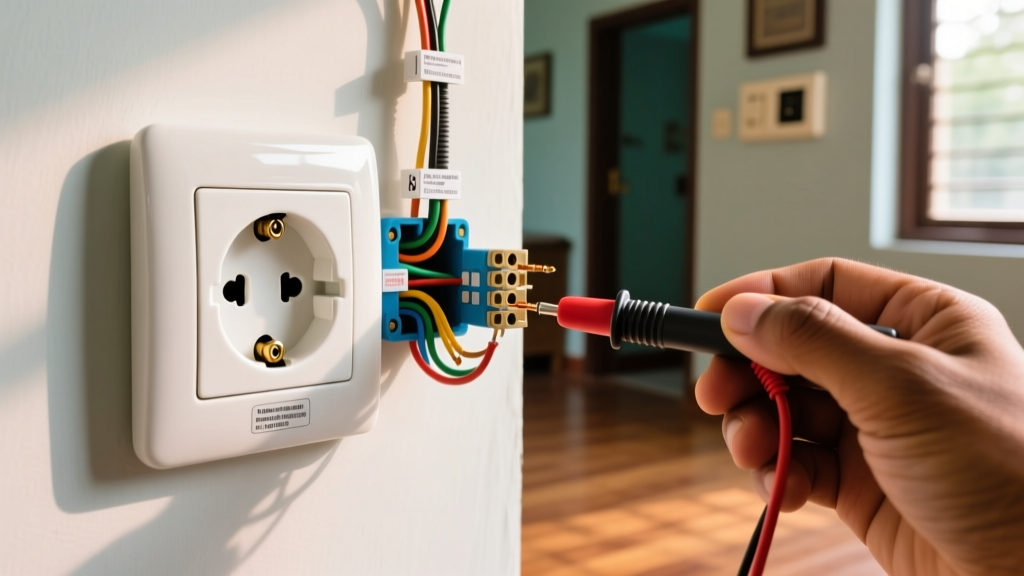
Insert the probes into the socket and record the following three measurements:
- Line to Neutral (L-N): Measures the supply voltage. Expected: 220V - 240V.
- Line to Earth (L-E): Verifies the earth path back to the source. Expected: 220V - 240V (usually 1V to 3V lower than L-N due to earth wire resistance).
- Neutral to Earth (N-E): The most critical diagnostic reading in Indian wiring. Expected: 0V to 2V.
Diagnostic Matrix for Indian Sockets
| Test Point | Expected Reading | Actual Reading | Probable Fault Condition |
|---|---|---|---|
| L - N | 230V | < 190V | Severe voltage drop; undersized wiring or overloaded distribution transformer. |
| L - E | 228V | 0V | Open Earth (missing earth wire) or broken earth pit connection. |
| N - E | < 2V | > 10V | Floating Neutral; unbalanced 3-phase loads or loose neutral at DB. |
| L - N | 230V | 0V (but L-E is 230V) | Open Neutral; neutral wire disconnected at the socket terminal. |
Deep Dive: Troubleshooting Common Indian Wiring Faults
The 'Floating Neutral' Phenomenon
In many Indian apartments, the Neutral-to-Earth (N-E) voltage reads anywhere from 15V to 40V. This is known as a floating neutral. It occurs because the neutral wire carries the unbalanced return current from the three-phase distribution system. If the neutral conductor is undersized, or if connections at the main panel are loose and oxidized, a voltage drop occurs across the neutral wire.
The Fix: This cannot be fixed at the socket level. An electrician must tighten all neutral links in the DB and check the main LT (Low Tension) panel in the building basement. Attempting to bond Neutral and Earth at the socket to 'fix' this is illegal and highly dangerous.
Bootleg Grounds (Neutral-Earth Jumper)
In older homes lacking a dedicated earth wire, some local electricians install a small jumper wire between the Neutral and Earth terminals inside the socket. This tricks a basic socket tester into showing a 'correct earth' reading. However, if the neutral wire breaks upstream, the metal chassis of any plugged-in appliance (like a washing machine) becomes live at 230V.
How to detect it: Turn off the MCB for the circuit. Set your multimeter to Continuity/Resistance mode. Measure between Neutral and Earth at the socket. If you read near 0 ohms, you have a bootleg ground. The earth wire must be pulled back to the DB.
Earthing Topologies: TT vs. TN-C-S
Understanding your building's earthing system is vital for accurate testing. For deeper technical specifications on earthing, refer to the Fluke India electrical testing resources and local CEA manuals.
- TT System (Common in independent houses): Relies on a local earth pit (often a copper-bonded rod driven into the soil, treated with bentonite clay and salt). The earth resistance must be less than 5 ohms. If your L-E voltage is low or fluctuating, the earth pit has likely dried out and requires chemical treatment and watering.
- TN-C-S System (Common in modern high-rises): The earth and neutral are combined in the utility supply and separated at the building's main intake. This provides a very low-impedance earth path, resulting in near-perfect 0V N-E readings and fast tripping of MCBs during short circuits.
When to Upgrade: Smart Outlets and USB-C Integration
If your inspection reveals that the socket is physically sound but outdated, consider upgrading to modern modular plates. Brands like Legrand (Artis series) and Anchor (Roma) now offer IS 1293 compliant sockets with integrated 65W USB-C Power Delivery (PD) and 18W USB-A QC 3.0 ports. These eliminate the need for bulky adapter bricks and feature built-in surge suppression (typically rated for 2.5kA), which is highly recommended for protecting sensitive electronics from the frequent switching surges on the Indian grid.
Final Safety Directive
Never bypass the 30mA RCCB to stop nuisance tripping. Nuisance tripping is a symptom of either a failing appliance, moisture ingress in an outdoor socket, or cumulative capacitive leakage from multiple SMPS (Switched-Mode Power Supplies). Isolate circuits one by one to find the fault rather than compromising your primary life-safety device.