
When working with residential or commercial electrical systems in Europe, understanding the specific standards of each country is non-negotiable. If you are tasked with verifying an electrical outlet in Germany, you are dealing with the Schuko (Type F) standard, operating at 230V/50Hz. Unlike North American NEMA or British BS 1363 systems, the German Schuko relies on lateral earthing clips rather than a dedicated earth pin, which introduces unique inspection criteria and failure modes.
This comprehensive 2026 inspection and testing guide details the exact protocols, tooling, and regulatory frameworks (DIN VDE) required to safely verify German 230V receptacles. Whether you are performing an initial verification on a new build or a recurring safety audit, this guide provides the actionable depth required for professional compliance.
Anatomy of the German Schuko (Type F) Receptacle
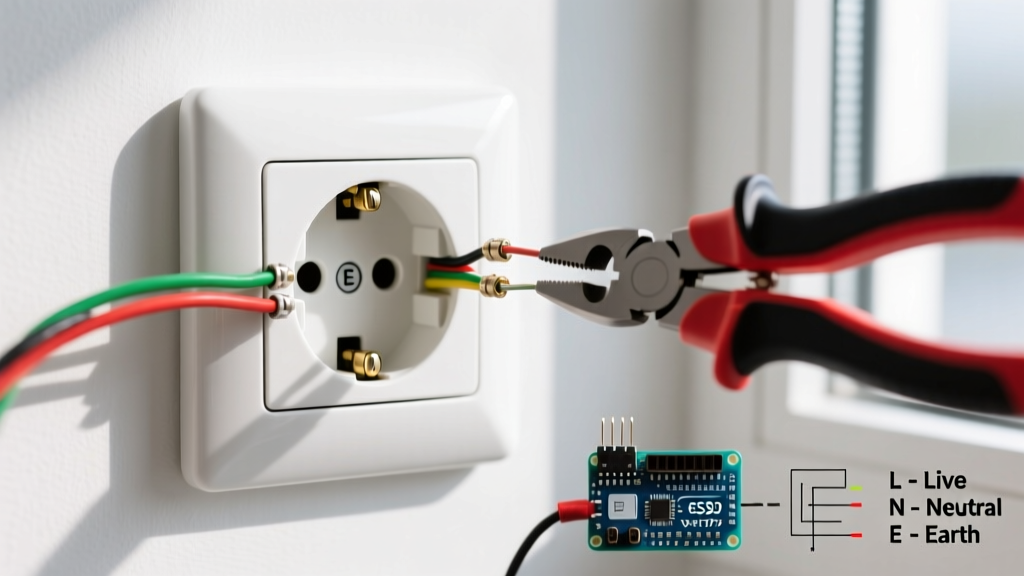
The standard electrical outlet in Germany is governed by the CEE 7/3 (socket) and CEE 7/4 (plug) specifications. Colloquially known as the 'Schuko' (short for Schutzkontakt, meaning protective contact), it features two 4.8mm diameter phase/neutral pins spaced 19mm apart, flanked by two lateral earthing clips.
| Feature | German Schuko (Type F) | US NEMA 5-15R | UK BS 1363 (Type G) |
|---|---|---|---|
| Nominal Voltage | 230V AC | 120V AC | 230V AC |
| Earth Mechanism | Lateral metal clips | Third round pin | Top rectangular pin |
| Pin Diameter (Plug) | 4.8 mm | Flat blades | Rectangular blades |
| Standard RCD Trip | 30mA (Type A or F) | 4-6mA (GFCI Class A) | 30mA (Type A) |
Required Testing Equipment for 2026 Compliance
To properly test an electrical outlet in Germany, a standard multimeter is insufficient. You must use a VDE-compliant Installation Tester (for fixed wiring) or a PAT Tester (for portable appliances). In 2026, the industry standard tools include:
- Fluke 1653B or 1654B Installation Tester: Priced between €1,300 and €1,800, these units automate loop impedance, RCD trip times, and polarity checks specifically calibrated for European TN-C-S and TT networks.
- Beha-Amprobe 93404: A highly popular German-market installation tester (approx. €1,100) that natively supports DIN VDE 0100-600 test sequences.
- Schuko Test Adapter (e.g., PCE-SH 5): Essential for accessing the lateral earth clips during loop impedance testing, as standard probe tips often fail to make reliable contact with the recessed side clips.
Step-by-Step Inspection and Testing Protocol
Testing an electrical outlet in Germany follows the strict sequence outlined in DIN VDE 0100-600 (Initial Verification) and DIN VDE 0105-100 (Operation of Electrical Installations). Skipping steps or performing live tests before dead tests is a severe safety violation.
Step 1: Visual Inspection (Sichtprüfung)
Before applying any test voltage, disconnect the circuit at the distribution board (Unterverteilung) and apply a lockout/tagout (LOTO) device.
- Faceplate Integrity: Check premium German brands like Gira, Jung, or Busch-Jaeger for UV degradation or micro-fractures around the 4.8mm pin entry holes.
- Terminal Torque: Remove the outlet from the flush-mounted box (Unterputzdose). Verify that the phase (L), neutral (N), and protective earth (PE) terminal screws are torqued to the manufacturer's specification—typically 0.5 Nm to 0.8 Nm for 2.5mm² solid copper conductors.
- Earth Clip Tension: Manually test the lateral earth clips. They must exhibit high spring tension to ensure a low-resistance bond with the plug's earth strips.
Step 2: Dead Testing (Pre-Energization)
With the circuit confirmed dead via a proven voltage indicator (Duspol):
- Continuity of Protective Conductors: Measure the resistance between the PE terminal of the outlet and the main earthing terminal (MET) at the distribution board. Acceptable values are typically < 0.5 Ω, depending on conductor length.
- Insulation Resistance: Apply 500V DC between L-PE and N-PE. The reading must exceed 1.0 MΩ (though modern XLPE/PVC cables often read > 200 MΩ). Any reading below 1.0 MΩ indicates degraded insulation or moisture ingress.
Step 3: Live Testing (Energized Verification)
Re-energize the circuit and use your installation tester with a Schuko adapter.
- Earth Loop Impedance (Ze and Zs): Measure the external loop impedance (Ze) at the board, and the total loop impedance (Zs) at the furthest outlet. For a standard 16A Type B MCB, Zs must be < 2.87 Ω (at 230V) to ensure magnetic tripping within 0.1 seconds.
- RCD Trip Testing: Germany mandates 30mA RCDs for all socket outlets (DIN VDE 0100-410). Test at 1x IΔn (must trip in < 300ms) and 5x IΔn (must trip in < 40ms). Test on both 0° and 180° phase angles.
- Polarity Check: Ensure the phase conductor is not swapped with the neutral. While Schuko plugs are reversible, reverse polarity at the fixed wiring level is dangerous if the installation feeds into single-pole switched appliances downstream.
2026 RCD Update: While Type A RCDs remain the standard for general household sockets, the proliferation of home EV chargers and smart appliances with frequency converters has driven a 2026 industry shift toward Type F (AC/DC sensitive) RCDs in German garages and utility rooms to prevent DC fault blinding.
Testing Smart and KNX-Integrated Schuko Outlets
In modern German smart homes, standard outlets are increasingly being replaced by KNX-integrated or Wi-Fi-enabled Schuko sockets (e.g., Gira X1 or MDT SCN-0616S). These outlets contain internal relays and power measurement ICs.
Crucial Testing Warning: Do NOT perform standard 500V DC insulation resistance tests on the load side of smart outlets without disconnecting the internal electronics. The high-voltage DC spike will instantly destroy the internal triac or relay switching components. Always isolate the smart module before conducting dead tests on the downstream wiring.
Common Failure Modes in German Outlets
Based on field data and E-Check Deutschland audit reports, the most frequent failures encountered when testing an electrical outlet in Germany include:
- Floating Earth (Schwebender Schutzleiter): The lateral earth clips lose tension over time or become coated in paint during renovations. This results in a high-impedance earth path, causing the RCD to fail to trip during a simulated fault.
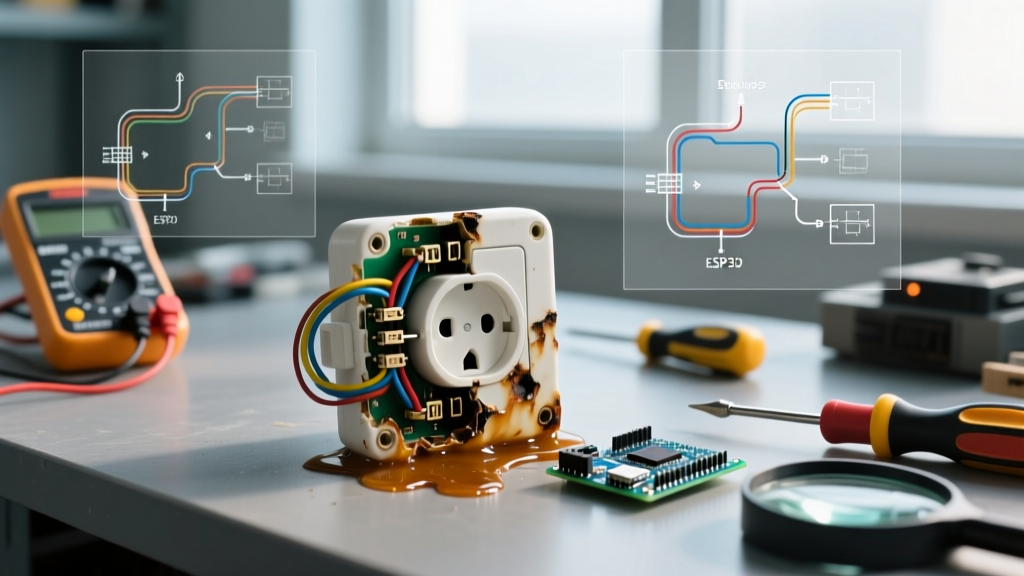
- Overheated Terminal Blocks: Using 1.5mm² wire on a 20A circuit (a code violation) or failing to strip the insulation cleanly, causing the screw to bite into the insulation rather than the copper. This creates a high-resistance joint that thermal imaging will easily flag at > 60°C under load.
- Crushed Flush-Mount Boxes: Older German installations often used ceramic or brittle Bakelite boxes. Overtightening the outlet's spreading claws (Krallen) can crack the box, compromising the mechanical stability and IP rating of the wall cavity.
Regulatory Compliance and the 'E-Check'
In Germany, electrical safety is heavily regulated by the VDE (Association for Electrical, Electronic & Information Technologies). While homeowners are not legally forced to test their own private outlets, landlords and commercial property managers are strictly liable under the DGUV Vorschrift 3 (formerly BGV A3) regulation.
To prove compliance, electricians perform the E-Check, a standardized inspection protocol that generates a legally binding certificate. The E-Check documentation must include:
- Measured loop impedance values for every circuit.
- RCD trip times (in milliseconds) for both half-wave and full-wave pulses.
- Visual defect logs with photographic evidence.
- A risk assessment matrix categorizing defects by urgency (e.g., 'Immediate Danger' vs. 'Recommendation').
Frequently Asked Questions
Can I use a US GFCI tester on a German outlet?
No. US testers are designed for 120V and rely on a dedicated ground pin to create a fault. They will not physically fit a Schuko outlet without a travel adapter, and even with an adapter, the internal fault-resistors are calibrated for 120V, meaning they will not generate the correct fault current to trip a 230V/30mA European RCD.
What is the acceptable earth loop impedance for a standard German socket?
While the absolute maximum depends on the specific MCB rating (e.g., < 2.87 Ω for a 16A Type B breaker), industry best practices recommend keeping Zs below 1.5 Ω to account for voltage fluctuations and temperature-induced resistance increases in the copper conductors.
Are child-proof shutters required in German outlets?
Unlike the UK (BS 1363), the German DIN VDE standards do not mandate integrated child-proof shutters (Kinderschutz) in standard Schuko faceplates. However, they are highly recommended and widely available as aftermarket inserts or factory-fitted options from brands like Jung and Berker.