
Bridging the Gap Between Wiring Diagrams and Physical Box Covers
When reviewing a standard wiring diagram for a 3-way switch, GFCI receptacle, or smart dimmer, the schematic meticulously details line, load, neutral, and ground routing. However, these 2D diagrams inherently ignore the Z-axis: the physical depth and spatial constraints dictated by the electrical outlet box cover and the underlying junction box. In 2026, as smart home devices and AFCI/GFCI combinations become bulkier, understanding the physical envelope of your wall plates and weatherproof covers is just as critical as understanding the circuit topology.
At ElectricalFlux, we treat the electrical outlet box cover not merely as a cosmetic finishing piece, but as a vital mechanical and code-compliant boundary. Whether you are installing a standard Leviton 80401 nylon wall plate or a heavy-duty TayMac ML500 in-use weatherproof cover, the dimensions, material composition, and NEC (National Electrical Code) mandates governing these covers dictate the success and safety of your installation.
NEC Article 314: Box Fill and Cover Depth Calculations
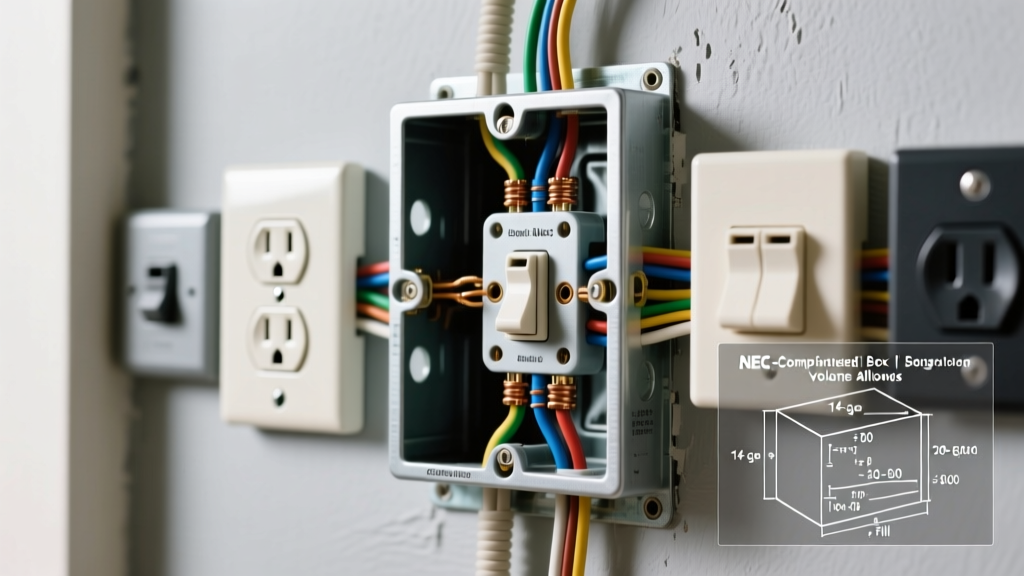
The most common failure point in residential wiring occurs when electricians or DIYers ignore box fill calculations. NFPA 70 (National Electrical Code) Article 314 outlines the strict volume requirements for outlet boxes. While the box itself provides the primary cubic inch volume, the electrical outlet box cover—specifically mud rings, plaster rings, and extension rings—directly alters the usable interior space and the physical depth available for wire bending.
NEC 314.19(A) Flush-Mounted Boxes: In finished walls, the front edge of the box (or the plaster ring/mud ring acting as the cover base) must not be set back more than 6 mm (1/4 inch) from the finished surface. This dictates the minimum thickness and offset of your cover hardware.
Below is a reference matrix correlating standard steel box sizes, their corresponding cover/mud ring depths, and the maximum allowable 12 AWG wire fill based on NEC Table 314.16(A).
| Box Type & Trade Size | Standard Cover / Mud Ring Depth | Total Usable Volume (Cubic Inches) | Max 12 AWG Wires (2.25 cu in each) | Ideal Application |
|---|---|---|---|---|
| 4 x 1-1/2 Square (109) | 1/2" Raised Plaster Ring | 25.5 cu in | 11 Wires | Standard single receptacle, basic smart switches |
| 4 x 2-1/8 Square (1900) | 1/2" Raised Plaster Ring | 34.5 cu in | 15 Wires | Deep junction splicing, bulky smart dimmers |
| 3 x 2 x 2-1/2 Device Box | Integral / Flush Wall Plate | 12.5 cu in | 5 Wires | Simple single-pole switch (no neutrals) |
| 4 x 4 Weatherproof Box | 2.75" In-Use Bubble Cover | 30.3 cu in + Cover Volume | 13 Wires | Exterior GFCI receptacles (NEMA 3R) |
The Smart Switch Depth Problem
Modern smart switches, such as the Lutron Caseta PD-6WCL or the GE Enbrighten Z-Wave Plus dimmer, require significant rear-box depth due to their internal relays and heat sinks. If your wiring diagram calls for a neutral wire (adding to the box fill count) and your electrical outlet box cover is a shallow, flat plate over a 1.5-inch deep box, the device will physically protrude, cracking the cover or bowing the drywall. Always pair deep 4x11/1900 boxes with raised plaster rings to accommodate these devices.
Wet Locations and NEC 406.9 In-Use Cover Mandates
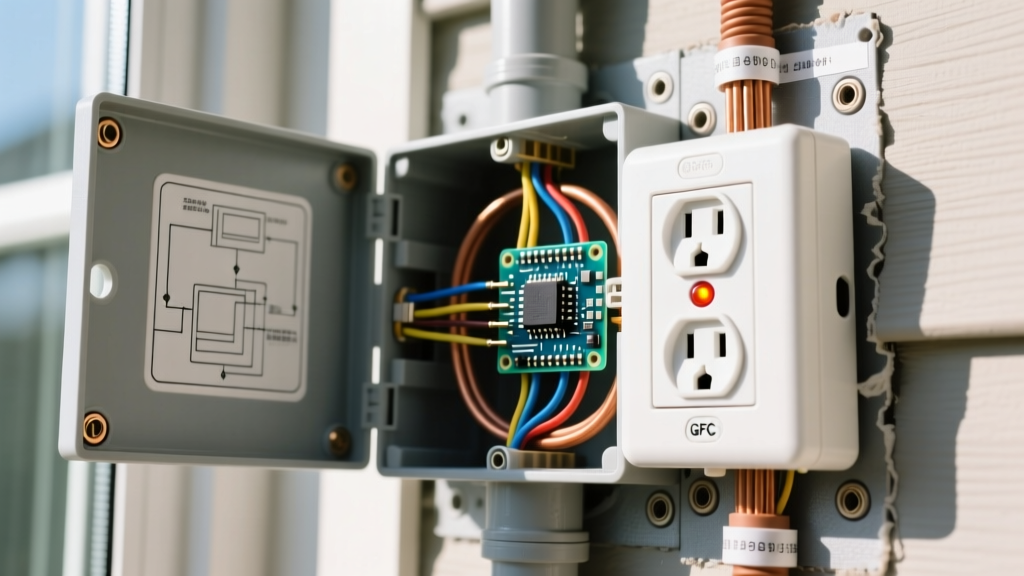
When your wiring diagram moves from the interior living space to the exterior envelope, the rules for the electrical outlet box cover change drastically. Under NEC 406.9(B)(1), all 15- and 20-ampere, 125- and 250-volt receptacles installed in damp or wet locations must be enclosed in a weatherproof enclosure that provides protection while the receptacle is in use (cord plugged in). This is universally known as an "in-use" or "bubble" cover.
Product Comparison: Standard vs. Extra-Deep In-Use Covers
Not all weatherproof electrical outlet box covers are created equal. The depth of the cover determines whether you can plug in a bulky transformer (like those used for landscape lighting or holiday displays) while maintaining the NEMA 3R weatherproof seal.
- TayMac ML500 (1-Gang In-Use): Priced around $14, this is the industry standard. It offers an interior depth of 2.75 inches. It easily accommodates standard GFCI receptacles and typical 3-prong plugs, but struggles with oversized power bricks.
- Hubbell XCEL XCH100 (Extra-Deep): Priced around $22-$26, this cover provides a massive 3.5-inch interior depth. It is specifically engineered for wet-location EV chargers, large outdoor power supplies, and heavy-duty extension cord connections.
Installation Pro-Tip: The foam gasket included with these covers is critical. A common failure mode is overtightening the four mounting screws, which permanently compresses and tears the foam gasket, breaking the weatherproof seal and allowing moisture to infiltrate the GFCI receptacle, leading to nuisance tripping. Torque the screws to just 10-12 inch-pounds to maintain gasket rebound.
Blank Electrical Outlet Box Covers for Junction Splicing
Wiring diagrams frequently utilize junction boxes to splice branch circuits, route feeders to subpanels, or transition from NM-B (Romex) cable to THHN in conduit. When a box is used strictly for splicing and contains no receptacles or switches, NEC 314.29 mandates that the box must remain "accessible." You cannot bury a junction box behind drywall or paneling.
To remain code-compliant, you must seal the box with a blank electrical outlet box cover. These are solid metal or polycarbonate plates with no device openings.
Selecting the Right Blank Cover
- 4-Inch Square Blank Covers (e.g., Raco 175): These feature knockout (KO) provisions. If your wiring diagram requires a cable clamp or a conduit connector entering directly through the face of the box rather than the sides, a KO blank cover is mandatory. Cost: $1.50 - $3.00.
- Solid Blank Covers (e.g., Steel City 700): These have no knockouts and are used when all conduits and cables enter through the sides or back of the box. They provide a cleaner look and higher structural integrity for heavy industrial applications. Cost: $2.00 - $4.50.
Troubleshooting Common Cover and Box Fitment Failures
Even with a perfect wiring diagram, physical installation errors can compromise the electrical outlet box cover. Here are the most frequent edge cases and failure modes we diagnose in the field:
1. Plaster Ring Misalignment and 'Bow-Tie' Gaps
If the underlying mud ring is mounted crookedly, a rigid thermoset nylon or metal wall plate will not sit flush against the drywall. Attempting to force the plate flat by overtightening the 6-32 mounting screws will result in a "bow-tie" gap (where the center touches but the corners lift) or, worse, a cracked plate. Solution: Use deep-cover jumbo wall plates (e.g., Leviton Midway or Jumbo sizes) which span a wider surface area and bridge minor drywall imperfections without requiring excessive screw torque.
2. Oversized Knockout Gaps on Blank Covers
When transitioning from a 4-inch square box to a single-gang device, electricians often use a 4-square-to-1-gang plaster ring. If the wiring diagram later changes and the device is removed, replacing it with a standard 1-gang blank cover leaves the outer edges of the 4-square box exposed. Solution: Always keep 4-inch square blank covers (Raco 174) on hand to properly seal the full footprint of the underlying box.
3. UV Degradation of Polycarbonate Exterior Covers
For exterior applications, using an interior-rated PVC or standard polycarbonate electrical outlet box cover will result in severe UV degradation within 18 to 24 months. The plastic becomes brittle, yellows, and shatters upon impact. Solution: Always specify die-cast aluminum or UV-stabilized polycarbonate (like the TayMac MX series) for any cover exposed to direct sunlight, ensuring compliance with OSHA and NFPA outdoor electrical safety standards.
Frequently Asked Questions (FAQ)
Can I use a metal wall plate on a plastic outlet box?
Yes, but you must ensure the device yoke (the metal strap holding the switch or receptacle) is properly grounded. The grounding path flows from the box, through the device yoke, to the metal plate. If using a plastic box, the device must be grounded via the equipment grounding conductor (EGC) pigtail, and the metal plate will ground through the device's mounting screws.
Do in-use weatherproof covers add to the box fill calculation?
No. NEC Table 314.16(A) calculates volume based on the box and integral plaster rings. The external volume of a weatherproof bubble cover does not count toward the internal wire fill allowance, as the wires do not occupy that external space.
What is the standard screw size for a 1-gang electrical outlet box cover?
The industry standard for 1-gang and 2-gang device wall plates is a 6-32 UNC machine screw, typically 1/2 inch or 3/4 inch in length, finished in ivory, white, or brown to match the plate. Blank covers for 4-inch square boxes typically use larger 8-32 or 10-24 screws depending on the manufacturer's tapped knockouts.