
Understanding the SNI Standards for Indonesian Outlets
When troubleshooting an Indonesia electrical outlet, you must first understand the local regulatory framework and physical standards. Indonesia operates on a 230V supply voltage and 50Hz frequency, governed by the PUIL 2011 (Persyaratan Umum Instalasi Listrik) standards and enforced by the BSN (Badan Standardisasi Nasional). Unlike North American 120V systems, the 230V single-phase power delivered by the state utility company, PLN (Perusahaan Listrik Negara), carries a significantly higher risk of arc flash and lethal shock during diagnosis.
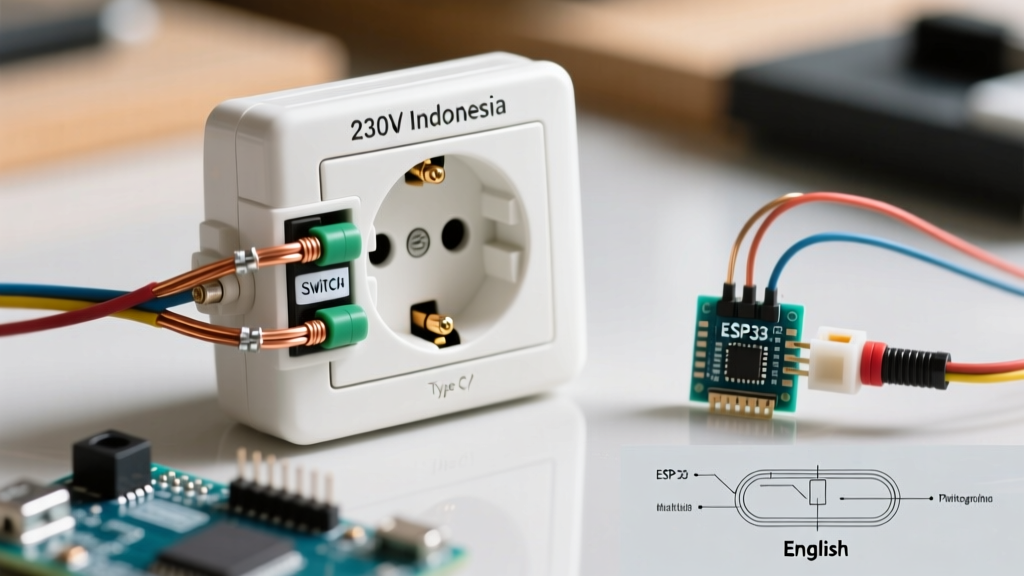
The vast majority of Indonesian homes and commercial spaces utilize two primary socket types. Identifying which type you are diagnosing is the critical first step in determining load capacity and grounding status.
| Feature | Type C (Europlug) | Type F (Schuko) |
|---|---|---|
| Pin Diameter | 4.0 mm | 4.8 mm |
| Max Current Rating | 2.5 Amps | 16 Amps |
| Grounding Mechanism | None (Ungrounded) | Side Earth Clips |
| Typical Applications | Phone chargers, LED lamps, routers | AC units, water heaters, PCs, microwaves |
| Physical Socket Depth | Shallow / Flush | Deep Recess (15mm) |
According to the IEC World Plugs database, Type F is the standard for high-draw appliances requiring an earth ground. However, a common diagnostic trap in Indonesia is finding Type F sockets installed on circuits where the wall box lacks a physical earth wire—a critical safety failure we will address below.
Diagnosing Common Indonesia Electrical Outlet Failures
1. Voltage Fluctuations and Brownouts
PLN grid stability varies drastically between major metropolitan areas like Jakarta and rural regions in Kalimantan or Sulawesi. The IEC 60038 standard dictates a tolerance of 230V ±10% (207V to 253V). If your appliances are resetting or power supplies are whining, you must verify the voltage at the receptacle.
- Under-Voltage (Below 207V): Often caused by overloaded neighborhood distribution transformers or undersized branch wiring (e.g., using 1.5mm² NYM cable on a 20A MCB). This causes excessive current draw on inductive loads like refrigerator compressors, leading to thermal overload.
- Over-Voltage (Above 253V): Usually indicates a failing neutral connection at the main distribution pole, causing phase-to-neutral voltage to spike toward phase-to-phase levels (400V). This will instantly destroy switching power supplies.
2. The 'Missing Ground' Hazard in Older Builds
In many Indonesian homes built before the early 2000s, installers frequently used 2-core NYM cables (Line and Neutral only) but installed Type F Schuko sockets to accommodate foreign appliances. This creates a false sense of security. When you plug in a grounded device, the side earth clips connect to a floating wire.
Expert Warning: Never assume a Type F socket in Indonesia is grounded simply because the physical receptacle has earth clips. Always verify Line-to-Earth voltage with a True RMS multimeter before connecting sensitive laboratory or medical equipment.
3. Thermal Degradation and Loose Schuko Contacts
A frequent failure mode involves the physical degradation of the 4.8mm pin receivers. High-draw appliances, such as 2000W instant water heaters (drawing roughly 8.7A continuous, with high inrush currents), cause cheap, non-SNI-certified outlets to overheat. Look for brown scorch marks or melted PVC around the pin entry holes. This indicates that the internal brass leaf springs have lost their tension, creating high-resistance contact points that generate excessive heat (I²R losses).
Essential Tools for 230V Troubleshooting
To safely diagnose an Indonesia electrical outlet, you need equipment rated for CAT III 600V or higher. Do not use cheap, unbranded digital multimeters, as they lack the internal blast shields and HRC fuses required for 230V mains troubleshooting.
- True RMS Multimeter: The Fluke 117 or Uni-T UT61E+. True RMS is necessary because grid distortion from neighboring solar inverters or industrial VFDs can skew average-responding meters.
- Non-Contact Voltage Tester (NCVT): Fluke 2AC II for verifying the presence of voltage before removing the faceplate.
- Receptacle Tester: A standard European 230V socket tester (with Schuko ground pins) to quickly identify reverse polarity or missing earth.
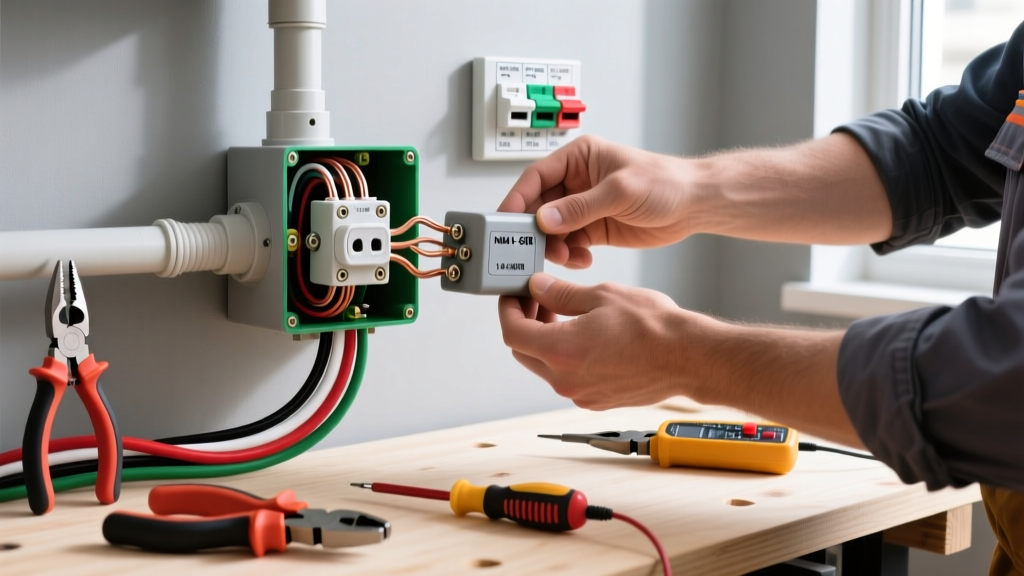
- Insulated Screwdrivers: VDE-certified 1000V flathead and Phillips drivers for terminal work.
Step-by-Step Diagnostic Protocol
Follow this exact sequence when an outlet is dead, tripping the ELCB (Earth Leakage Circuit Breaker), or exhibiting physical damage.
Phase 1: Dead Outlet Diagnosis
- Verify MCB Status: Check the main DP (Distribution Panel) box. If the specific MCB for the room has tripped, do not reset it immediately. A trip indicates a short circuit or severe overload.
- Test for Voltage: Insert the multimeter probes into the Line and Neutral holes. A reading of 0V confirms an open circuit upstream. A reading of 230V indicates the outlet is live, and the failure is likely a broken internal brass contact preventing the appliance pins from engaging.
- Isolate the Circuit: Turn off the MCB. Use the NCVT to confirm the absence of voltage.
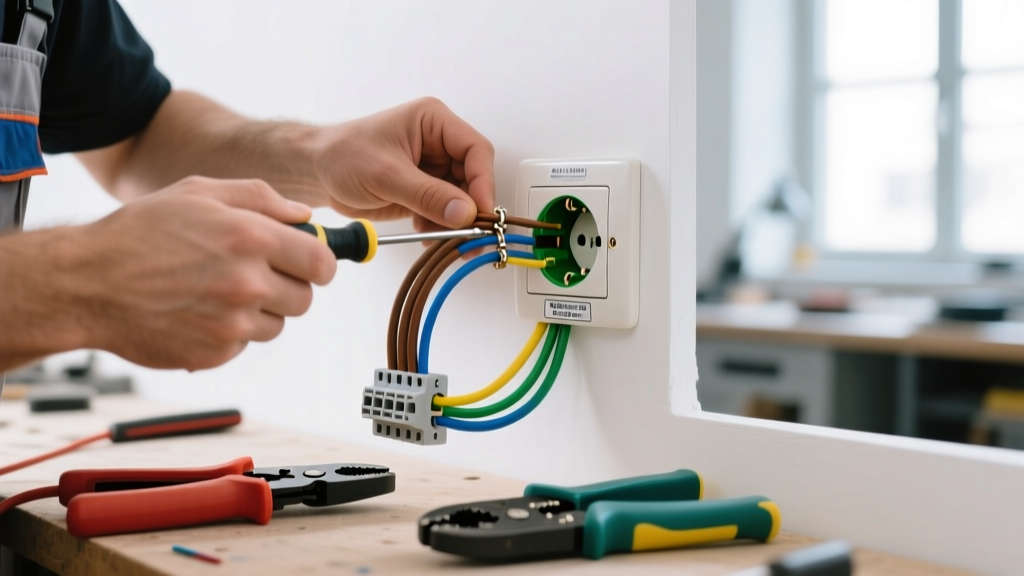
- Inspect Termination: Remove the faceplate. In Indonesia, wires are often looped through screw terminals rather than using wire nuts or Wago connectors. Check for backed-out screws or snapped 2.5mm² copper conductors caused by aggressive stripping.
Phase 2: Grounding Verification
As detailed in the World Standards Type F guide, the Schuko system relies on side clips for grounding. To verify the integrity of the earth path:
- Set multimeter to AC Voltage.
- Measure Line to Neutral: Should read ~225V - 235V.
- Measure Line to Earth (touching the side clip): Should read ~225V - 235V.
- Measure Neutral to Earth: Should read < 2.0V.
If Line-to-Earth reads 0V, the earth wire is disconnected. If Neutral-to-Earth reads >10V, you have a shared neutral/earth fault or a heavily overloaded neutral busbar in the main panel, requiring immediate intervention by a certified PUIL-licensed electrician.
When to Replace: Recommended SNI-Certified Brands
If you identify thermal damage, cracked faceplates, or loose pin retention, the outlet must be replaced. Do not use generic, unbranded outlets found in local hardware markets, as they often fail SNI pull-force and flammability tests. For reliable replacements, specify the following SNI-certified models:
| Brand & Model Series | Specific Model Number | Approx. Cost (IDR / USD) | Best Use Case |
|---|---|---|---|
| Panasonic WIDE21 | WEG1161 (16A Schuko) | 55,000 IDR / $3.50 | General residential, high durability |
| Schneider AvatarOn | E84T25/16/2 (16A) | 85,000 IDR / $5.50 | Premium builds, aesthetic focus |
| Broco | BS-16 (16A Grounded) | 35,000 IDR / $2.25 | Budget-friendly, basic compliance |
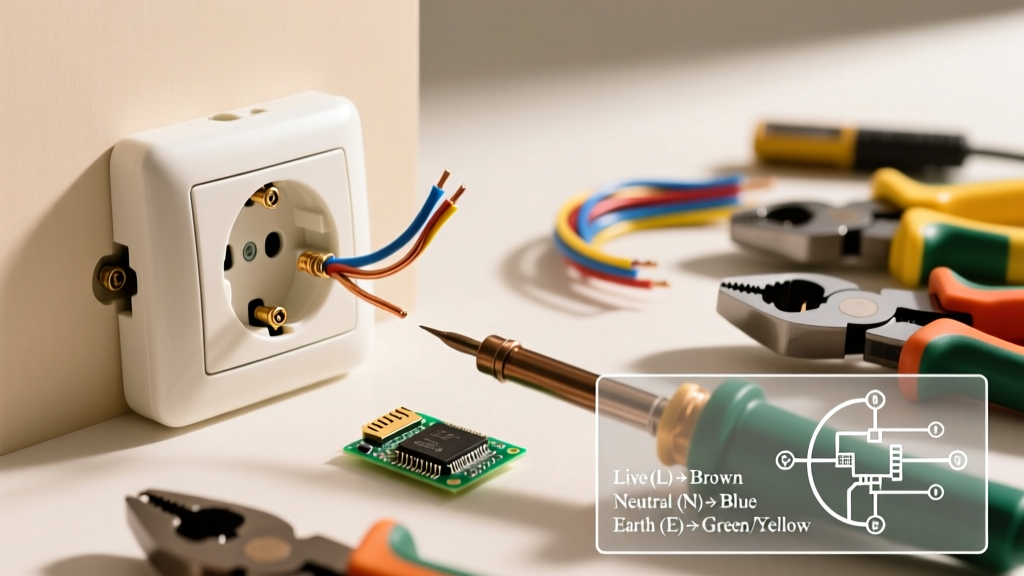
Installation Tip: When wiring a new 16A Type F outlet, ensure the Line (Phase) wire is connected to the correct terminal. While Schuko plugs are reversible, Indonesian PUIL standards dictate that the Line wire should ideally be routed to the right-hand pin when facing the socket, matching the standard color coding where Brown is Line, Blue is Neutral, and Yellow/Green is Earth.
Frequently Asked Questions
Can I use a US 120V appliance in an Indonesia electrical outlet?
No. Plugging a 120V North American appliance directly into a 230V Indonesian outlet will result in catastrophic failure, likely destroying the appliance's power supply and posing a severe fire hazard. You must use a step-down voltage transformer rated for at least 150% of the appliance's maximum wattage to handle inrush currents safely.
Why does my ELCB trip every time it rains?
This is a common issue in Indonesia due to high humidity and improper outdoor weatherproofing. If the tripping correlates with rain, moisture is likely infiltrating an outdoor receptacle or a poorly sealed junction box on the same circuit, creating a leakage path to ground that exceeds the ELCB's 30mA trip threshold. Inspect all exterior IP44-rated enclosures for degraded rubber gaskets.
Are universal multi-sockets safe for high-draw appliances?
Absolutely not. Universal sockets (which accept Type A, C, G, and I plugs) are largely banned under strict SNI interpretations because the internal contacts cannot maintain adequate clamping force on 4.8mm Schuko pins. Using them for air conditioners or water heaters guarantees localized heating and eventual melting. Always use dedicated Type F sockets for 16A loads.