
The Physics and Code Behind Electrical Outlet Amps
Understanding electrical outlet amps is the foundational baseline for any safe wiring project. Amperage measures the volume of electrical current flowing through a circuit. When current passes through the brass contacts of a receptacle and the copper wire, it encounters resistance. This resistance generates heat, governed by the formula P = I²R (Power loss equals current squared times resistance). If the outlet's amp rating is exceeded, the internal contacts overheat, the plastic faceplate warps, and arc faults become imminent.
The National Fire Protection Association (NFPA) outlines strict parameters for receptacle ratings in the National Electrical Code (NEC), specifically under Article 210.21. As of the 2026 NEC adoption cycle, inspectors are heavily scrutinizing not just the breaker size, but the exact torque applied to terminal screws and the matching of wire gauge to the receptacle's amp rating. This guide breaks down the exact tools, materials, and specifications required to match electrical outlet amps to your circuit safely.
Receptacle Amp Ratings: The NEMA Matrix
North American outlets follow NEMA (National Electrical Manufacturers Association) configurations. The physical shape of the slots dictates the amperage and voltage, preventing you from plugging a high-draw appliance into an under-rated circuit. Below is the definitive matrix for standard residential and light-commercial outlet amps.
| NEMA Config | Amp Rating | Voltage | Required Wire Gauge | Max Breaker Size | Common Applications |
|---|---|---|---|---|---|
| 5-15R | 15A | 125V | 14 AWG (Min) | 15A | Bedrooms, living rooms, lighting |
| 5-20R | 20A | 125V | 12 AWG (Min) | 20A | Kitchens, bathrooms, garages |
| 6-15R | 15A | 250V | 14 AWG (Min) | 15A | Small window AC units, heaters |
| 6-20R | 20A | 250V | 12 AWG (Min) | 20A | Large window ACs, commercial tools |
| 14-50R | 50A | 125/250V | 6 AWG Copper | 50A | EV chargers, electric ranges |
Material Selection: Outlets, Wire, and Breakers
15A vs 20A Receptacles: Physical and Material Differences
The most common point of failure in DIY wiring is confusing 15A and 20A receptacles. A standard 15A outlet (NEMA 5-15R) features two parallel vertical slots. A 20A outlet (NEMA 5-20R) features one vertical slot and one T-shaped horizontal slot. The T-slot allows specialized 20A plugs to enter, while still accepting standard 15A plugs.
- 15A Receptacle Example: Leviton Decora 15A (SKU: R52-05320-00W). Features standard brass terminal screws. Typical 2026 retail price: $1.80 - $2.50.
- 20A Receptacle Example: Leviton Decora 20A (SKU: R52-05362-00W). Features heavier internal brass contacts and a T-slot face. Typical 2026 retail price: $3.50 - $4.80.
Pro Tip: Never install a 20A receptacle on a 15A circuit. While it physically fits and the heavier contacts are safe, it misleads the user into thinking they can safely draw 20 amps from a circuit protected by only a 15A breaker and potentially wired with 14 AWG wire.
Wire Gauge and Insulation
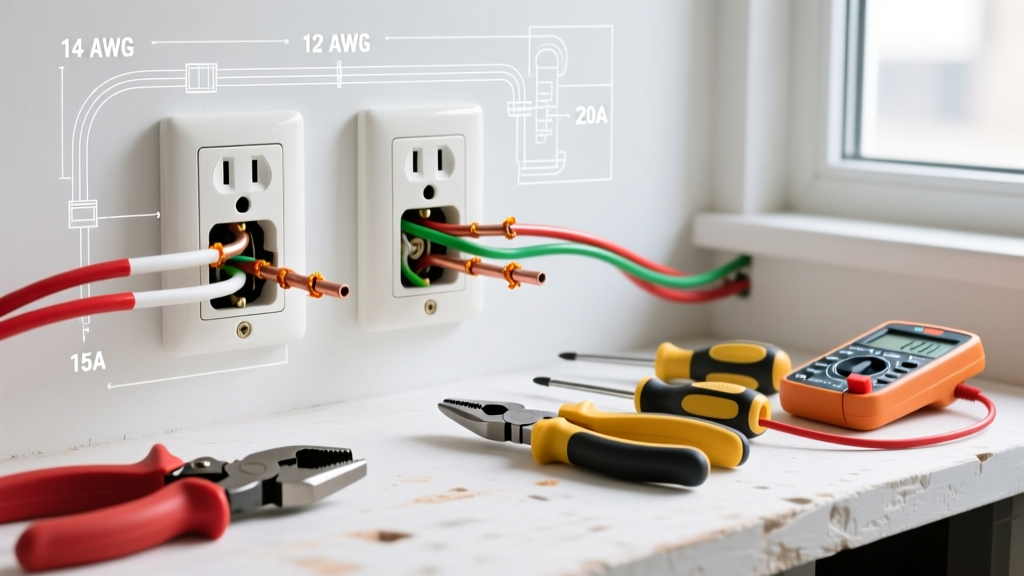
Matching electrical outlet amps to the correct wire gauge is non-negotiable. Copper pricing fluctuations in 2026 have made 12 AWG roughly 40% more expensive than 14 AWG, tempting some to undersize wire. Do not do this.
- 14 AWG NM-B (Romex): Rated for 15A maximum. Used exclusively with 15A breakers and 15A receptacles. Jacket color: White.
- 12 AWG NM-B (Romex): Rated for 20A maximum. Required for kitchen small-appliance circuits, bathrooms, and outdoor receptacles. Jacket color: Yellow.
- 10 AWG THHN: Used in conduit for 30A circuits (e.g., NEMA 10-30R for older dryers).
Essential Tools for Amp Verification and Installation
Properly terminating and verifying electrical outlet amps requires more than a standard screwdriver. Modern code compliance demands precision tools.
1. True-RMS Clamp Meters
To measure the actual amperage draw on a circuit without breaking the connection, a clamp meter is mandatory. The Fluke 323 True-RMS Clamp Meter (approx. $220) is the industry standard. It accurately measures up to 400A AC and includes a built-in non-contact voltage detector. For a budget alternative, the Klein Tools CL801 ($110) offers excellent accuracy for residential troubleshooting.
2. Calibrated Torque Screwdrivers
Under NEC 110.14(D), terminations must be torqued to the manufacturer's specified values using a calibrated tool. Hand-tightening outlet screws often leads to under-torquing (causing arcing and heat) or over-torquing (stripping the brass threads). Leviton specifies 14 in-lbs for their standard 15A and 20A receptacle terminal screws. The Klein Tools 32500 Series torque screwdriver set ensures exact compliance.
3. Advanced Receptacle Testers
Standard $10 plug-in testers only check for basic wiring faults. For modern circuits, use the Klein Tools RT250 ($45). It tests GFCI trip times, verifies proper grounding impedance, and features an LCD screen that displays exact fault conditions, ensuring your 20A bathroom outlets are actually protected.
Critical Failure Modes and Edge Cases
Even with the right materials, improper installation techniques lead to catastrophic failures. Watch for these specific edge cases:
The "Backstab" Push-In Connector Failure
Many 15A and 20A receptacles feature push-in holes on the back. These rely on a small internal spring-metal grip. Under continuous high-amp loads (like a 1500W space heater drawing 12.5A), thermal expansion and contraction cause the wire to creep out of the spring grip. This increases resistance, leading to localized melting. Always use the side terminal screws or the screw-and-clamp backwire mechanism for any circuit expected to carry near its maximum amp rating.
The 80% Continuous Load Rule
The NEC defines a continuous load as one that runs for 3 hours or more. For these loads, you must derate the circuit by 20%.
Example: A 20A circuit powering a server rack or a continuous-duty dehumidifier can only safely carry 16 amps continuously. If your device draws 18A continuously, you must upgrade to a 30A circuit with 10 AWG wire and a NEMA 5-30R receptacle.
Multi-Wire Branch Circuits (MWBC)
Kitchens often use MWBCs to supply two 20A circuits using a single 12/3 cable (sharing a neutral). If you are replacing outlets on an MWBC, you must break the hot-side brass fin tab to separate the two 120V legs. Failing to break this tab will result in a 240V dead short across the duplex outlet, instantly destroying the receptacle and tripping the breaker. Furthermore, the Occupational Safety and Health Administration (OSHA) and the NEC require simultaneous disconnect (a handle tie or 2-pole breaker) for MWBCs to prevent shock hazards from the shared neutral when servicing.
Frequently Asked Questions
Can I install a 15A outlet on a 20A circuit?
Yes. According to NEC Table 210.21(B)(3), 15A receptacles are explicitly permitted on 20A circuits, provided there is more than one receptacle on the circuit (a duplex outlet counts as two). This is standard practice in residential construction for kitchen and bathroom small-appliance circuits. However, you cannot install a single 15A receptacle on a 20A circuit; it must be a 20A rated outlet in that specific single-receptacle scenario.
Why do my 20A outlets keep tripping the breaker when I use my table saw?
Electric motors experience Locked Rotor Amperage (LRA) or inrush current, which can be 3 to 6 times higher than their running amps. A table saw rated at 15A running amps might pull 60A for a fraction of a second on startup. If your breaker is an older thermal-magnetic model, it may trip on the magnetic instantaneous curve. Upgrading to a modern breaker with a specialized high-magnetic trip curve (like the Eaton BR220HQC) can solve nuisance tripping without compromising safety.
What wire and outlet do I need for a Level 2 EV Charger?
Most residential Level 2 EV chargers require a 240V, 40A continuous load. Per the 80% rule, this requires a 50A breaker. You must use a NEMA 14-50R receptacle wired with 6 AWG copper THHN in conduit, or 6/3 NM-B cable. For detailed infrastructure guidelines, refer to the U.S. Department of Energy's Home EV Charging guide. Ensure the receptacle is torqued to 40 in-lbs (verify with manufacturer specs) to prevent the infamous 14-50R melting issue common in high-draw EV charging scenarios.