
Understanding the Hungary Electrical Outlet Ecosystem
When troubleshooting a Hungary electrical outlet, you are navigating a unique intersection of modern European standards and legacy Soviet-era infrastructure. Hungary operates on a standardized 230V supply voltage and 50Hz frequency. While modern constructions in Budapest, Debrecen, and Szeged adhere strictly to contemporary EU wiring codes, millions of residential units—particularly the ubiquitous Panelház (prefabricated concrete apartment blocks built between the 1960s and 1990s)—harbor outdated wiring topologies that pose severe diagnostic challenges.
According to data from World Standards, Hungary primarily utilizes Type C (ungrounded Europlug) and Type F (grounded Schuko) receptacles. However, the physical presence of a Schuko faceplate does not guarantee a functional earth ground. For electrical professionals and advanced DIYers, diagnosing a Hungary electrical outlet requires looking past the faceplate and understanding the historical wiring practices that define the country's residential grid.
Outlet Type Comparison Matrix
| Feature | Type C (Europlug) | Type F (Schuko) |
|---|---|---|
| Pin Configuration | Two round pins (4mm diameter) | Two round pins (4.8mm) + grounding clips |
| Grounding | None (Double Insulated only) | Yes (Side earth clips) |
| Common Locations | Older bathrooms, lighting circuits, legacy dry areas | Modern kitchens, living areas, high-draw appliance circuits |
| Max Current Rating | 2.5A (plug limit) | 16A (standard circuit breaker limit) |
The 'Nullázás' Hazard: Diagnosing Fake Grounds
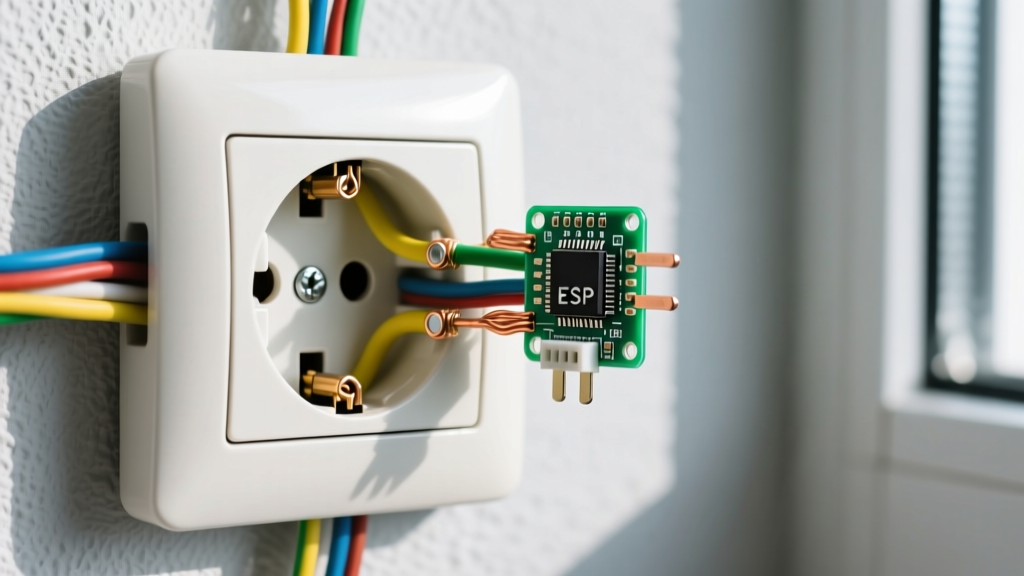
The most critical and dangerous anomaly you will encounter when inspecting a Hungary electrical outlet is a legacy practice known as nullázás (protective neutral bonding). In older Panelház buildings, a dedicated earth ground wire was rarely pulled through the conduit from the main distribution board. To provide a 'grounded' Schuko socket, electricians simply installed a jumper wire bridging the Neutral (N) and Protective Earth (PE) terminals directly at the back of the receptacle.
⚠️ CRITICAL SAFETY WARNING: A standard 3-prong plug-in socket tester will read 'Correct Wiring' on a nullázás outlet because it merely checks for voltage potential between N and PE. It cannot detect that they are the exact same wire. If the neutral wire breaks upstream, or if a fault causes the neutral to rise above ground potential, the metal chassis of your connected appliance becomes energized at a lethal 230V.
How to Diagnose Nullázás
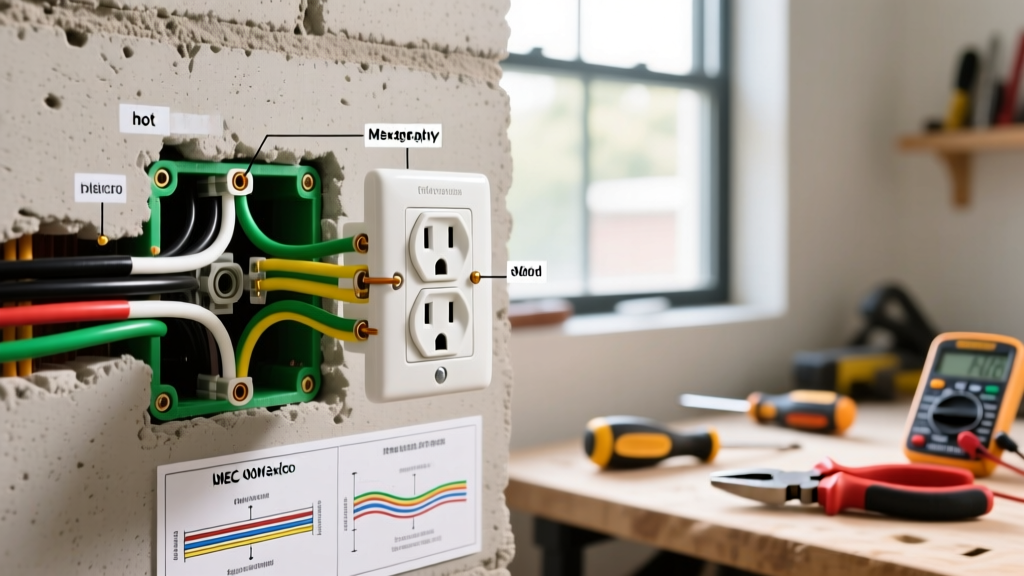
- Visual Inspection: Turn off the main breaker. Remove the socket faceplate. If you see a short copper jumper wire connecting the blue (neutral) terminal to the green/yellow (earth) terminal, you have identified nullázás.
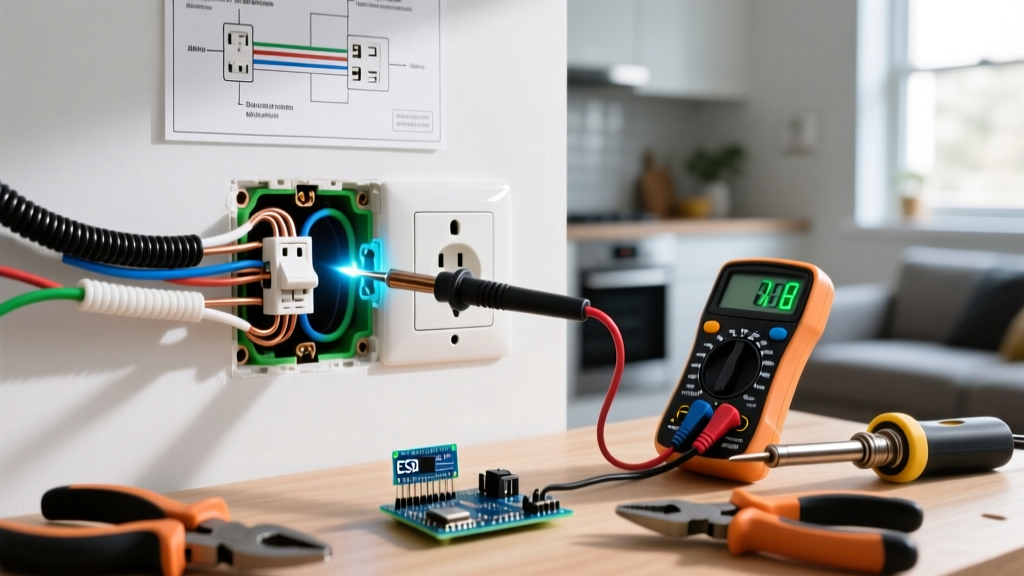
- Multimeter Continuity Test: With the power off and the socket disconnected from the wall wires, test for continuity between the incoming N and PE wires. If they are continuous back to the panel, the building lacks a true earth stake, and the outlet must be upgraded with a dedicated ground wire or replaced with a Type C socket paired with an RCBO (Residual Current Breaker with Overcurrent) for safety.
Troubleshooting Aluminum Wiring in Panelház Buildings
Most older Hungarian apartments utilize 2.5mm² or 4mm² solid aluminum conductors. Aluminum is highly susceptible to 'cold creep' (thermal expansion and contraction that loosens terminal screws over time) and rapid surface oxidation. When an aluminum wire oxidizes at the terminal connection, it creates a high-resistance joint, leading to localized heating, voltage drops, and eventually, melted socket housings or electrical fires.
According to guidelines published by the Hungarian Institute of Standardization (MSZT), modernizing these connections requires specific chemical and mechanical interventions. You cannot simply tighten oxidized aluminum screws; the oxide layer will crush but remain electrically resistive.
The WAGO Alu-Plus Solution
When replacing an old Bakelite socket with a modern Schuko receptacle, do not wrap aluminum wire around modern copper terminal screws. Instead, use the following protocol:
- Strip and Clean: Strip 11mm of insulation from the aluminum wire. Wipe away any visible white aluminum oxide powder.
- Apply Contact Paste: Inject WAGO Alu-Plus contact paste (Item No. 249-130) into a WAGO 221-413 lever connector. This paste chemically breaks down the oxide layer and prevents galvanic corrosion.
- Transition to Copper: Insert the aluminum wire into one side of the lever connector, and a short 2.5mm² copper pigtail into the other. Connect the copper pigtail to the new Schuko socket's terminal screws.
- Torque Verification: Use a calibrated torque screwdriver set to 1.2 Nm to secure the copper pigtail to the socket terminals, ensuring optimal clamping force without stripping the brass threads.
For a deeper technical breakdown on transition connections, refer to the WAGO Global aluminum cable connection guidelines.
Step-by-Step Diagnostic Protocol for Voltage Drop
If a Hungary electrical outlet is exhibiting signs of voltage drop (e.g., lights dimming when a microwave turns on, or smart home hubs rebooting), follow this diagnostic flow using a Fluke T6-1000 electrical tester:
- Baseline Measurement: Measure the voltage at the main distribution panel (L-N). It should read between 225V and 235V.
- Load Testing: Plug a known 2000W resistive load (like a space heater) into the suspect outlet. Measure the voltage at the outlet under load.
- Calculate Drop: If the voltage drops below 210V under load, you have a high-resistance fault. This is almost always caused by loose aluminum connections in the junction boxes (doboz) located near the ceiling, not the outlet itself.
- Junction Box Remediation: Open the ceiling junction boxes. Look for old ceramic terminal blocks or twisted-and-taped aluminum splices. Replace all splices with WAGO 221-614 connectors filled with Alu-Plus paste.
2026 Component Recommendations & Costs
When replacing faulty outlets, it is vital to use IP20-rated receptacles that fit standard Hungarian 65mm round flush-mounted backboxes. As of 2026, the most reliable and widely available brands in the Hungarian market include:
- Legrand Niloe (Type F): Features robust polycarbonate housing and deep recessed grounding clips. Price range: 1,800 - 2,200 HUF.
- Schneider Electric Asfora: Excellent for high-humidity areas like kitchens, featuring integrated child protection shutters that require high insertion force, reducing accidental contact. Price range: 2,100 - 2,600 HUF.
- Prodax Classic: A domestic Hungarian brand often used in budget renovations. While functional, the internal terminal clamps are less forgiving of aluminum pigtails than Legrand or Schneider. Price range: 900 - 1,300 HUF.
Frequently Asked Questions
Can I use a US 110V appliance in a Hungary electrical outlet?
No. Hungary operates on 230V/50Hz. Plugging a US 110V appliance directly into a Hungarian Schuko outlet will instantly destroy the appliance's power supply and may cause a fire. You must use a step-down voltage transformer rated for at least 150% of the appliance's wattage. Note that a simple plug adapter (Type A to Type F) does not convert voltage.
Why does my socket tester show an 'Open Ground' on a brand new Schuko outlet?
If you have installed a new outlet in a pre-1990 Panelház apartment, the building likely lacks a main earth wire. The previous 'ground' was achieved via nullázás. If you removed the neutral-earth jumper during your upgrade (which is the correct safety procedure), the socket tester will now correctly identify that there is no physical earth ground present. To fix this, an electrician must pull a new PE wire from a grounded distribution board, or you must rely on a 30mA RCBO breaker for shock protection.
Are Type C and Type F outlets interchangeable on the same wall plate?
Physically, yes. Modern European dual-gang and triple-gang frames (like the Legrand Valena Life series) allow you to mix Type C and Type F modules. However, from a diagnostic and safety standpoint, Type C modules should only be used on lighting circuits or for double-insulated (Class II) devices, whereas Type F modules must be used for any appliance requiring an earth ground (Class I devices like refrigerators or washing machines).