
The Lethal Reality of Water Intrusion in Receptacles
When a homeowner or facility manager encounters a water electrical outlet, the immediate risk extends far beyond a tripped breaker. Water intrusion creates a low-resistance path to ground, introducing severe electrocution hazards, arc flash potentials, and long-term corrosion that can cause high-resistance fires behind the drywall. As electrical systems evolve and local jurisdictions adopt the latest 2023 and 2026 National Electrical Code (NEC) cycles, the compliance requirements for outdoor, basement, and damp-location receptacles have become strictly enforced. This guide provides a professional-grade safety protocol, code-compliant remediation steps, and specific product recommendations to address wet outlets safely.
Phase 1: Emergency Response Protocol (First 15 Minutes)
If you discover water pooling around, dripping into, or splashing onto an active electrical outlet, do not attempt to unplug devices or touch the cover plate. Follow this strict isolation sequence:
- Isolate the Circuit: Go to the main service panel and switch off the specific breaker feeding the affected outlet. If the breaker panel is located in a wet area (like a flooded basement), wear rubber-soled boots and use a dry wooden stick or fiberglass ladder to avoid grounding yourself.
- Verify De-energization: Use a Non-Contact Voltage Tester (NCVT) such as the Fluke 2AC-II VoltAlert (retail ~$35). Test a known live circuit first to verify the tool is functioning, then test the wet outlet. NCVTs detect the capacitive coupling of the AC field; water can sometimes distort this field, so double-check with a multimeter once the receptacle is safely removed.
- Extract and Inspect: Remove the faceplate and unscrew the receptacle from the junction box. Pull the device out carefully to inspect the wire nuts, terminal screws, and the back of the box for standing water or moisture trails.
Expert Warning: Never use a standard hair dryer or heat gun on high heat to dry out an energized junction box. The localized heat can melt THHN/THWN wire insulation (rated for 90°C) and deform the polycarbonate housing of the receptacle, creating a secondary fire hazard.
Phase 2: NEC Code Compliance for Wet and Damp Locations
To prevent a water electrical outlet scenario from recurring, you must understand how the NEC categorizes moisture exposure. According to NFPA 70 (NEC) Article 100, locations are strictly defined:
- Damp Locations: Areas protected from weather and not subject to saturation with water, but subject to moderate degrees of moisture (e.g., under open canopies, roofed open porches, basements, and interior walls with chronic condensation).
- Wet Locations: Installations underground, in concrete slabs, or exposed to weather, rain, and washing down (e.g., exterior walls without overhangs, garden walls, and car wash bays).
Mandatory GFCI Protection (NEC 210.8)
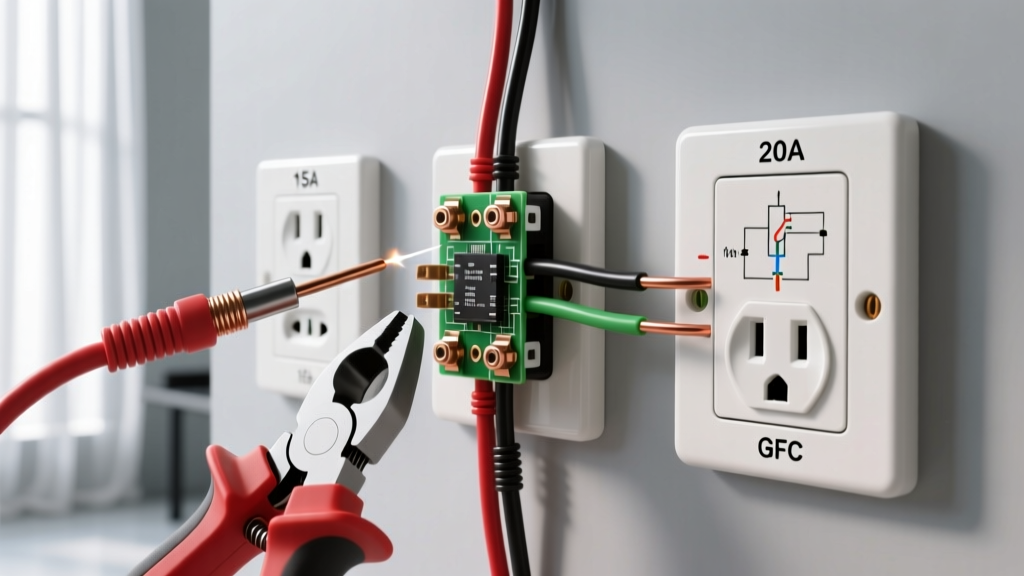
The NEC mandates Ground Fault Circuit Interrupter (GFCI) protection for all 125-volt through 250-volt, single-phase, 15- and 20-ampere receptacles in wet and damp locations. A Class A GFCI device monitors the current differential between the hot and neutral conductors. If water creates a leakage path to ground and the differential reaches the 4mA to 6mA threshold, the internal solenoid trips the circuit in under 25 milliseconds, preventing lethal ventricular fibrillation. For comprehensive safety standards on these devices, refer to the Electrical Safety Foundation International (ESFI) guidelines on GFCIs.
Weatherproof Enclosures and Covers (NEC 406.9)
NEC 406.9(A) requires that receptacles in damp locations be protected by a weatherproof cover plate. However, NEC 406.9(B) dictates that receptacles in wet locations must be enclosed in a weatherproof enclosure that provides protection whether or not a plug is inserted (commonly known as an 'in-use' or 'bubble' cover). Standard flat, flip-lid covers are no longer code-compliant for wet locations if a cord is left plugged in.
Phase 3: Product Selection and Upgrades
When replacing a compromised water electrical outlet, standard indoor receptacles will fail prematurely due to internal brass corrosion. You must specify Weather-Resistant (WR) rated devices. Look for the 'WR' stamp on the strap and the UV-resistant polycarbonate face.
Recommended Code-Compliant Hardware
- Leviton 8599-0W0 GFCI Receptacle (WR Rated): Priced between $18 and $24, this 20A tamper-resistant GFCI features UV-resistant materials and nickel-plated brass terminals specifically designed to resist the green patina (verdigris) caused by water oxidation.
- Taymac MX850W Weatherproof In-Use Cover: Retailing for $12 to $15, this extra-duty, non-metallic bubble cover provides 2-3/4 inches of depth, accommodating bulky AC adapters and smart plugs while maintaining a watertight seal via a closed-cell foam gasket.
- Hubbell SystemOne Weatherproof Box: For new masonry or stucco installations, this die-cast aluminum box ($35-$45) features sealed conduit hubs and a powder-coated finish that prevents the galvanic corrosion seen in cheap zinc-alloy boxes.
Phase 4: Failure Modes and Diagnostics Matrix
Water intrusion does not always cause an immediate short circuit. Often, it creates insidious, high-resistance faults that manifest over weeks. Use the following diagnostic matrix to identify the root cause of your water electrical outlet issues.
| Symptom | Underlying Failure Mode | NEC Code Fix & Remediation |
|---|---|---|
| GFCI trips randomly during rainstorms, but resets fine when dry. | Moisture wicking into the conduit or junction box, creating a micro-leakage path (2-3mA) that spikes above 5mA when humidity peaks. | Seal all conduit fittings with silicone. Install an 'in-use' bubble cover per NEC 406.9(B). Ensure the box weep holes are facing down. |
| Breaker won't trip, but outlet feels warm and smells like ozone/fish. | Water caused corrosion on the hot terminal screw, increasing contact resistance. High resistance generates heat (I²R losses) without drawing enough current to trip a 20A breaker. | Replace the receptacle immediately. Cut back corroded wire to clean copper. Use WR-rated device per NEC 406.4(D). |
| Voltage reads 120V on multimeter, but devices fail to power on. | 'Phantom voltage' caused by water bridging the hot wire to a high-resistance ground path, collapsing the voltage under load. | Trace the circuit. Water may have compromised a wire nut splice upstream in the conduit. Dry and re-terminate using gel-filled wire nuts. |
Phase 5: Advanced Remediation and Drying Techniques
If water has entered the electrical conduit or the wall cavity behind the junction box, simply wiping the receptacle dry is insufficient. Water exhibits capillary action, traveling inches or even feet up the strands of stranded wire or beneath the jacket of solid Romex (NM-B) cable.
The 48-Hour Drying Protocol
- Air Circulation: Leave the junction box open and position a standard oscillating fan to blow ambient-temperature air directly into the box for 48 hours.
- Desiccant Application: For enclosed conduit runs where airflow is restricted, electricians utilize specialized desiccant packs or dry nitrogen purging to displace moisture. For DIYers, packing the open box temporarily with silica gel packets (sealed in a permeable mesh) can draw out ambient dampness.
- Dielectric Grease Application: Once 100% dry, apply a small amount of dielectric grease (e.g., MG Chemicals Silicone Thermal Compound) to the terminal screws and wire connections. This hydrophobic barrier repels future condensation without interfering with electrical conductivity.
Workplace Safety and Professional Standards
For commercial facilities or property managers dealing with exterior water electrical outlets, adherence to OSHA electrical safety standards is mandatory. OSHA requires that all electrical equipment be installed and maintained in a manner that protects employees from shock and electrocution. This includes routine thermal imaging inspections of exterior receptacles to detect high-resistance corrosion before it results in an arc flash event. If your facility utilizes pressure washers near exterior outlets, NEC Article 511 (Commercial Garages and Washing Facilities) or general wet-location mandates require all receptacles to be GFCI protected and fitted with heavy-duty, industrial-grade gasketed in-use covers.
Final Verdict: Replace, Don't Just Dry
While a completely dry, uncontaminated junction box can be returned to service, any water electrical outlet that has suffered prolonged exposure, mineral deposits from hard water, or visible green/white corrosion on the brass terminals must be replaced. The cost of a $22 WR-rated GFCI is negligible compared to the life-safety risks of a compromised ground fault protection mechanism. Always verify your local jurisdiction's adoption of the latest NEC code cycles, and when in doubt, consult a licensed electrical contractor to perform a megger test on the branch circuit to ensure the wire insulation integrity has not been compromised by water intrusion.