
Understanding the Greece Electrical Outlet Standard
When working with a Greece electrical outlet, you are interacting with the standard European 230V, 50Hz AC system. Greece primarily utilizes two plug and socket types: Type C (the ungrounded Europlug) and Type F (the grounded Schuko). For any permanent residential or commercial installation in 2026, the Type F Schuko receptacle is the mandatory standard for power circuits, governed locally by the HD 384 standard, which is the Hellenic harmonization of the international IEC 60364 framework.
While Type C sockets are sometimes found in older lighting circuits or low-draw applications, modern electrical codes strictly require grounded Type F outlets for general-purpose receptacles. This tutorial will guide you through the safe installation and wiring of a modern Type F Schuko receptacle, addressing specific regional quirks you might encounter in Greek infrastructure.
Tools and Materials for a Modern Schuko Installation
Working with 230V systems requires precision and insulated tools. Do not use standard hardware store screwdrivers; ensure your tools are VDE-certified for at least 1000V.
- Receptacle: Schneider Electric Odace or Legrand Niloe Type F Schuko (16A, 250V).
- Voltage Tester: Fluke 1AC-II VoltAlert or a trusted CAT III multimeter.
- Wire Strippers: Knipex MultiStrip 10 (set to 1.5mm² or 2.5mm²).
- Connectors: WAGO 221 lever nuts (for junction box splices) or bootlace ferrules (if terminating stranded wire directly into screw terminals).
- Screwdrivers: VDE-insulated Pozidriv #1 and #2, and a flathead for terminal screws.
Standard Greek & European Wire Color Codes
Before touching any conductors, you must understand the harmonized European color codes, which are strictly enforced in modern Greek electrical panels. Older installations (pre-2006) may feature legacy colors, but your new wiring must adhere to the current standard.
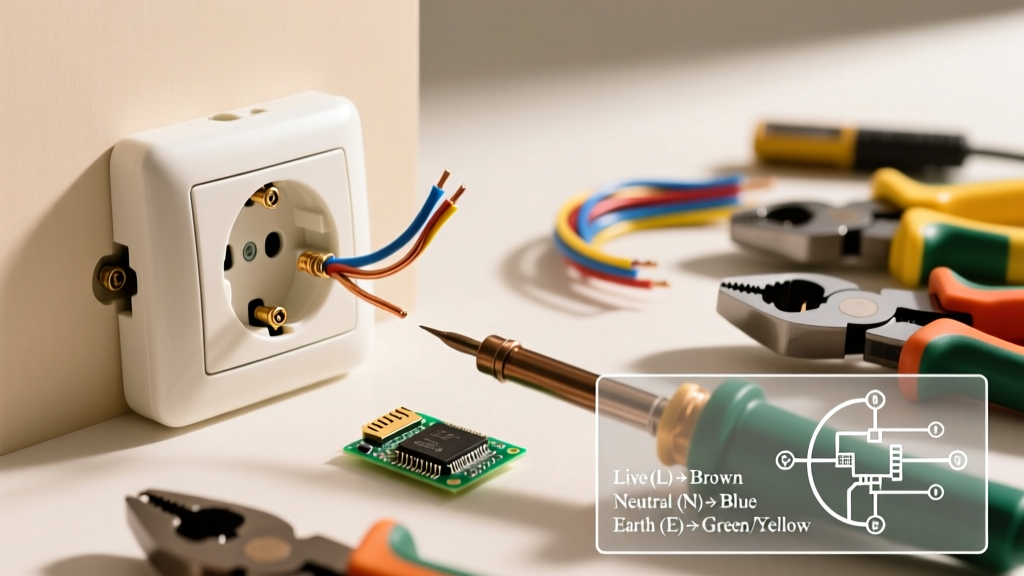
| Function | Current EU/Greece Color (Post-2006) | Legacy Greek Color (Pre-2006) | Terminal Marking |
|---|---|---|---|
| Phase / Line (Live) | Brown | Black or Red | L |
| Neutral | Blue | Grey or Light Blue | N |
| Protective Earth (Ground) | Green / Yellow Stripe | Bare Copper or Green | ⏚ (Earth Symbol) |
Step-by-Step Installation Tutorial
Step 1: Isolate the Circuit and Verify
Locate your main distribution board (known locally as the pinakas). Switch off the specific miniature circuit breaker (MCB) governing the room's sockets. In Greece, this is typically a 16A C-curve breaker for 2.5mm² socket circuits. After flipping the breaker, use your non-contact voltage tester on an existing outlet on the same circuit to verify the power is dead. Always test the tester on a known live source first to ensure the battery is functional.
Step 2: Prepare the Backbox and Conductors
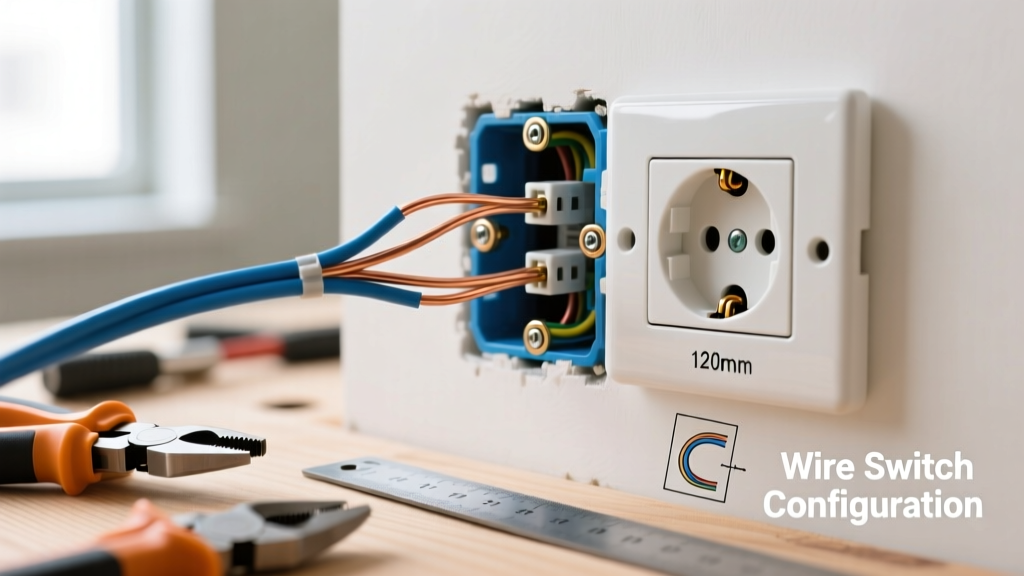
Remove the faceplate of the old outlet. Greek walls are typically masonry or plasterboard, utilizing standard 60mm diameter European flush-mount backboxes. Extract the wires carefully. Using your Knipex strippers, strip exactly 12mm of insulation from the Brown, Blue, and Green/Yellow wires. If the wires are stranded (flexible), crimp a 1.5mm² or 2.5mm² copper bootlace ferrule onto the ends to prevent fraying and ensure a solid connection under the terminal screws.
Step 3: Terminate the Connections
Identify the terminals on the back of your Type F Schuko receptacle. Unlike US outlets, Schuko terminals are often recessed or utilize specific screw-clamp mechanisms.
- Insert the Green/Yellow (Earth) wire into the central terminal marked with the ⏚ symbol. Tighten to approximately 1.2 Nm. The earth connection is critical; it connects to the two metal grounding clips on the top and bottom edges of the socket face.
- Insert the Blue (Neutral) wire into the terminal marked N.
- Insert the Brown (Live) wire into the terminal marked L.
Pro Tip: While European AC alternates and polarity technically swaps 50 times a second, modern Greek electrical inspectors enforce strict L/N polarity for safety and to ensure single-pole switches break the live conductor. Always match Brown to L and Blue to N.
Step 4: Mount and Secure the Receptacle
Fold the wires neatly into the backbox using a zigzag pattern—never force them, as pinched insulation against the metal mounting brackets can cause a short circuit. Align the receptacle claws (or use the dedicated M3.5 mounting screws if your backbox has threaded inserts, which is highly recommended for tiled walls). Tighten the mounting screws evenly until the faceplate sits flush against the wall.
Edge Case: The 'Missing Earth' Problem in Older Greek Buildings
If you are renovating an apartment in Athens, Thessaloniki, or Patras built before the late 1980s, you may open the backbox to find only two wires (Brown/Black and Blue/Grey) and absolutely no earth wire.
Never 'bootleg' a ground by jumping the neutral terminal to the earth terminal. This is incredibly dangerous; if the neutral wire disconnects upstream, the metal casing of any plugged-in appliance will become energized at 230V.
The 2026 Compliant Solution: If you cannot pull a new 3-core cable back to the panel, you must install a standard ungrounded socket (Type C) or, preferably, rely on the mandatory RCCB (Residual Current Circuit Breaker, or Antireumatiko in Greek) in the main panel. The RCCB will trip within 30 milliseconds if it detects a leakage current through a human body, providing life-saving protection even without a physical earth wire. However, upgrading the wiring to include a dedicated PE (Protective Earth) conductor is the only fully code-compliant permanent fix.
Troubleshooting Common Installation Errors
The RCCB Trips Immediately Upon Energizing
If the main 30mA RCCB trips the moment you turn the breaker back on, you likely have a ground fault. Check that no bare copper from the Brown or Blue wires is touching the metal backbox or the Earth terminal. In damp areas (like Greek bathrooms or outdoor terraces), ensure the IP44-rated weather flaps are sealed properly to prevent moisture ingress.
Loose Connections and Thermal Runaway
Greek summers can push ambient indoor temperatures above 35°C (95°F). A loose terminal screw on a 16A circuit will generate excessive heat, melting the Schuko faceplate. Always perform a 'tug test' on every wire after tightening the terminal screw, and ensure no bare copper is exposed outside the terminal housing.
Summary
Installing a Greece electrical outlet requires adherence to European 230V safety standards, proper wire preparation, and an understanding of local infrastructure quirks. By utilizing VDE-insulated tools, respecting the HD 384 color codes, and addressing missing ground wires safely via RCCB protection, you ensure a robust and safe electrical system. For further reading on international plug configurations and safety directives, consult the World Standards Type F guide and the EU Low Voltage Directive.