
Understanding the Ghana Electrical Outlet Standard
If you are upgrading your home's electrical infrastructure or adding a new appliance circuit, understanding the local standards is critical. The standard Ghana electrical outlet follows the British BS 1363 specification (Type G). This system operates on a 230V supply voltage with a 50Hz frequency and features a 13-ampere (13A) switched socket outlet with integrated safety shutters. According to the Energy Commission of Ghana, all electrical installations must adhere to strict safety codes heavily based on the IET Wiring Regulations (BS 7671) to prevent fire hazards and electric shocks.
For beginners, installing a 13A switched socket might seem intimidating, but with the right tools, precise measurements, and a methodical approach, it is a highly manageable DIY project. This tutorial will walk you through wiring a single 13A Ghana electrical outlet on a 2.5mm² radial circuit.
Essential Tools and Materials for the Job
Before touching any wires, gather the correct materials. In 2026, high-quality electrical components are readily available in major hubs like Accra and Kumasi. Expect to pay between 120 GHS and 250 GHS ($10–$20 USD) for a premium socket.
Recommended Hardware
- Socket Outlet: Schneider Electric Zenceli or MK Logic Plus 13A Switched Socket (Type G).
- Cable: 2.5mm² Twin and Earth PVC insulated cable (Solid core).
- Backbox: 35mm deep galvanized steel or heavy-duty PVC flush-mount backbox.
- Earth Sleeve: Green/Yellow PVC sleaving (mandatory for exposed earth wires).
Required Tools
- Voltage Indicator and Proving Unit (e.g., Fluke 2T or Martindale VI-138).
- VDE Insulated Screwdrivers (Flathead and Pozidriv #2).
- Wire strippers calibrated for 2.5mm² and 1.5mm² conductors.
- Digital Multimeter for post-installation testing.
Safety Warning: Never rely solely on a standard multimeter to verify a dead circuit. Always use a dedicated, GS38-compliant voltage indicator to test for the presence of voltage before and after isolation.
Step-by-Step Installation Guide
Step 1: Isolate the Circuit and Verify
Navigate to your main Distribution Board (DB). Identify the Miniature Circuit Breaker (MCB) or RCBO controlling the specific socket circuit you are working on. Switch it to the OFF position. Apply a lockout/tagout device if possible. Use your voltage indicator to test the existing socket or wires at the work location to confirm the circuit is completely dead.
Step 2: Prepare the 2.5mm² Twin and Earth Cable
Route the 2.5mm² cable into the 35mm backbox, leaving about 150mm of working length protruding from the wall. Strip the outer grey PVC sheath back to the point where the cable enters the backbox. Never leave the outer sheath inside the backbox, as it reduces the physical space and can trap heat.
Next, strip the individual conductor insulation. The precise stripping length is critical: remove exactly 15mm of insulation from the Brown (Live) and Blue (Neutral) wires. For the bare Earth wire, slide a continuous Green/Yellow PVC sleeve over the entire exposed length, right up to the terminal block.
Step 3: Terminate the Conductors
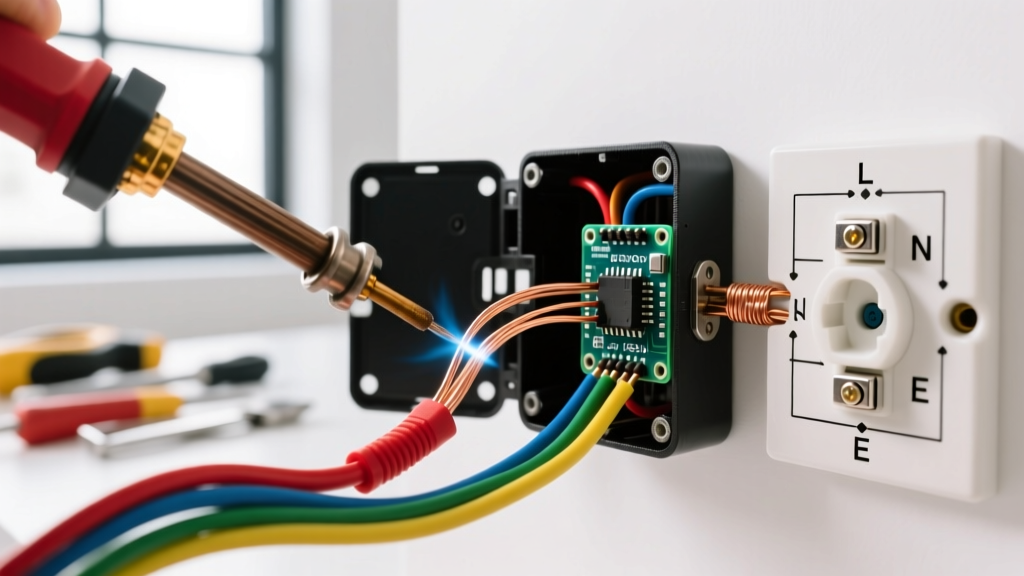
Turn the socket mechanism face down. You will see three terminal groups. The wiring configuration for a standard Ghana electrical outlet (looking at the rear of the mechanism) is as follows:
- Earth (E): Top center terminal. Insert the sleeved Green/Yellow wire.
- Neutral (N): Left side terminal (usually marked with a blue indicator or 'N'). Insert the Blue wire.
- Live (L): Right side terminal (usually marked with a brown indicator or 'L'). Insert the Brown wire.
Ensure no bare copper is visible outside the terminal blocks, and no insulation is trapped inside the brass clamps. Tighten the terminal screws to approximately 1.5 Nm to 2.0 Nm. Give each wire a firm tug to ensure it is mechanically secure.
Step 4: Mount and Secure the Faceplate
Carefully fold the wires into the 35mm backbox. Ensure the earth wire is pushed to the back to avoid being pinched by the faceplate screws. Align the socket faceplate with the mounting lugs and drive the two M3.5 machine screws home. Do not overtighten, as this can warp the plastic faceplate or crack the plaster around the backbox.
Circuit Design: Sizing and Breaker Configurations
When adding a new Ghana electrical outlet, it must be protected by the correct breaker at the distribution board. The Energy Commission of Ghana strictly enforces overcurrent protection limits to prevent cable melting and electrical fires. Refer to the table below for standard configurations:
| Circuit Type | Cable Size | MCB Rating | Maximum Floor Area |
|---|---|---|---|
| Radial Circuit | 2.5mm² | 20A (Type B or C) | 50 m² |
| Radial Circuit | 4.0mm² | 32A (Type B or C) | 75 m² |
| Ring Final Circuit | 2.5mm² | 32A (Type B or C) | 100 m² |
Testing and Commissioning
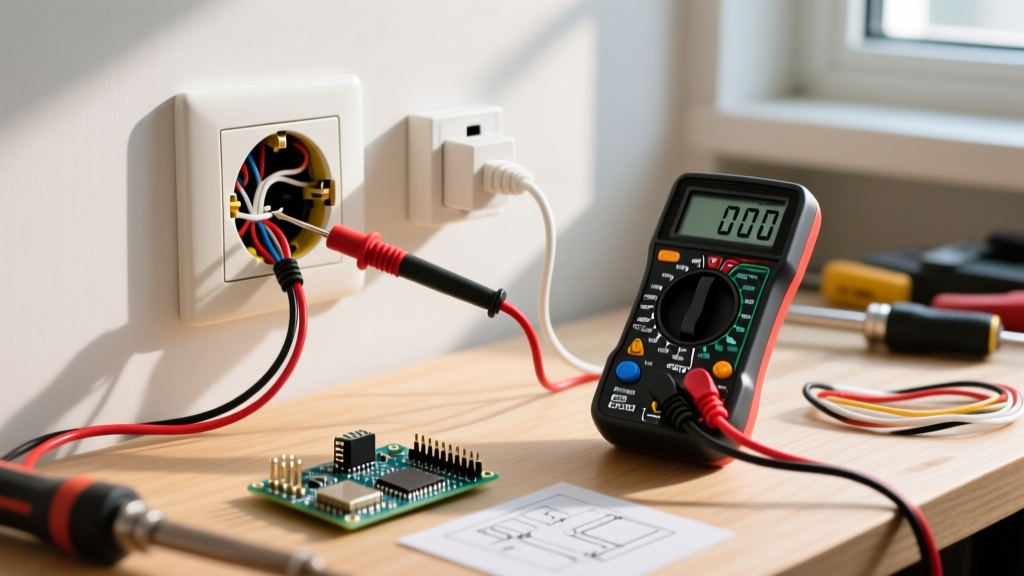
Once the socket is physically installed, restore power at the DB. Use a digital multimeter set to AC Voltage (V~) to verify the wiring integrity at the new outlet:
- Live to Neutral (L-N): Should read between 220V and 240V (Nominal 230V ±10%).
- Live to Earth (L-E): Should read between 220V and 240V.
- Neutral to Earth (N-E): Should read less than 2V (ideally 0.5V or lower).
If L-E reads 0V, you have a broken earth connection. If N-E reads high (e.g., >50V), you likely have a shared neutral fault or a broken neutral return. Turn the power off immediately and re-check your terminations.
Common Beginner Mistakes to Avoid
Even with a straightforward Type G socket, beginners frequently make errors that compromise safety. Avoid these critical pitfalls:
- Missing Earth Sleeving: Leaving the bare earth wire unsleeved inside the backbox is a direct violation of IEC and local Ghanaian wiring codes. It can lead to accidental short circuits if the bare wire touches the Live terminal.
- Over-Stripping Conductors: Stripping 25mm of insulation instead of 15mm leaves exposed live copper outside the terminal block, creating a severe shock hazard.
- Undersized Backboxes: Using a shallow 25mm backbox makes it nearly impossible to safely fold 2.5mm² solid core cables without stressing the terminal connections. Always use 35mm deep boxes for standard sockets.
- Ignoring the Switch: The 13A socket features an integrated rocker switch. Ensure the switch mechanism is not obstructed by plaster or wallpaper when mounting the faceplate.
Frequently Asked Questions
Do I need a license to install a Ghana electrical outlet in my home?
For minor DIY additions in your own primary residence, a license is not strictly enforced. However, any commercial installation, new build, or major rewiring must be performed by an electrician licensed by the Energy Commission of Ghana and inspected for a compliance certificate.
Can I use a Type C (Europlug) socket instead of Type G?
No. The Type G standard (BS 1363) is the legally recognized and safest standard for Ghana. Type C sockets lack the integrated fusing and mechanical shutters required for 230V safety. For more on global plug standards, refer to the IEC World Plugs database.
Why does my socket feel warm to the touch?
A warm faceplate indicates a high-resistance connection. This is usually caused by loose terminal screws, stranded wires that were not properly twisted or ferruled, or drawing close to the 13A limit for extended periods. Turn off the circuit, open the socket, and re-terminate the wires immediately to prevent a fire.