
Understanding the Austrian Type F (Schuko) Standard
When tackling residential electrical renovations or troubleshooting in Austria, understanding the local receptacle standard is non-negotiable. The Austria electrical outlet standard is the Type F, universally known as the 'Schuko' (short for Schutzkontakt, meaning protective contact). Defined officially as CEE 7/3, this outlet delivers 230V AC at 50Hz and is rated for 16 amps, providing a maximum continuous load of roughly 3,680 watts.
Unlike the UK's Type G or the US NEMA 1-15, the Schuko system does not use a dedicated third pin for grounding. Instead, it relies on two earthing clips located on the top and bottom inner edges of the recessed circular socket. According to the IEC World Plugs database, the Type F socket features a 45mm diameter recess that is 16mm deep, designed to accept plugs with 4.8mm diameter pins spaced 19mm apart. This recessed design is a critical safety feature, ensuring that a user cannot touch live pins while partially inserting a plug.
Standard EU Wiring Color Codes in Austria
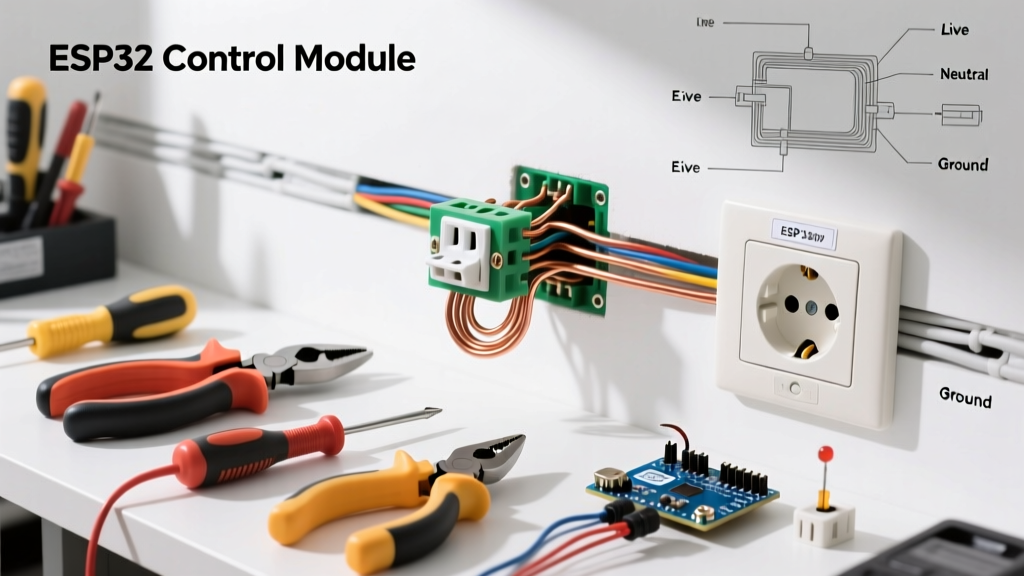
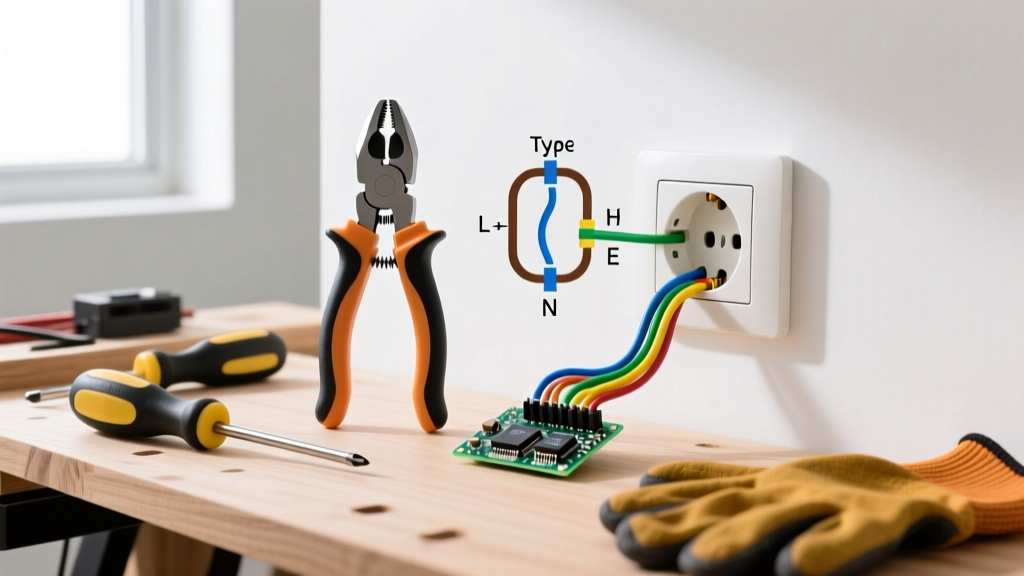
Austria strictly adheres to the harmonized European Union wiring color codes dictated by IEC 60446. Before stripping any wires, verify the following color scheme:
- Phase (L - Live): Brown (occasionally Black in older 3-phase setups)
- Neutral (N): Blue
- Protective Earth (PE): Green/Yellow striped
Expert Warning: Never assume color codes in pre-1990 Austrian buildings. Older installations may use grey for neutral or red/yellow for phases. Always verify with a CAT III or CAT IV rated two-pole voltage tester (Duspol) before touching any conductors.
Scenario 1: Wiring a Modern TN-S System Receptacle
In modern Austrian residential builds (post-1980s), you will encounter a TN-S or TN-C-S earthing system where the Protective Earth (PE) and Neutral (N) are separated. Here is the precise workflow for terminating a standard 16A Schuko receptacle (such as the Legrand Mosaic or Berker S.1 series):
Step-by-Step Termination
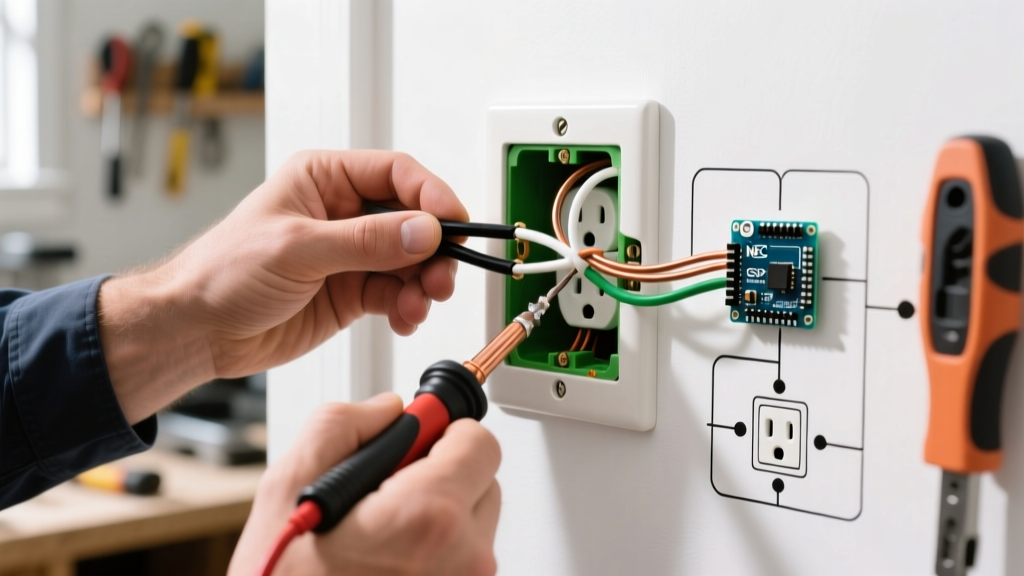
- Strip the Sheathing: Remove the outer PVC sheath of the NYM-J 3x1.5mm² or 3x2.5mm² cable, leaving the inner cores intact. Do not nick the copper.
- Prepare the Conductors: Strip exactly 12mm of insulation from the Brown, Blue, and Green/Yellow wires. If you are using stranded wire (H07V-K), you must crimp wire ferrules (Aderendhülsen) using a dedicated crimping tool. Solid core wires can be inserted directly.
- Connect the Earth First: Insert the Green/Yellow wire into the central earth terminal block. This is usually the longest terminal to ensure it is the first to connect and last to disconnect if the cable is pulled.
- Terminate L and N: Connect the Brown wire to the Phase (L) terminal and the Blue wire to the Neutral (N) terminal. While Schuko plugs are unpolarized (they can be inserted upside down), maintaining L on the right and N on the left when facing the socket is standard Austrian best practice.
- Torque the Screws: Tighten the terminal screws to the manufacturer's specification, typically 0.8 Nm to 1.2 Nm. Under-tightening causes high-resistance arcing; over-tightening can shear the copper strand.
Scenario 2: Navigating the 'Klassische Nullung' Hazard
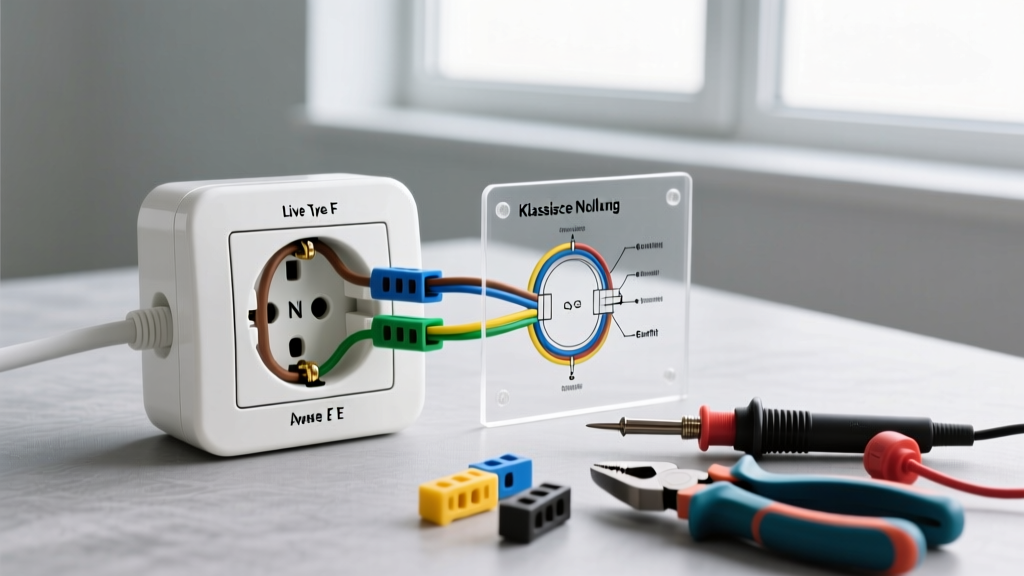
If you are renovating an older Austrian apartment (Altbau), you will likely encounter a dangerous, obsolete wiring method known as Klassische Nullung (Classic Neutral Grounding). Before the widespread adoption of dedicated PE wires and RCDs (FI-Schutzschalter), electricians used a 2-wire system (Phase and PEN).
To provide 'grounding', a small copper wire bridge was installed directly inside the outlet, connecting the Neutral terminal to the Earth clips. As detailed in historical analyses of the Schuko standard evolution, this creates a severe shock hazard. If the upstream Neutral wire ever breaks or a fuse is incorrectly placed on the neutral line, the chassis of any plugged-in metal appliance (like a washing machine or toaster) becomes energized at a lethal 230V.
Remediation Strategy
Under the current ÖVE/ÖNORM E 8001 standard (the Austrian electrotechnical safety code), Klassische Nullung is strictly prohibited in new installations. If you discover a bridged outlet:
- Do not simply remove the bridge without verifying the upstream panel. Removing it leaves the appliance ungrounded, which is equally dangerous for Class I appliances.
- Upgrade the Circuit: The only code-compliant solution is to pull a new 3-core cable (with a dedicated PE) from a distribution board equipped with a 30mA Residual Current Device (RCD/FI).
- Temporary Mitigation: If a full rewire is impossible immediately, ensure the circuit is protected by a modern RCBO (Residual Current Breaker with Overcurrent) at the main panel, though the PEN conductor must still meet strict cross-sectional area requirements (minimum 10mm² Cu for PEN).
Comparative Matrix: Type F vs. Type E vs. Type C
Understanding how the Austrian Type F interacts with neighboring European standards is vital for sourcing compatible hardware and troubleshooting cross-border appliance imports.
| Feature | Type F (Austria/Germany) | Type E (France/Belgium) | Type C (Europlug) |
|---|---|---|---|
| Socket Earth | Two side metal clips | Single protruding male pin | None (Unearthed) |
| Plug Earth | Side metal strips | Female receptacle hole | None |
| Hybrid Compatibility | Accepts CEE 7/7 hybrid plugs | Accepts CEE 7/7 hybrid plugs | Accepts Type E & F sockets |
| Max Current | 16A (Heavy appliances) | 16A (Heavy appliances) | 2.5A (Light electronics) |
| Physical Recess | 16mm deep circular | 16mm deep circular | Flush or shallow recess |
For a deeper dive into physical socket dimensions and international compatibility matrices, the World Standards Type F guide provides excellent visual references for the CEE 7/7 hybrid plug, which bridges the gap between Austrian Type F and French Type E sockets.
Integrating Smart Schuko Outlets in 2026
Smart home retrofits are incredibly common in Austrian rentals where hardwired smart switches aren't permitted. Smart Schuko plug-in relays (like the Shelly Plus Plug S or Aqara Smart Plug EU) are the go-to solution. However, DIYers frequently make critical errors regarding load management.
The Shelly Plus Plug S is rated for 12A (2,760W) continuous, not the full 16A the wall outlet provides. Plugging a 2,200W space heater and a 1,000W coffee maker into a single smart plug via an adapter will melt the internal relay contacts. Always calculate the resistive load of heating appliances carefully. Furthermore, smart plugs require a stable 2.4GHz Wi-Fi or Zigbee mesh network; thick Austrian masonry walls (Ziegelbauweise) severely attenuate RF signals, necessitating the use of Zigbee router nodes in adjacent rooms.
Essential VDE-Rated Tools for Austrian Electrical Work
To work safely on 230V systems, your toolkit must meet stringent European safety standards. Do not use standard hardware store tools.
- Voltage Tester: Benning Duspol digital or Fluke T6-600. Never trust a non-contact voltage pen (NCV) for verifying dead circuits in Austria; capacitive coupling in dense masonry walls causes frequent false positives.
- Screwdrivers: Wera or Wiha VDE-insulated screwdrivers rated for 1,000V. You will primarily need a PZ1 (Pozidriv) for terminal screws and a flathead SL0.8x4.0 for release tabs.
- Wire Strippers: Knipex MultiStrip 10. Automatically adjusts to 1.5mm² and 2.5mm² solid and stranded copper without nicking the conductor.
- Torque Screwdriver: Wera VDE torque screwdriver set to 1.0 Nm for consistent, code-compliant terminal termination.
Final Safety and Compliance Check
While DIY electrical work is technically permitted for minor replacements in Austria (like swapping a broken socket faceplate), any alteration to the fixed installation (pulling new cables, adding circuits, or modifying the distribution board) must be performed or signed off by a certified electrician registered with the Austrian Electrotechnical Association (OVE). Always isolate the circuit at the main breaker, lock out the panel, and test for zero potential before beginning any Austria electrical outlet wiring project.