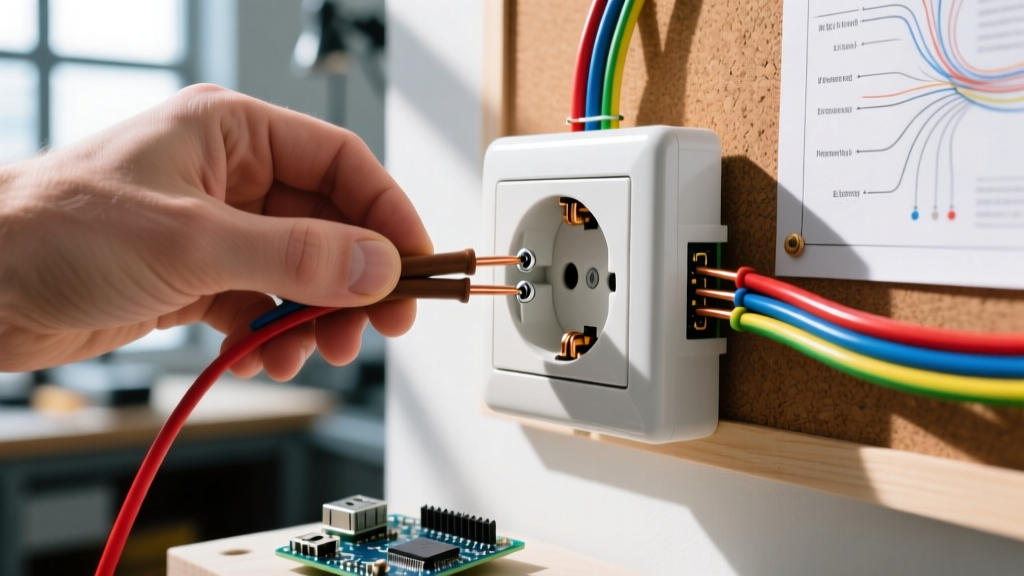

Understanding the French Electrical Outlet (Type E)
Renovating a property in France or installing a new circuit requires strict adherence to the NF C 15-100 standard. Unlike the UK's BS 1363 or North America's NEMA 5-15, the French electrical outlet utilizes the Type E (CEE 7/5) configuration. For DIYers, expats, and international electricians, understanding the specific code requirements for wire gauges, circuit breaker limits, and spatial distribution is critical. Failing to comply will result in a rejected Consuel safety inspection, which is legally required for all new builds and major electrical renovations in France.
The Anatomy of the CEE 7/5 Socket
The defining feature of a French electrical outlet is the protruding earth (ground) pin located on the socket itself, rather than on the plug. According to the international plug and socket standards, the Type E socket features two 4.8mm holes for live and neutral, spaced 19mm apart, with a 4.8mm male earth pin projecting outward. This design ensures that the earth connection is always made before the live pins engage, providing superior shock protection. Modern French sockets are rated for 16A at 230V, yielding a maximum theoretical load of 3,680W per receptacle.
NF C 15-100 Circuit and Wire Gauge Mandates
The NF C 15-100 standard strictly dictates the relationship between the circuit breaker rating (disjoncteur), the copper wire cross-section, and the maximum number of outlets permitted on a single radial circuit. Using undersized wire or overloading a breaker is an immediate code violation.
| Circuit Breaker Rating | Minimum Wire Gauge (Copper) | Max Outlets per Circuit | Typical Application |
|---|---|---|---|
| 16A or 20A | 1.5 mm² | 8 (if 16A) / 12 (if 20A) | Standard lighting & low-draw sockets (rare for sockets in modern builds) |
| 16A or 20A | 2.5 mm² | 8 (if 16A) / 12 (if 20A) | Standard living room, bedroom, and hallway receptacles |
| 20A | 2.5 mm² | 1 (Dedicated) | Washing machine, dishwasher, tumble dryer |
| 32A | 6.0 mm² | 1 (Dedicated) | Electric oven, induction cooktop, water heater |
Expert Note: While 1.5 mm² wire is technically permitted for 8-outlet circuits under older interpretations, modern Legrand and Schneider Electric installation guides strongly recommend using 2.5 mm² for all standard socket circuits to minimize voltage drop and accommodate future high-draw devices.
Room-by-Room Minimum Outlet Requirements
The French electrical code does not just limit the maximum number of outlets; it also enforces strict minimums to prevent the dangerous use of extension cords. When planning your GTL (Gaine Technique Logement) and circuit distribution, ensure you meet these baseline requirements:
- Living Room (Séjour): Minimum of 5 outlets. If the room is larger than 28m², or if a TV/network panel is installed, the minimum increases to 7. At least one outlet must be located adjacent to the main light switch.
- Bedrooms (Chambres): Minimum of 3 outlets per bedroom, excluding any dedicated circuits for HVAC or specialized equipment.
- Hallways & Corridors: Minimum of 1 outlet for any passage wider than 4m².
- Kitchen (Cuisine): The most heavily regulated room. You must install a minimum of 6 outlets above the worktop (specifically on a 2.5 mm² / 20A circuit). Additionally, you need 4 dedicated circuits for white goods (oven, cooktop, washing machine, dishwasher).
- Bathrooms (Salle d'eau): Highly restricted due to water proximity. Only 1 outlet (often integrated with a shaver socket or located in Volume 3) is permitted, and it must be protected by a 30mA differential switch (interrupteur différentiel).
Strategic Placement and Height Restrictions
Code compliance extends beyond the electrical panel to the physical placement of the French electrical outlet on the wall. The NF C 15-100 standard mandates specific installation heights to ensure accessibility and safety:
- Standard Wall Outlets: Must be installed with the center of the socket between 5 cm and 30 cm above the finished floor level.
- Kitchen Worktop Outlets: Must be placed between 8 cm and 25 cm above the worktop surface. They cannot be installed directly above a sink or a cooking hob.
- Accessible Design (PMR): For properties designed for Persons with Reduced Mobility, all socket mechanisms must be placed between 90 cm and 130 cm from the floor to accommodate wheelchair users.
Step-by-Step Wiring Guide for Type E Sockets
Wiring a modern French socket (such as a Legrand Céliane or Schneider Odace) requires precision. French color codes differ slightly from older international standards. The mandatory colors are: Brown (Phase/Live), Blue (Neutral), and Green/Yellow (Earth).
1. Preparation and Stripping
Turn off the main breaker and verify zero voltage with a CAT III multimeter. Strip the outer sheath of the RO2V cable, then strip exactly 12 mm of insulation from the individual copper conductors. Stripping too little will result in the insulation being clamped inside the terminal; stripping too much exposes live copper, creating an arc-flash hazard.
2. Connecting the Terminals
Modern French mechanisms utilize either screw terminals or automatic push-in clamps (bornes automatiques). If using push-in terminals, insert the Brown wire into the L (Phase) terminal, the Blue wire into the N (Neutral) terminal, and the Green/Yellow wire into the Earth terminal (marked with the ⏚ symbol). Ensure the earth wire is connected first physically, as it is the longest wire in the backbox to ensure it remains connected if the cable is accidentally pulled.
3. Mounting and Finishing
Secure the mechanism to the drywall using the adjustable claws (griffes) or M3.5 screws if using a standard 67mm round backbox (boîte d'encastrement). Use a spirit level to ensure the faceplate is perfectly horizontal before snapping on the decorative trim.
Passing the Consuel Inspection: Common Failure Points
The Consuel inspector will rigorously test your installation. To avoid a costly re-inspection fee (approximately €150 in 2026), watch out for these common pitfalls:
Inspector Alert: The most frequent failure for DIY renovations in France is the lack of a Liaison Équipotentielle Principale (Main Equipotential Bonding). You must bond all incoming metallic water and gas pipes to the main earth bar in your GTL using a minimum 6 mm² (or 16 mm² depending on the main supply) green/yellow cable. Failing to bond the plumbing will result in an automatic fail, regardless of how perfectly your outlets are wired.
Additionally, ensure that every single socket circuit is protected by a 30mA Type A or Type AC RCD (interrupteur différentiel) at the distribution board. Type A is now mandatory for circuits powering washing machines, dishwashers, and EV chargers due to their internal DC rectifiers, which can blind standard Type AC breakers.
Final Thoughts on Material Selection
When sourcing materials, avoid importing non-compliant sockets from overseas marketplaces. A genuine NF-certified French electrical outlet from reputable brands like Legrand, Schneider, or Hager will cost between €4.50 and €12.00 per complete mechanism (including the backbox, mechanism, and faceplate). Always look for the NF USE certification mark stamped on the back of the mechanism, which guarantees the plastic is halogen-free and the internal brass contacts meet the stringent thermal testing required by French law.