
Understanding Electric Outlet Dimensions: The Three Layers
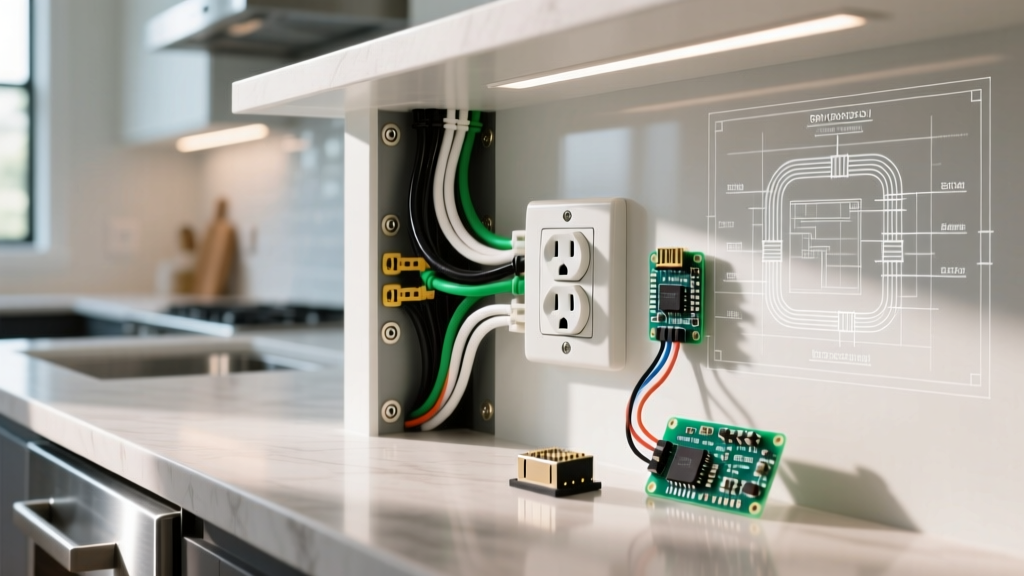
When beginners search for electric outlet dimensions, they usually picture the visible plastic wall plate. However, a successful, code-compliant installation requires understanding three distinct dimensional layers: the receptacle face, the wall plate, and the hidden electrical box behind the drywall. Misjudging any of these three layers leads to jagged drywall gaps, devices that refuse to sit flush, or worse, National Electrical Code (NEC) violations regarding box fill capacity.
In this 2026 installation tutorial, we break down the exact measurements you need for standard 15-amp and 20-amp residential circuits, including the hidden depth requirements for modern GFCI and smart outlets.
Layer 1: Receptacle Face and Strap Dimensions
The physical receptacle (the device you plug into) is governed by the NEMA WD6 standard, which ensures all North American manufacturers produce universally compatible devices.
- Standard Duplex Receptacle: The visible face measures approximately 1.31 inches wide by 2.62 inches high. However, the metal mounting strap (yoke) that screws into the box is wider, measuring exactly 3.28 inches wide by 1.31 inches high.
- Decora (Rocker) Receptacle: The visible face is a large rectangle measuring 1.31 inches wide by 2.62 inches high. The mounting strap remains the standard 3.28 inches wide.
- Device Depth: A standard pass-through duplex receptacle extends about 0.95 inches into the wall box. However, modern GFCIs (like the Leviton GFNT1) extend 1.35 inches, and Wi-Fi smart outlets (like the Leviton DW15R) can extend up to 1.75 inches into the box.
Layer 2: Wall Plate Dimensions and Drywall Rescue
Wall plates cover the gap between the receptacle and the drywall. Choosing the right plate dimension is a common troubleshooting step for beginners who have cut their drywall hole slightly too large.
Standard, Mid-Size, and Jumbo Plates
| Plate Category | Width x Height | Best Use Case |
|---|---|---|
| Standard 1-Gang | 2.75' x 4.5' | Clean, precise drywall cutouts. |
| Mid-Size (Trade Size) | 3.13' x 4.88' | Covers minor drywall tearing or slightly oversized cuts (adds 3/16' per side). |
| Jumbo / Oversized | 3.5' x 5.25' | Covers severe drywall damage or large gaps around old-work boxes. |
Pro Tip: Always keep a few Mid-Size plates in your inventory. They cost only $0.30 more than standard plates but save hours of drywall mudding and sanding when a rotary cutout tool slips.
Layer 3: Electrical Box Dimensions (The Hidden Measurements)
The electrical box (or junction box) houses the wire splices and the back of the receptacle. This is where beginners make the most critical errors. Box dimensions are defined by Width, Height, and Depth, which combine to create Cubic Inch Capacity (Volume).
Common Single-Gang Box Dimensions
| Box Type | Model Example | Dimensions (W x H x D) | Volume | 2026 Avg. Cost |
|---|---|---|---|---|
| New Work Shallow | Carlon B114R | 2.25' x 3.75' x 1.5' | 14 cu in | $1.25 |
| New Work Deep | Carlon B120R | 2.25' x 3.75' x 2.25' | 20 cu in | $2.10 |
| Smart Outlet Extra Deep | Carlon B122R | 2.25' x 3.75' x 2.5' | 22.5 cu in | $4.50 |
| Old Work (Remodel) | Carlon B108R | 2.25' x 3.75' x 1.5' | 8 cu in | $1.80 |
The 14 Cubic Inch Trap: NEC Box Fill Calculations
The most common failure mode for DIYers and apprentice electricians is buying the standard blue 14 cubic inch single-gang box (like the Carlon B114R) and using it for a pass-through circuit. According to NFPA NEC Article 314.16, this is often a direct code violation.
Every conductor, device, and clamp inside the box takes up physical space, calculated in cubic inches. For standard 14 AWG copper wire, the NEC assigns a volume allowance of 2.0 cubic inches per unit.
Step-by-Step Box Fill Calculation (14 AWG Pass-Through)
Imagine you are wiring a standard outlet in the middle of a room (power comes in from the panel, and continues out to the next outlet).
- Current-Carrying Conductors: You have two 14/2 Romex cables entering the box. That is 2 black (hot) wires and 2 white (neutral) wires. 4 wires x 2.0 cu in = 8.0 cu in.
- Device (Receptacle) Yoke: The NEC counts the physical outlet as two volume allowances. 2 x 2.0 cu in = 4.0 cu in.
- Grounding Conductors: All bare copper ground wires combined count as a single allowance. 1 x 2.0 cu in = 2.0 cu in.
- Internal Cable Clamps: Non-metallic blue boxes have built-in plastic clamps. All clamps combined count as one allowance. 1 x 2.0 cu in = 2.0 cu in.
Total Required Volume: 8.0 + 4.0 + 2.0 + 2.0 = 16.0 Cubic Inches.
If you use a standard 14 cu in shallow box for this installation, you are overfilling the box by 2 cubic inches. Overfilled boxes trap heat, crush wire insulation, and will fail an electrical inspection. Always use a 20 cu in deep box (like the Carlon B120R) for pass-through circuits.
Drywall Cutout Dimensions for 1-Gang Boxes
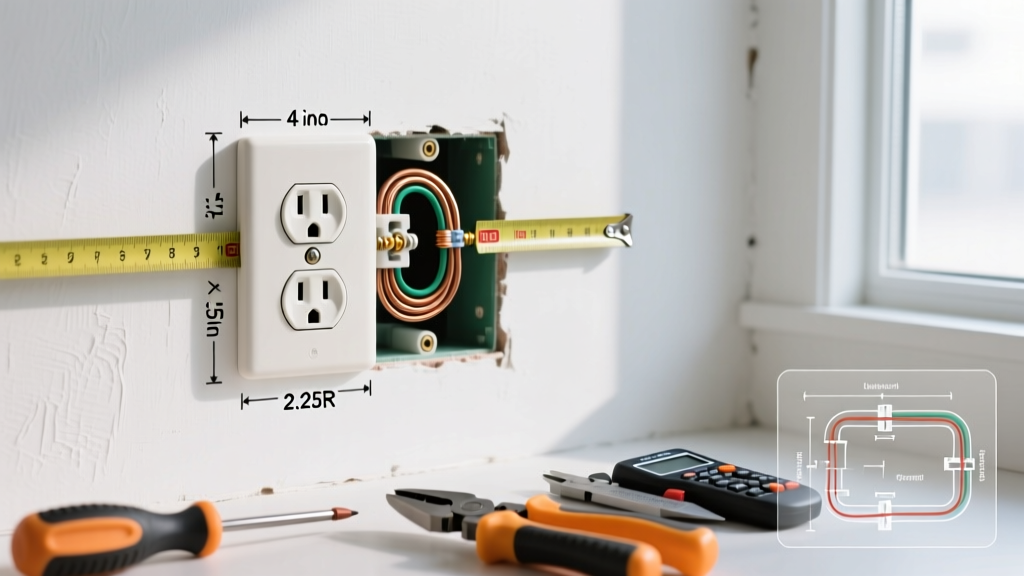
When cutting the hole in your drywall to accommodate the electrical box, precision is key. The physical outside dimensions of a standard single-gang nail-on box or old-work box are roughly 2.25 inches wide by 3.75 inches high.
However, you should not cut the drywall to those exact dimensions.
- For New Work (Mud Rings): If you are using a 4x4 square metal box with a 1-gang drywall mud ring, your cutout must be exactly 2.75' x 4.5'.
- For Old Work (Remodel Boxes): The flanges on the front of the box will overlap the drywall, but the rear wings need room to flip. Trace the front lip of the old-work box directly onto the wall, which usually yields a 2.75' x 3.75' cutout.
Use a drywall keyhole saw for single cutouts to maintain control and avoid severing hidden plumbing or low-voltage cables. For multi-gang installations, a rotary spiral saw with a drywall bit is faster but requires a steady hand to avoid overcutting the corners.
Handling Deep Smart Outlets in Shallow Walls
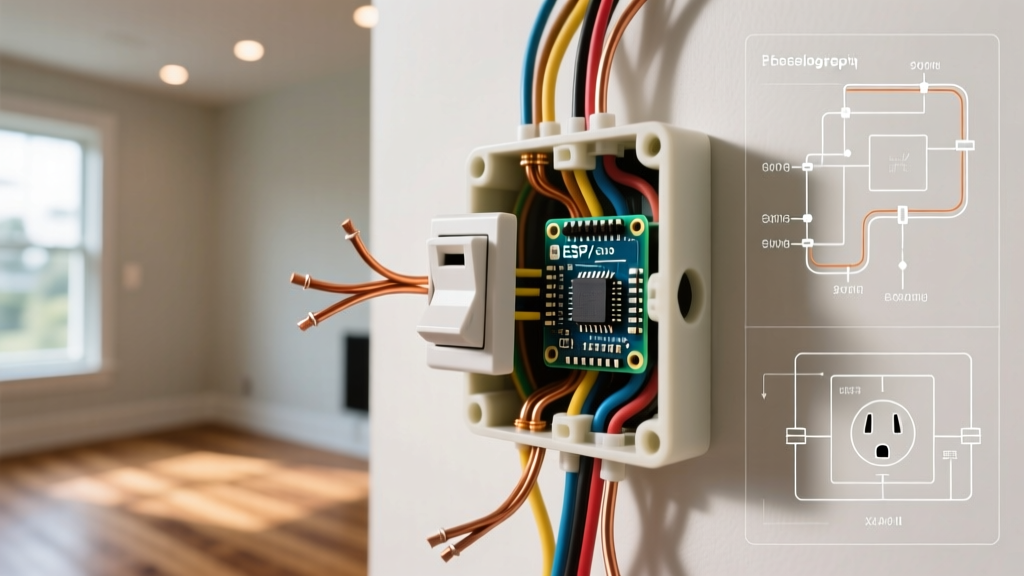
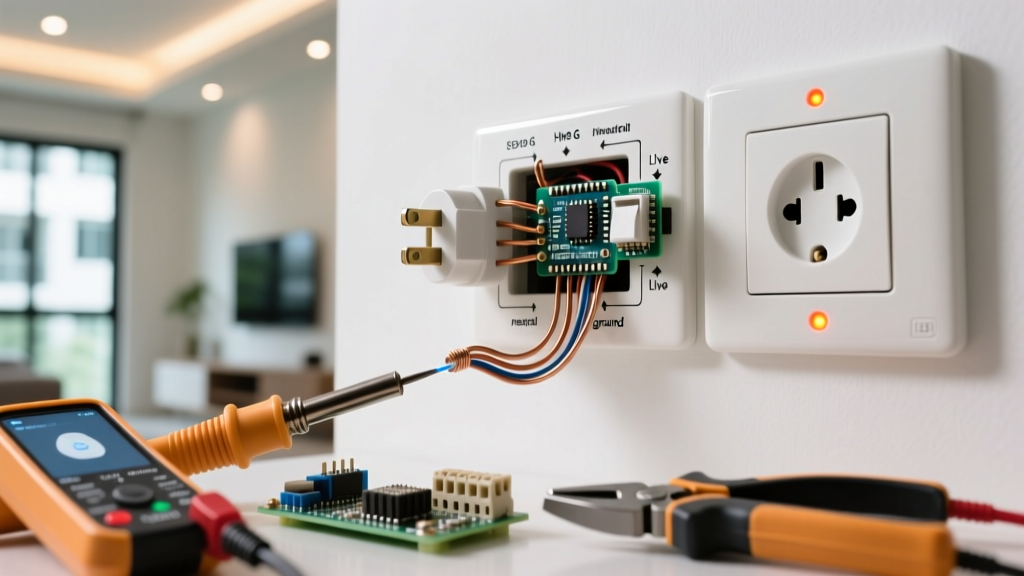
As smart home technology becomes standard in 2026, electricians frequently encounter homes with 2x4 framing and shallow 14 cu in boxes. Wi-Fi enabled receptacles feature massive internal power supplies and relays that require up to 1.75 inches of depth just for the device body, leaving zero room for wire bending.
If you are retrofitting a smart outlet into an existing shallow box, you must upgrade to an extra-deep old-work box (minimum 20 cu in) or use a 4x4 square box with a single-gang plaster ring if the wall cavity depth permits. According to UL electrical safety guidelines, forcing a smart device into an undersized box can bend the terminals, leading to arcing and potential fire hazards over time.
Summary Checklist for Beginners
- Verify your wall plate size: Standard (2.75' x 4.5') or Mid-Size for gap coverage.
- Calculate NEC box fill before buying your electrical boxes.
- Never use a 14 cu in box for a pass-through 14 AWG circuit with internal clamps.
- Buy 20 cu in or 22.5 cu in deep boxes for any GFCI, AFCI, or Smart receptacle installation.
- Cut drywall to 2.75' x 4.5' for standard mud rings to ensure the plate sits flush.
Mastering these electric outlet dimensions ensures your installation is not only visually flawless but mechanically safe and fully compliant with the National Electrical Code.