
The Reality of Extending an Electrical Outlet
When homeowners and DIYers research how to extend an electrical outlet, they are typically referring to 'daisy-chaining'—running a new non-metallic (NM) cable from an existing receptacle to power a new location. While conceptually simple, this procedure is a frequent source of electrical fires and failed inspections when executed without strict adherence to the National Electrical Code (NEC). According to the U.S. Consumer Product Safety Commission (CPSC), improper receptacle wiring, overloaded junction boxes, and loose terminal connections account for thousands of residential structure fires annually.
This guide strips away the generic advice and provides a rigorous, code-compliant framework for extending a 15-amp or 20-amp receptacle circuit in 2026, focusing on box fill mathematics, thermal failure modes, and exact material specifications.
NEC Code Prerequisites Before You Cut the Drywall
Before you even touch a wire stripper, you must verify that the existing circuit can legally and safely handle the extended load. The National Fire Protection Association (NFPA) outlines strict parameters for receptacle circuits in NEC Article 210.
1. The 80% Continuous Load Rule
NEC Article 210.20(A) dictates that a branch circuit must not be loaded beyond 80% of its rating for continuous loads (those expected to run for 3 hours or more).
- 15-Amp Circuit (14 AWG wire): Maximum continuous load is 12 Amps (1,440 Watts on a 120V system).
- 20-Amp Circuit (12 AWG wire): Maximum continuous load is 16 Amps (1,920 Watts on a 120V system).
Edge Case: If you are extending an outlet to a dedicated workspace that will host high-draw equipment like a 1,500W space heater or a server rack, you must calculate the existing baseline load. If the current circuit already carries 1,000W of lighting and electronics, adding a 1,500W heater will trip the breaker and violate code.
2. GFCI and AFCI Mandates
Under the latest NEC cycles, extending an outlet into specific zones triggers mandatory protection upgrades. If your extension routes into a kitchen, bathroom, garage, unfinished basement, or outdoor area, the new receptacle must be GFCI protected (NEC 210.8). Furthermore, if the circuit supplies outlets in living areas, bedrooms, or kitchens, it must be protected by a Combination-Type AFCI breaker (NEC 210.12). Extending an un-protected legacy circuit into these zones requires upgrading the breaker panel first.
Box Fill Calculations: The Most Common Code Violation
The single most dangerous mistake when learning how to extend an electrical outlet is ignoring NEC Table 314.16(B) regarding box fill. Every electrical box has a maximum cubic inch capacity. Adding a new cable means adding more conductors, which generates more heat. If the box is overfilled, heat cannot dissipate, leading to melted insulation and short circuits.
Volume Allowance Per Conductor
| Wire Gauge | Volume Allowance per Conductor | Typical Use Case |
|---|---|---|
| 14 AWG | 2.0 Cubic Inches | 15-Amp Lighting & Receptacle Circuits |
| 12 AWG | 2.25 Cubic Inches | 20-Amp Kitchen, Bathroom, & Appliance Circuits |
| 10 AWG | 2.50 Cubic Inches | 30-Amp Dryer / HVAC Circuits (Rarely extended via receptacles) |
Calculating Your Existing Box
To determine if your existing box can accept a new outgoing cable, count the 'allowances' based on NEC rules:
- Hot and Neutral Wires: 1 allowance for each wire entering/leaving the box.
- Ground Wires: All bare/green grounds combined count as exactly 1 allowance.
- Internal Clamps: Count as 1 allowance (if present).
- The Receptacle Device Itself: Counts as 2 allowances.
Real-World Example: You have an existing 14 AWG circuit. The box currently holds 1 incoming cable (2 wires), 1 outgoing cable (2 wires), 1 ground bundle, and the receptacle. That is 2 + 2 + 1 + 2 = 7 allowances. At 2.0 cu in per allowance (14 AWG), you need a box with at least 14 cubic inches of volume. A standard single-gang 'old work' box is usually 14 to 18 cu in. If you add a second outgoing cable to extend the outlet, you add 2 more wires (4 cu in). If your box is only 14 cu in, you are now in violation of NEC 314.16. You must either upgrade to a deep 22 cu in box or use a surface raceway.
Step-by-Step: Executing the Extension Safely
If your box fill calculations pass and the circuit load is within limits, proceed with the physical extension.
Step 1: De-energize and Verify
Turn off the breaker and verify zero voltage using a non-contact voltage tester like the Klein Tools NCVT-2 (approx. $25). Test a known live source first to ensure the tool's battery is functional, then test the target outlet.
Step 2: Choose Your Wiring Method
- In-Wall Extension: Use 14/2 or 12/2 NM-B (Romex) cable, matching the existing circuit gauge. Never mix 14 AWG wire on a 20-amp breaker.
- Surface Raceway (When Box Fill is Exceeded): If the existing box cannot handle more wires, install a Wiremold V772-1 surface raceway channel to route the wires to a new surface-mounted Wiremold V771 box. This bypasses the need to fish wires through drywall and provides ample volume for the new receptacle.
Step 3: Pigtailing vs. Pass-Through Wiring
While you can wire the incoming and outgoing hot/neutral wires directly to the receptacle's side terminals (pass-through), the professional standard is pigtailing. Pigtailing ensures that if the new receptacle fails or is removed, the downstream outlets do not lose power.
- Strip exactly 3/4 inch of insulation from your 14 or 12 AWG wires using a precision stripper (e.g., Klein 11055).
- Connect the incoming hot, outgoing hot, and a 6-inch black pigtail using a Wago 221-413 Lever Nut ($0.45 each). Lever nuts provide a verifiable, vibration-resistant connection superior to traditional twist-on wire nuts.
- Repeat for the neutral (white) wires.
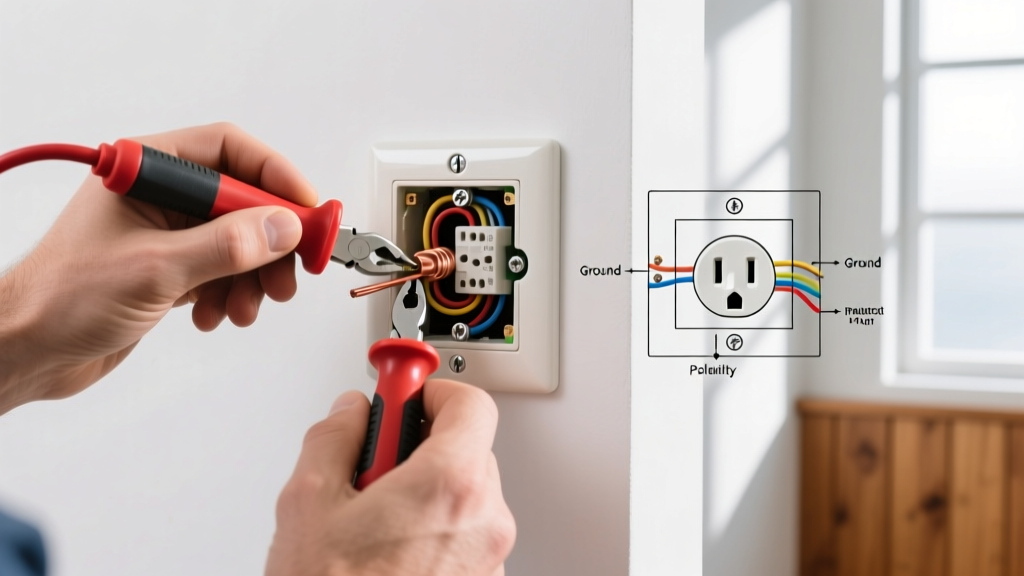
- Connect all bare copper grounds together with a green wire nut or Wago lever nut, leaving a single pigtail for the receptacle's green grounding screw.
Step 4: Termination and Torque
Wrap the wire clockwise around the brass (hot) and silver (neutral) terminal screws. Tighten the screws to the manufacturer's specified torque. For commercial-grade receptacles like the Leviton 5362-W ($4.15), the required torque is 14 in-lbs. For residential grades like the Leviton 5325-WMP ($1.25), it is 12 in-lbs. Use an insulated torque screwdriver like the Wiha 645P to ensure exact tension.
Material Cost & Product Specifications (2026 Pricing)
| Component | Recommended Model / Brand | Est. Cost (USD) | Code / Safety Note |
|---|---|---|---|
| Receptacle (15A Commercial) | Leviton 5362-W | $4.15 | Features screw-and-clamp plates; prevents backstabbing failures. |
| Wire Connectors | Wago 221-413 (3-Port Lever) | $0.45 / ea | UL Listed; transparent housing allows visual wire insertion verification. |
| Surface Raceway | Wiremold V772-1 (10ft Channel) | $22.50 | Solution for extending outlets when existing wall boxes are overfilled. |
| NM-B Cable (12/2) | Southwire 500ft Spool | $165.00 | Required for 20A circuits; 90°C rated insulation. |
Critical Failure Modes to Avoid
When extending an outlet, avoid these catastrophic edge cases:
- Backstabbing (Push-In Terminals): Never use the push-in holes on the back of a cheap residential receptacle. Thermal expansion and contraction cause the internal brass grips to loosen over time, creating high-resistance arcing faults. Always use side-wiring or screw-and-clamp termination.
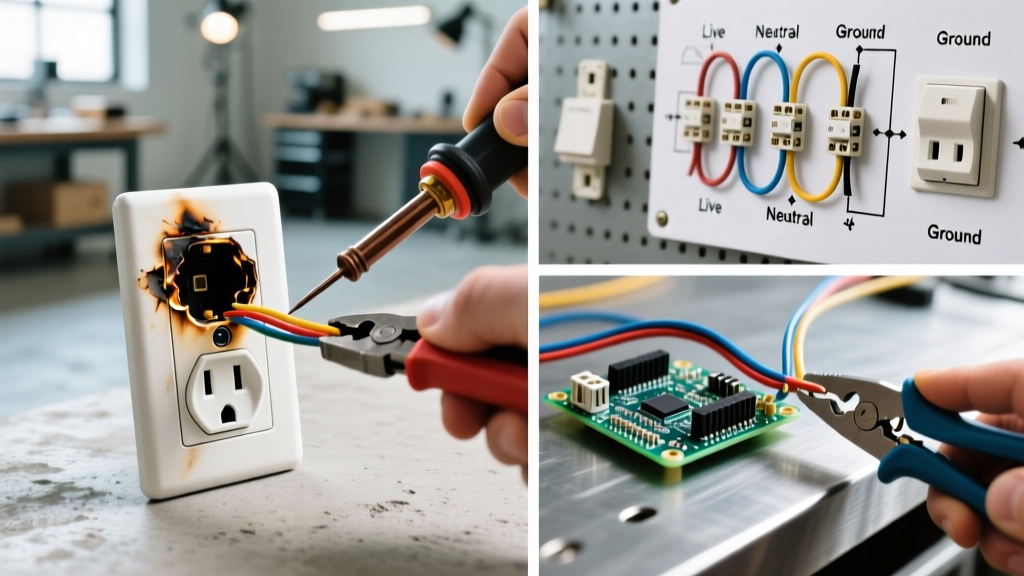
- Reversed Polarity: Ensure the black (hot) wire connects to the brass screw and the white (neutral) connects to the silver screw. Reversed polarity leaves the internal circuitry of plugged-in appliances energized even when switched off, creating a severe shock hazard.
- Daisy-Chaining GFCIs: If you are extending an outlet from the 'LOAD' terminals of an existing GFCI, the new outlet will also be GFCI protected. However, do not wire a second GFCI receptacle downstream of the first. Cascading GFCIs causes nuisance tripping and makes fault-tracing nearly impossible.
Frequently Asked Questions
Can I extend a kitchen outlet circuit to a living room?
No. NEC Article 210.52(B)(2) strictly prohibits kitchen small-appliance branch circuits from supplying outlets in any other room. Kitchen circuits must be dedicated solely to kitchen and dining area receptacles.
What if I don't know the gauge of the existing wire?
Do not guess. Remove the receptacle and inspect the wire jacket. 14 AWG is typically wrapped in white sheathing, while 12 AWG is wrapped in yellow sheathing. If the wires are older and lack color-coding, use a wire gauge stripping tool to measure the copper conductor diameter. 14 AWG is 1.63mm; 12 AWG is 2.05mm.
Is it legal to extend an outlet using an extension cord hidden in the wall?
Absolutely not. NEC Article 400.12(2) explicitly forbids using flexible cords and cables (extension cords) as a substitute for the fixed wiring of a building structure, nor can they be run through holes in walls, ceilings, or floors. Doing so is an immediate fire hazard and code violation.