
The Core Framework: Understanding SS 638 and the Safety Mark
When discussing an electrical outlet Singapore installation, the first point of reference is the Singapore Standard SS 638 (Code of Practice for Electrical Installations). Unlike the US (NEC) or Europe (IEC 60364), Singapore utilizes a unique hybrid framework that borrows heavily from British Standards (BS 7671) while integrating localized tropical environmental requirements.
Every physical socket faceplate sold and installed in Singapore must bear the Enterprise Singapore Safety Mark. This certification, managed by the Consumer Product Safety Office (CPSG), ensures the outlet meets SS 145 (the local equivalent to BS 1363 for 13A plugs and socket-outlets). Installing unmarked or grey-market outlets from overseas e-commerce platforms is a direct violation of EMA regulations and voids home insurance policies.
Physical Socket Specifications: Type G and SS 145
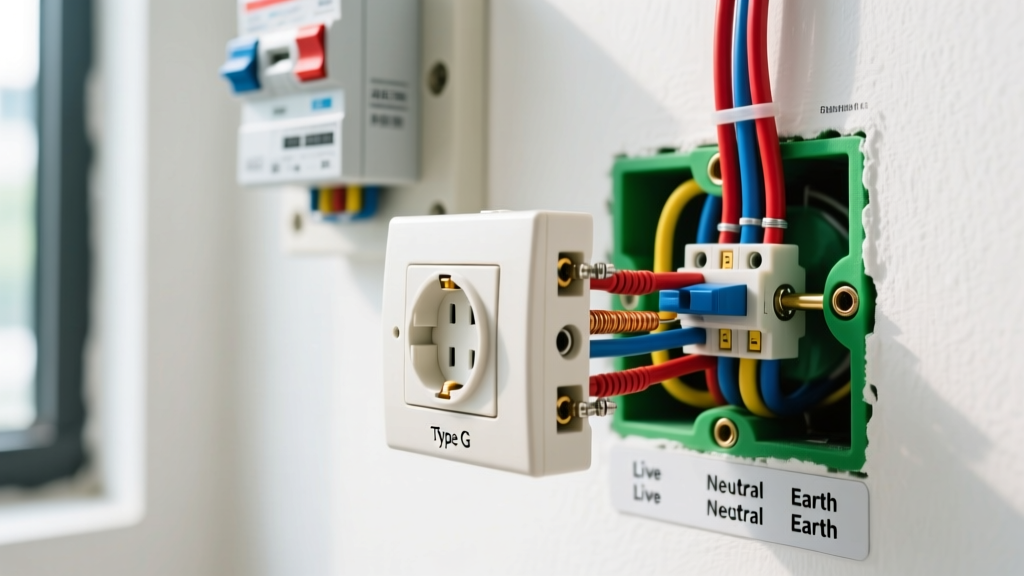
Singapore exclusively uses the Type G socket configuration. While it looks identical to the UK standard, local code dictates specific manufacturing tolerances and material requirements to withstand high ambient humidity.
- Pin Configuration: Three rectangular pins in a triangular pattern (Live, Neutral, Earth).
- Rating: Standard socket outlets are rated at 13 Amps (approx. 3,120W at 230V).
- Shutter Mechanism: SS 145 mandates interlocked shutters on the Live and Neutral apertures, operable only by the insertion of the longer Earth pin.
- Switching: Almost all general-purpose wall sockets in Singapore are switched socket outlets (featuring a red illuminated rocker switch). Unswitched sockets are generally restricted to specific appliance garages or concealed behind major white goods.
Circuit Topology: Radial vs. Ring Main
One of the most critical distinctions for electricians transitioning from the UK to Singapore is the circuit topology. While the UK heavily relies on 32A Ring Main circuits for general sockets, Singapore strictly favors Radial Circuits for residential and commercial socket outlets.
Standard Radial Circuit Sizing (SS 638)
For general 13A socket outlets in living rooms and bedrooms, the standard configuration is:
- Cable: 2.5mm² PVC/PVC copper cable (e.g., Taihan or Keppel brands).
- Protection: 20A Type C Miniature Circuit Breaker (MCB).
- Maximum Floor Area: A single 20A radial circuit should not serve an area exceeding 50 square meters.
For kitchens, where high-draw appliances (ovens, induction hobs) are common, dedicated 4.0mm² or 6.0mm² radial circuits protected by 32A or 40A MCBs are mandated. The use of ring circuits is exceptionally rare in modern Singaporean HDB and condo developments due to the difficulty of verifying ring continuity during periodic LEW (Licensed Electrical Worker) inspections.
| Parameter | Singapore Standard (SS 638 / SS 145) | UK Standard (BS 7671 / BS 1363) |
|---|---|---|
| Standard Voltage / Frequency | 230V (+10%/-6%) / 50Hz | 230V (+10%/-6%) / 50Hz |
| General Socket Circuit Topology | Radial (2.5mm² on 20A MCB) | Ring Main (2.5mm² on 32A MCB) |
| Earth Fault Protection | 30mA RCD / RCBO Mandatory | 30mA RCD / RCBO Mandatory |
| Cable Color Code | Brown (L), Blue (N), Green/Yellow (E) | Brown (L), Blue (N), Green/Yellow (E) |
| Regulatory Certification | Enterprise SG Safety Mark | BSI Kitemark / ASTA |
Mandatory RCD Protection and Earth Fault Loop Impedance
Under SS 638, all socket outlets intended for general use by ordinary persons must be protected by a Residual Current Device (RCD) with a tripping current not exceeding 30mA. In modern HDB Distribution Boards (DBs), you will typically find Residual Current Breakers with Overcurrent protection (RCBOs) rather than a single main RCCB. This provides individual circuit protection, preventing a single earth leakage fault (e.g., a faulty kettle) from blacking out the entire home.
Testing the Earth Fault Loop Impedance (Ze and Zs) is a mandatory sign-off requirement for any Licensed Electrical Worker (LEW) submitting a completion certificate to SP Services. A Zs reading exceeding 2.3 ohms on a 20A Type C MCB circuit will result in an automatic fail.
Wet Area Regulations: IP Ratings and Zoning
Singapore’s tropical climate and compact bathroom designs necessitate strict IP (Ingress Protection) ratings for electrical outlets near water sources.
- Bathrooms (Zone 2 and Outside Zones): Socket outlets are generally prohibited inside bathrooms unless they are specifically designed for shavers (incorporating an isolating transformer) or are located outside the designated zones with a minimum IP44 rating.
- Kitchens: Sockets installed within 1 meter of a sink basin must be IP44 rated to protect against splashing. Furthermore, they must be mounted at least 300mm above the countertop level to prevent water pooling ingress.
The 2026 Landscape: Smart Sockets and USB-C PD Outlets
As smart home adoption accelerates in Singapore, integrated USB wall sockets and Zigbee/Wi-Fi enabled smart outlets are surging in popularity. However, code compliance remains strict.
In 2026, Enterprise Singapore updated the Safety Mark requirements to explicitly cover integrated USB power supplies within socket faceplates. If you are installing a wall plate featuring USB-A or USB-C Power Delivery (PD) ports (now commonly pushing 65W for laptop charging), the internal switching power supply must be independently tested and certified for the Safety Mark. Popular compliant series include the Schneider Electric AvatarOn and Legrand Galion lines, which feature modular USB inserts that carry their own localized certification. Using uncertified modular inserts from overseas marketplaces poses a severe fire risk and violates the EMA electrical safety act.
Common Failure Modes in Singapore's Tropical Climate
When troubleshooting or maintaining outlets in Singapore, DIYers and electricians must account for localized environmental stressors:
- Humidity-Induced Tracking: High ambient humidity (often 80%+) combined with dust accumulation inside the socket cavity can lead to carbon tracking across the polycarbonate faceplate, causing micro-arcing. Premium brands use UV-stabilized, high-CTI (Comparative Tracking Index) polycarbonate to mitigate this.
- Thermal Expansion Loosening: Air-conditioned rooms subjected to rapid temperature swings can cause thermal expansion and contraction in the wiring terminals. Screw-terminal sockets require periodic torque checks; otherwise, the Live wire can loosen, increasing contact resistance and causing localized melting.
- Neutral-Earth Voltage in Older HDBs: In pre-2000 HDB estates, degraded main earthing conductors can result in a measurable Neutral-Earth voltage (often 2V to 5V). While not immediately lethal, this can cause sensitive smart-home hub power supplies to degrade prematurely.
Cost Guide and HDB Permit Requirements
If you are planning an installation, budget expectations for 2026 are as follows:
- Standard 13A Switched Socket (Premium Brand): SGD $18 to $35 (e.g., Schneider AvatarOn, Simon i7).
- Integrated USB-C PD 65W Socket: SGD $65 to $110.
- LEW Installation Labor (New Radial Point): SGD $150 to $250 per point, inclusive of 2.5mm² cabling, trunking, and DB termination.
HDB Regulations: For HDB flats, hacking into structural walls to conceal new wiring requires prior approval. Furthermore, any modification to the main Distribution Board or addition of new high-load circuits (like EV chargers or heavy-duty kitchen radials) requires an LEW to submit a formal application to SP Services and HDB. You can verify your electrician's credentials via the Singapore Standards e-Catalogue or the EMA registry to ensure they hold a valid license for the specific load capacity of your project.