
Mastering Electrical Outlet Repair in Columbus, OH: A Beginner's DIY Tutorial
Whether you own a historic 1920s home in German Village, a mid-century ranch in Clintonville, or a modern build in New Albany, dealing with dead or damaged receptacles is a universal homeowner headache. In 2026, hiring a licensed electrician in Central Ohio for a simple swap can be surprisingly expensive due to high demand and rising service call fees. Fortunately, basic electrical outlet repair in Columbus, OH is a highly accessible DIY project if you respect the fundamentals of safety and the Ohio Residential Code.
This comprehensive beginner tutorial will walk you through replacing a standard 15-amp duplex receptacle, navigating local Franklin County permit rules, and troubleshooting region-specific electrical quirks. According to the National Fire Protection Association (NFPA), electrical failures or malfunctions are a leading cause of home fires, making proper installation techniques non-negotiable.
Columbus Building Codes & Permit Requirements
Before you pick up a screwdriver, you must understand the regulatory landscape in Central Ohio. The City of Columbus and surrounding Franklin County municipalities enforce the Ohio Residential Code, which is closely aligned with the National Electrical Code (NEC).
- Permit Exemptions: In Columbus, swapping an existing receptacle for a new one of the same type and rating (like-for-like minor repair) does not require an electrical permit.
- When Permits Are Required: If you are running a new circuit, upgrading a 15A circuit to 20A, or adding an outlet where one didn't previously exist, you must pull a permit through the Columbus Building and Zoning Services.
- Tamper-Resistant (TR) Mandate: The NEC and Ohio code require all 15A and 20A, 125V and 250V receptacles in living areas to be Tamper-Resistant. You cannot legally install standard non-TR outlets in your living room or bedrooms.
Essential Tools & Local Sourcing
You do not need a master electrician's tool belt to replace an outlet, but you do need reliable, insulated gear. You can source these at the Westerville Home Depot or the Dublin Lowe's:
- Non-Contact Voltage Tester: Klein Tools NCVT-3 (approx. $28). Never rely solely on the breaker panel label.
- Wire Strippers: Klein Tools 11055 (approx. $22). Clean strips prevent wire nicking and subsequent hot spots.
- Receptacle: Leviton T5262-W 15A Tamper-Resistant Duplex (approx. $4.50). This is the industry standard for residential replacements.
- Electrical Tape: 3M Super 33+ (approx. $9). Used for wrapping the sides of the terminal screws post-installation.
- Screwdrivers: Insulated Phillips #2 and Flathead (Milwaukee 48-22-2804 set).
Step-by-Step: Replacing a Standard 15A Duplex Receptacle
Follow this exact sequence to ensure a safe, code-compliant installation. The U.S. Consumer Product Safety Commission (CPSC) emphasizes that verifying the absence of voltage is the single most critical step in any DIY electrical repair.
Step 1: Kill the Power and Verify
Head to your main electrical panel. In many Columbus homes serviced by AEP Ohio, panels are often Square D QO or Eaton BR series. Locate the breaker controlling the room you are working in and flip it to the OFF position. Return to the outlet, plug in a lamp to verify it is dead, and then use your Klein NCVT-3 to test the top and bottom of the faceplate. If the tester glows red or beeps, you have the wrong breaker.
Step 2: Extract and Inspect the Existing Wiring
Remove the center screw on the faceplate, then remove the top and bottom mounting screws holding the receptacle to the junction box. Gently pull the device out.
Historic Home Warning: If you live in Olde Towne East or Italian Village, you may encounter brittle cloth-sheathed wiring or ungrounded (2-prong) circuits. If the cloth insulation flakes off when you touch it, stop immediately and consult a professional. Do not attempt to strip or manipulate degraded cloth wiring.
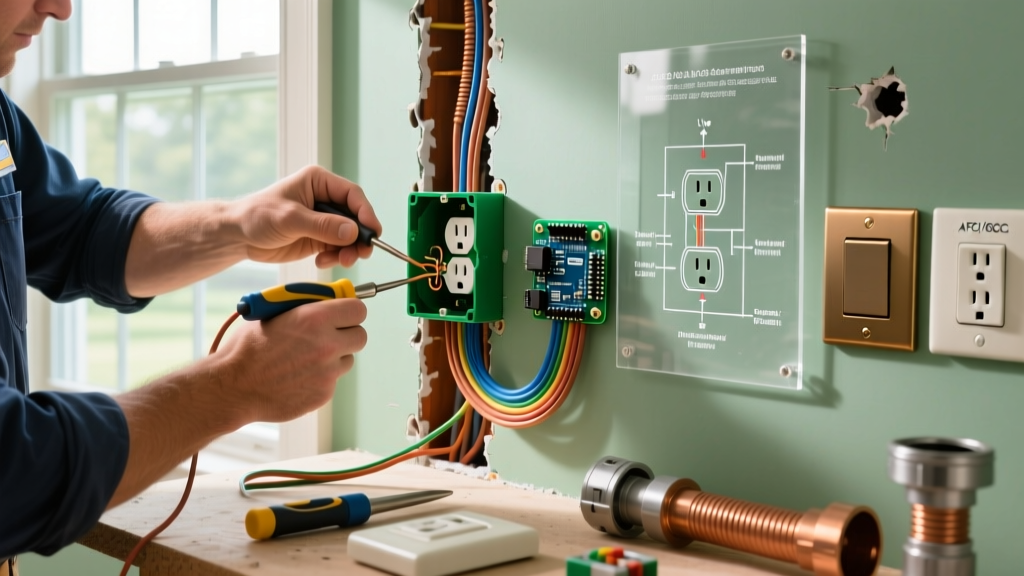
Inspect the bare copper ground, the white neutral, and the black hot wire. Note how they are connected. If the wires are pushed into the back of the old outlet (known as 'backstabbing'), they must be released using a small flathead screwdriver in the release slot, or cut off and re-stripped.
Step 3: Prep and Terminate the New Leviton Receptacle
Using your Klein 11055 strippers, strip exactly 3/4-inch of insulation from the black and white wires. Form a 'J-hook' at the end of the wire using the needle-nose pliers on your stripper tool.
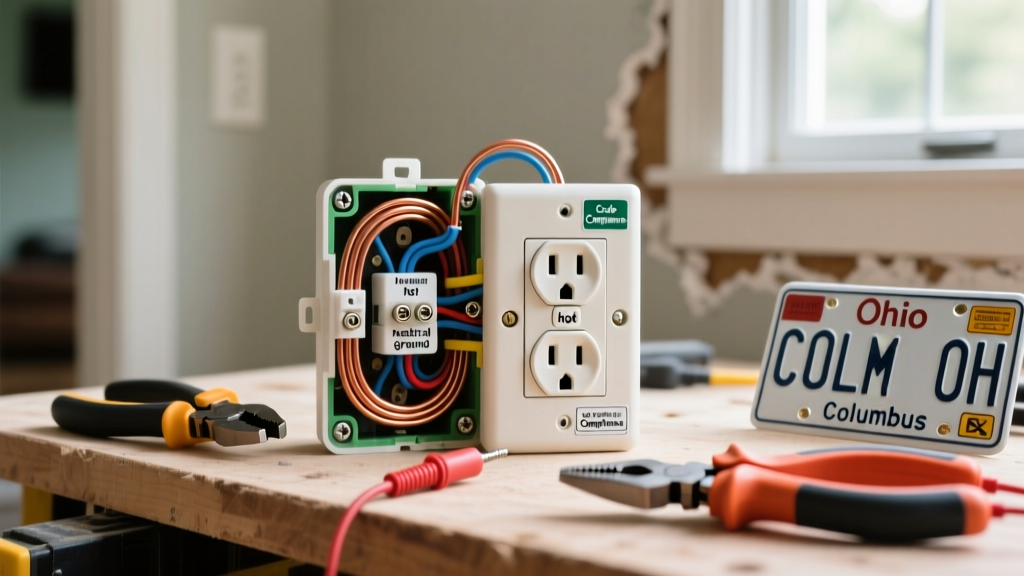
- Ground (Bare/Green): Connect to the green grounding screw at the bottom of the receptacle.
- Neutral (White): Connect to the silver-colored screws. The J-hook should wrap clockwise around the screw so that tightening the screw pulls the wire tighter.
- Hot (Black): Connect to the brass-colored screws, again wrapping clockwise.
Tighten the terminal screws firmly. A loose connection creates electrical arcing, which the U.S. Fire Administration (USFA) identifies as a primary ignition source for residential fires.
Step 4: Wrap, Fold, and Secure
Wrap a single layer of 3M Super 33+ electrical tape around the sides of the receptacle, covering the terminal screws. This prevents accidental shorting if the wires shift inside a cramped metal junction box. Carefully fold the wires in an accordion pattern, push the receptacle into the box, and secure it with the provided mounting screws. Attach the faceplate, restore power at the AEP Ohio panel, and test with a receptacle tester.
2026 Cost Breakdown: DIY vs. Columbus Pro Electricians
Is it worth doing it yourself? The table below illustrates the financial difference between tackling electrical outlet repair in Columbus, OH yourself versus hiring a licensed local contractor in 2026.
| Repair Scenario | DIY Material Cost | Columbus Electrician Rate (2026) | Estimated Time |
|---|---|---|---|
| Standard 15A TR Receptacle Swap | $4.50 - $8.00 | $150 - $225 (Min. Service Call) | 20 Minutes |
| GFCI Replacement (Kitchen/Bath) | $18.00 - $35.00 | $185 - $275 | 35 Minutes |
| Aluminum Wire Pigtail Repair | $12.00 (AlumiConn connectors) | $250 - $400 per circuit | 45 Minutes |
Note: Professional rates include the mandatory minimum trip charge prevalent in the Central Ohio market, which typically covers the first hour of labor.
Troubleshooting Region-Specific Outlet Failures
Central Ohio's climate and housing boom history create unique electrical challenges. Here is how to diagnose common local issues:
1. Exterior GFCIs Tripping in July and August
Ohio summers bring intense humidity and heavy thunderstorms. If your exterior GFCI outlet constantly trips during the summer, moisture is likely infiltrating the weatherproof cover. Upgrade to an 'in-use' extra-duty weatherproof cover (TayMac MX1000) that allows a cord to be plugged in while fully sealed. Ensure the caulk seal around the siding is intact.
2. Flickering Lights in 1970s Suburbs (Worthington, Hilliard)
Many homes built in the 1960s and 1970s in Columbus suburbs were wired with aluminum branch circuit wiring due to a copper shortage. Aluminum expands and contracts differently than copper, leading to loose connections at the brass/silver screws of standard outlets, causing flickering and severe fire hazards. If you spot silver wire, you must use COPALUM crimps or AlumiConn lug connectors to pigtail the aluminum to a copper lead before attaching it to a standard receptacle.
3. 'Dead' Outlets in Kitchen Islands
If an outlet in your kitchen suddenly dies, it is rarely a bad receptacle. In Columbus, kitchen countertop circuits are required to be protected by GFCIs. A tripped GFCI upstream (often located near the sink or in the basement directly below the kitchen) will cut power to all downstream outlets. Always trace the circuit back to the primary GFCI device and hit the 'Reset' button before assuming an outlet is broken.
Final Safety Reminders
Electrical outlet repair in Columbus, OH is a rewarding DIY task that saves money and improves home safety. However, never work on a panel with the main breaker exposed, and never bypass the grounding prong to fit an older appliance. When in doubt, or if you encounter scorched wires, melted plastic, or aluminum wiring, put the tools down and call a licensed Central Ohio electrician. Your safety is worth far more than the cost of a service call.