
When an Electrical Outlet Is Not Working: A Safety-First Diagnostic Approach
When an electrical outlet is not working, the immediate instinct is often to plug in a lamp, shrug, and move to the next room. However, from a safety and code compliance perspective, a dead receptacle is a critical warning sign. According to the Consumer Product Safety Commission (CPSC), electrical receptacles and wiring are involved in thousands of residential fires annually, often stemming from degraded connections, overloaded shared neutrals, or bypassed safety devices.
Troubleshooting a dead outlet requires more than just swapping the hardware; it demands a systematic review of the circuit's integrity, adherence to the latest National Electrical Code (NEC) standards, and an understanding of upstream protective devices. This guide provides a comprehensive, code-compliant diagnostic matrix to identify why your receptacle has lost power and how to safely restore it without introducing new fire or shock hazards.
The "Dead Receptacle" Diagnostic Matrix
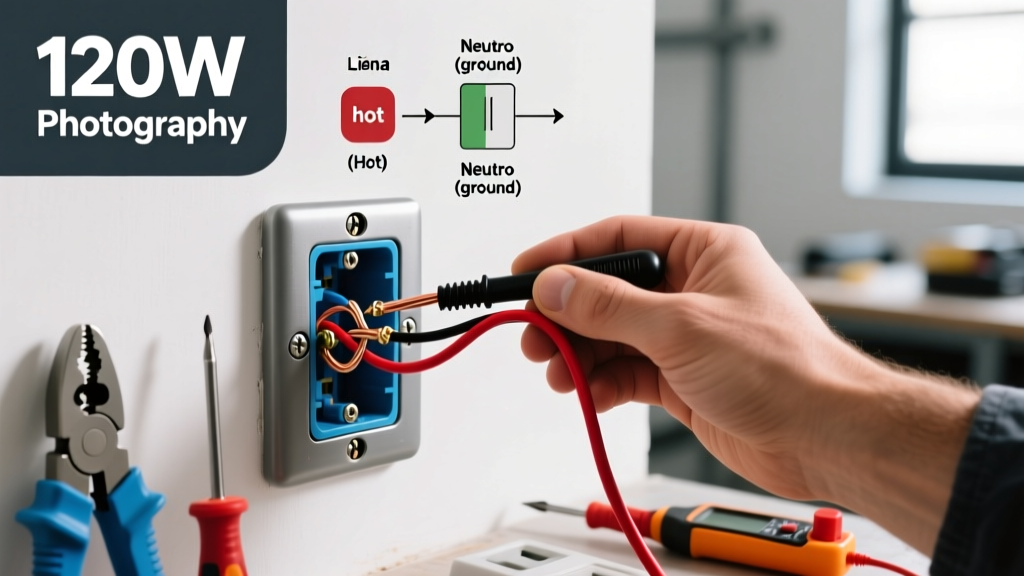
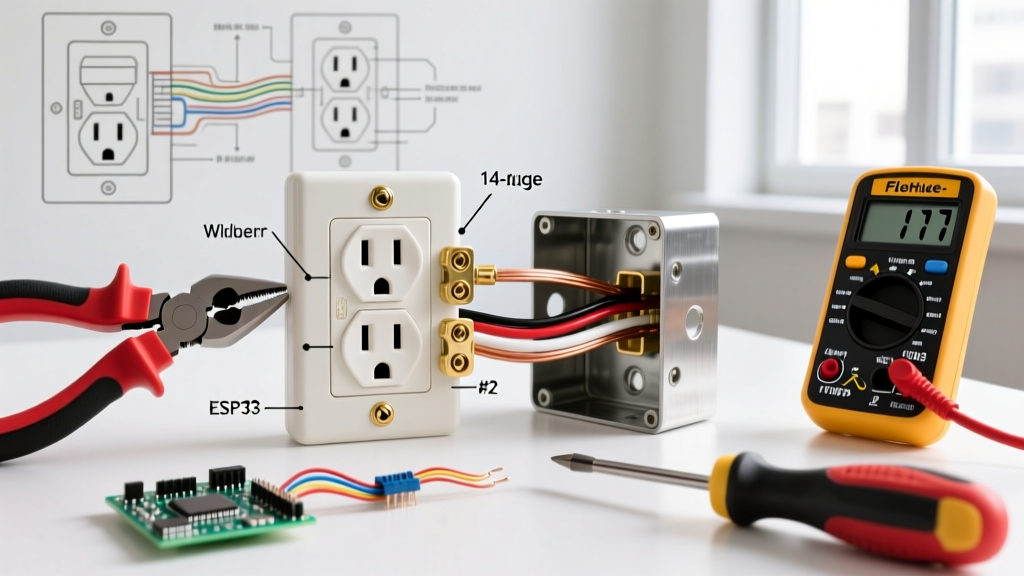
Before opening any electrical boxes, use a non-contact voltage tester and a receptacle tester to categorize the failure. The table below maps common symptoms to their underlying causes and relevant NEC codes.
| Symptom / Tester Reading | Probable Failure Mode | NEC Code Reference | Required Action |
|---|---|---|---|
| No power; GFCI/AFCI breaker tripped | Ground fault, arc fault, or downstream wiring damage | NEC 210.8 & 210.12 | Reset breaker; if it trips immediately, locate downstream fault. |
| Tester reads "Open Neutral" | Disconnected white wire, failed backstab connection | NEC 110.14 | Inspect side-wire terminations; replace push-in (backstabbed) receptacles. |
| Tester reads "Reversed Polarity" | Hot and neutral wires swapped on terminal screws | NEC 250.148 | Swap black (brass) and white (silver) wires; verify ground continuity. |
| Top half works, bottom half dead | Tab on brass/hot side not broken for split-wired switch loop | NEC 210.52 | Check wall switch; verify break-off tab is intact if not switch-controlled. |
| Tester reads "Open Ground" | Missing equipment grounding conductor (EGC) or bootleg ground | NEC 250.148 | Run new EGC or upgrade to GFCI receptacle with "No Equipment Ground" label. |
Step 1: Verifying Upstream GFCI and AFCI Compliance
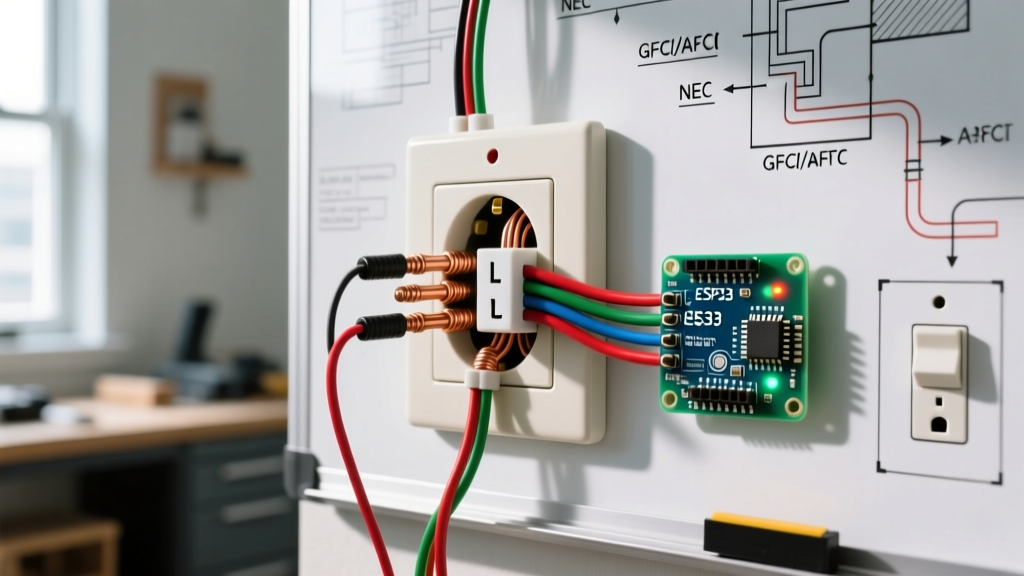
The most common reason an electrical outlet is not working in modern homes is a tripped upstream protective device. Under the NEC 2023 and upcoming 2026 code cycles, Arc-Fault Circuit Interrupter (AFCI) and Ground-Fault Circuit Interrupter (GFCI) protections are required in nearly all living spaces, kitchens, bathrooms, and outdoor areas.
Tracing the Circuit
A standard bedroom receptacle might be wired downstream of a dual-function AFCI/GFCI breaker in the main panel, such as the Eaton BRCAF120 (typically priced between $48 and $55). If this breaker detects a minor ground leakage or a parallel arc fault (often caused by a frayed lamp cord or a nail piercing a wire inside the wall), it will cut power to the entire branch circuit.
- Action: Locate your main panel and look for breakers with a "Test" button. If the handle is in the middle (tripped) position, turn it fully OFF, then snap it ON.
- Edge Case: If the breaker immediately trips again, do not force it. This indicates a hard fault, such as a pinched wire in a junction box or a degraded neutral bond. Forcing a tripped AFCI breaker can result in catastrophic arcing.
Step 2: Inspecting for Backstabbed Connections (Code Violation Risks)
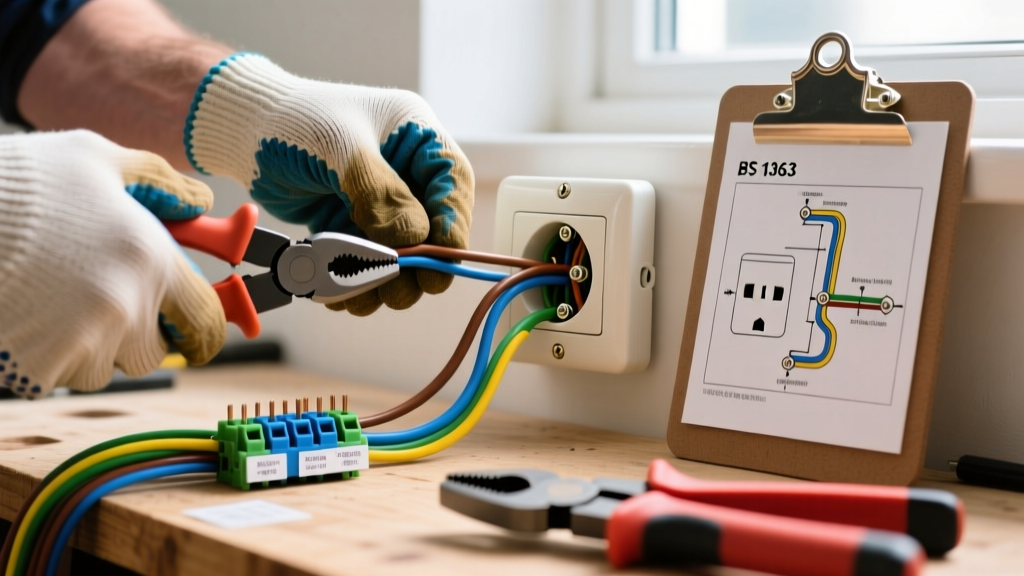
If the breaker is on and power is reaching the box, but the outlet remains dead, the failure is likely at the termination point. Many builder-grade receptacles feature "push-in" or "backstab" connectors on the rear. While technically permitted for 14 AWG solid copper wire under specific conditions, these spring-loaded connections are notorious for failing over time.
Expert Insight: Thermal cycling—the expansion and contraction of wires as loads are turned on and off—causes the internal spring tension in backstab connectors to fatigue. This leads to high-resistance connections, localized melting, and eventually an open circuit. Per NFPA NEC 110.14 (Terminations), connections must be made using methods specifically identified for the conductor material and size.
The Code-Compliant Fix
Never reuse a failed backstab receptacle. Replace it with a commercial-grade or high-quality residential model that utilizes side-wiring or screw-clamp plates. The Leviton 5262-W (approx. $3.50) features robust side-wiring screws, while the Hubbell HBL5262 (approx. $12.00) offers heavy-duty screw-clamp plates that grip the wire securely under the screw head.
Torque Specification: NEC 110.14(D) requires terminations to be torqued to the manufacturer's specifications. For standard 15A and 20A receptacles, this is typically 14 in-lbs. Use a calibrated torque screwdriver, such as the Klein Tools 32500TORX, to ensure the connection is neither too loose (causing arcing) nor too tight (stripping the brass threads or snapping the wire).
Step 3: Checking for Open Neutrals and Bootleg Grounds
When diagnosing why an electrical outlet is not working, a simple plug-in tester like the Klein Tools RT250 ($35) is invaluable. If the tester indicates an "Open Neutral," the return path for the current is broken. This often happens when a wire nut connection in a downstream junction box vibrates loose or when a daisy-chained neutral wire is severed during drywall installation.
The Danger of Bootleg Grounds
Occasionally, a DIYer attempting to "fix" an older two-prong ungrounded outlet will install a jumper wire between the neutral (silver) terminal and the ground (green) terminal to trick a tester into reading a correct ground. This is known as a "bootleg ground" and is a severe violation of NEC 250.148.
- The Hazard: If the neutral wire ever disconnects upstream, the metal chassis of any plugged-in appliance will become energized with 120V, creating a lethal shock hazard.
- The Compliant Solution: If an equipment grounding conductor (EGC) is genuinely absent, NEC 406.4(D)(2)(c) permits the installation of a GFCI receptacle. The GFCI must be labeled with the included "No Equipment Ground" and "GFCI Protected" stickers. This provides shock protection without creating a false ground path.
Step 4: Multi-Wire Branch Circuits (MWBC) and Handle Ties
If you are troubleshooting a kitchen or living room outlet where the top half works but the bottom half is dead (or vice versa), you may be dealing with a Multi-Wire Branch Circuit (MWBC). An MWBC uses two hot wires (typically black and red) sharing a single neutral (white) wire to provide two 120V circuits on opposite phases.
Code Requirements for MWBCs
Under NEC 210.4(B), all ungrounded (hot) conductors of an MWBC must be provided with a means to simultaneously disconnect all ungrounded conductors. This is achieved using a double-pole breaker or a handle tie on two adjacent single-pole breakers.
Failure Scenario: If a previous homeowner replaced the panel and forgot to install the handle tie, turning off one breaker to work on the "dead" half of the outlet leaves the shared neutral energized by the other half of the circuit. Furthermore, if the two hot wires are accidentally placed on the same phase leg instead of opposite phases, the shared neutral will carry the sum of both loads (up to 40A on a 20A wire), leading to melted insulation and electrical fires inside the wall.
2026 Repair Cost Guide & When to Call a Licensed Electrician
While replacing a standard receptacle is a straightforward DIY task for those with electrical experience, certain diagnostic findings require a licensed professional. Below are average 2026 market rates for electrical troubleshooting and repairs.
- Standard Receptacle Replacement: $125 - $175 (Includes service call, labor, and basic 15A/20A hardware).
- GFCI/AFCI Breaker Replacement: $200 - $300 (Includes panel work, new dual-function breaker, and circuit testing).
- MWBC Rewiring / Handle Tie Installation: $150 - $250 (Crucial for correcting shared-neutral fire hazards).
- Open Neutral / Wall Chase Rewiring: $400 - $800+ (Requires fishing new NM-B Romex through finished drywall).
When to Stop DIY Troubleshooting: If you open the electrical box and discover melted wire insulation, a distinct smell of ozone or burning plastic, or aluminum wiring (identifiable by its silver color and "AL" stamp) connected directly to copper-only brass terminals, stop immediately. Aluminum wiring requires specific CO/ALR rated receptacles or AlumiConn connectors to prevent galvanic corrosion and subsequent fires. Turn off the main breaker and contact a certified electrician.
Summary
When an electrical outlet is not working, it is a symptom of a broader circuit condition. By systematically verifying upstream AFCI/GFCI protection, eliminating backstabbed terminations, testing for proper polarity, and respecting MWBC code requirements, you ensure your home's electrical system remains safe, functional, and fully compliant with modern NEC standards.