
The Hidden Fire Hazard: When Receptacles Overheat
If you have ever touched a faceplate and felt an electrical outlet getting hot, you have encountered one of the most common—and dangerous—warning signs in residential wiring. Heat in an electrical system is not a normal byproduct of standard operation; it is a symptom of resistance, overload, or mechanical failure. According to the NFPA electrical fire reports, electrical distribution and lighting equipment are consistently among the leading causes of home structure fires, with loose connections and overloaded receptacles acting as primary culprits.
As a code requirement explainer, we must look beyond simple DIY fixes and examine the National Electrical Code (NEC). The 2023 and 2026 NEC enforcement cycles have introduced stricter mandates for termination torque, arc-fault protection, and device grading. Understanding why your outlet is overheating requires a deep dive into Joule heating, wire gauge mismatches, and the specific NEC articles designed to prevent your walls from catching fire.
The Physics of Heat and NEC Article 110.14(D)
The fundamental physics behind an overheating outlet is defined by Joule's First Law: Power (Heat) equals Current squared multiplied by Resistance ($P = I^2R$). When current flows through a low-resistance copper wire, heat generation is negligible. However, when current is forced through a high-resistance connection—such as a loose screw terminal or a degraded push-in backstab—the resistance spikes, generating intense localized heat.
To combat this, the NEC introduced and continues to enforce Article 110.14(D), which mandates the use of calibrated torque tools for electrical connections. In the past, electricians relied on 'hand-tight' judgment. Today, the code requires terminations to be tightened to the manufacturer's specified torque values. For standard 15A and 20A duplex receptacles, this typically means exactly 14 in-lbs (inch-pounds) of torque. Under-tightening causes arcing and heat; over-tightening strips the brass screw threads or crushes the copper wire, reducing its cross-sectional area and creating a new hot spot.
Code Insight: Under NEC 110.14(D), if a receptacle manufacturer specifies a torque value on the device yoke, you are legally and practically required to use a listed torque screwdriver (such as the Klein Tools 32500 series or Wiha insulated torque drivers) to achieve that exact specification during installation or remediation.
Diagnostic Matrix: Why Your Receptacle is Overheating
To properly diagnose an electrical outlet getting hot, you must match the physical symptoms to the underlying code violation. Use the matrix below to identify your specific failure mode.
| Symptom Profile | Root Cause | NEC Code Violation | Required Remediation |
|---|---|---|---|
| Faceplate is warm to the touch; breaker hasn't tripped. | Continuous load exceeding 80% of circuit capacity. | NEC 210.20(A) - Continuous loads must not exceed 80% of branch circuit rating. | Redistribute loads; ensure space heaters are on dedicated 20A circuits. |
| Hot spot localized directly behind the plug prongs. | Worn internal brass wipers; loose plug-to-receptacle contact. | NEC 406.4(A) - Receptacles must be of grounding type and in good repair. | Replace with a Commercial Specification grade receptacle (e.g., Leviton 5362). |
| Entire wall cavity feels warm; faint burning plastic smell. | Backstab push-in connection failure causing high-resistance arcing. | NEC 110.14(D) - Improper termination not torqued to spec. | Remove backstabbed wires; terminate on side screw terminals at 14 in-lbs. |
| Outlet gets hot only when high-draw appliances (AC, microwave) run. | 14 AWG wire incorrectly paired with a 20A breaker. | NEC 240.4(D) - Overcurrent protection mismatch for small conductors. | Downsize breaker to 15A or rewire circuit with 12 AWG copper. |
Overloaded Circuits and Wire Gauge Mismatches
One of the most severe reasons for an electrical outlet getting hot is a wire gauge mismatch, often the result of unpermitted DIY work or outdated renovations. Standard residential lighting and receptacle circuits use either 14 AWG (American Wire Gauge) copper protected by a 15-amp breaker, or 12 AWG copper protected by a 20-amp breaker.
If a previous homeowner swapped a 15A breaker for a 20A breaker because 'it kept tripping,' they created a severe fire hazard. The 14 AWG wire will safely carry up to 15 amps. If you pull 18 amps through that wire to power a portable heater and a gaming PC simultaneously, the wire will heat up inside the wall long before the 20A breaker trips. The heat transfers down the copper conductor directly into the receptacle's brass terminals. The CPSC electrical safety guidelines explicitly warn against upsizing breakers without verifying the hidden wire gauge, noting that concealed wiring fires often smolder for hours before detection.
The 'Backstab' Push-In Connection Failure
Turn any cheap, builder-grade receptacle around, and you will see small holes on the back marked with strip lengths. These are push-in (backstab) terminals. They rely on a tiny internal spring-steel clip to grip the 14 AWG solid copper wire. While UL-listed for use, these connections are notorious for failing under continuous thermal cycling.
As the outlet heats up during use and cools down when unplugged, the copper wire expands and contracts. Over a few years, this thermal cycling weakens the spring clip. The grip loosens, microscopic gaps form, and electrical arcing begins. Arcing generates temperatures exceeding 10,000°F at the microscopic point of contact, melting the plastic polycarbonate housing of the outlet. Professional electricians universally avoid backstabs in favor of side-screw terminations or rear-clamp pressure plates (like those found on Hubbell's 5362-A 20A commercial receptacles, which cost around $6.50 in 2026).
Step-by-Step Code-Compliant Remediation
If you have identified an overheating outlet, immediate replacement is mandatory. Do not attempt to 'tighten' a melted or discolored device. Follow this precise, code-compliant workflow:
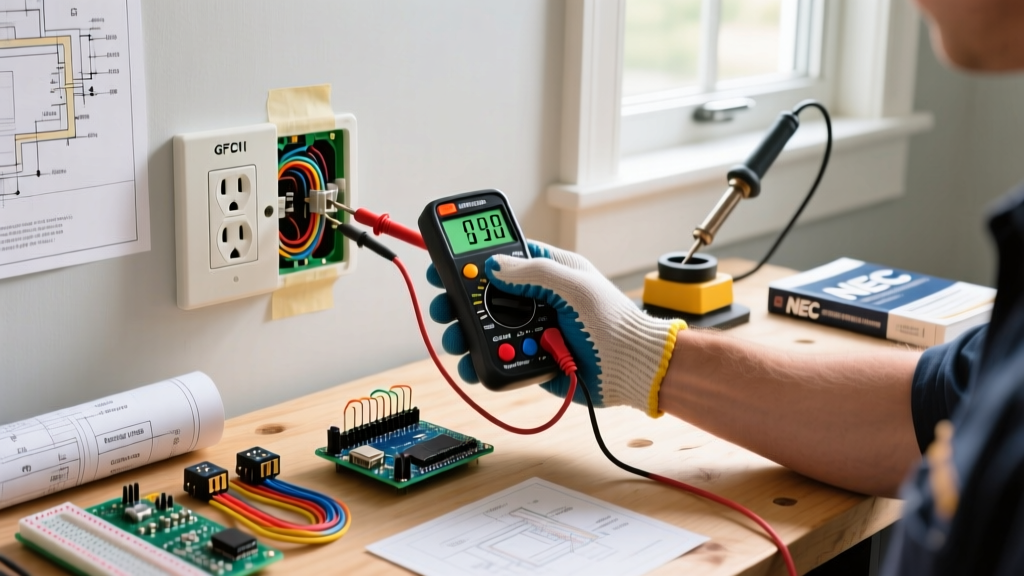
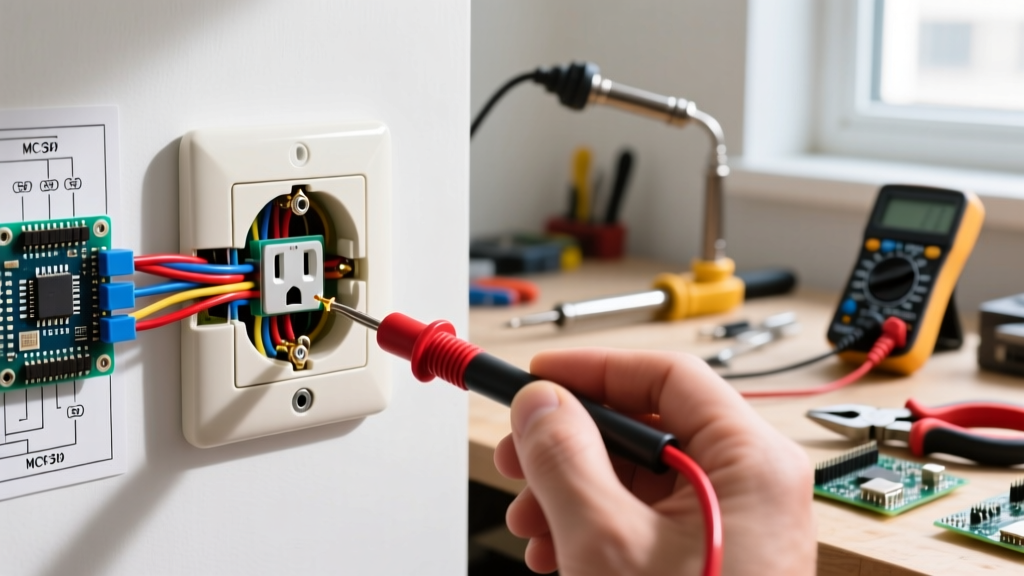
- De-energize and Verify: Turn off the branch circuit breaker. Use a non-contact voltage tester (e.g., Fluke 2AC-II) and a plug-in circuit analyzer to confirm zero voltage. Never trust the breaker label blindly.
- Inspect the Wiring Insulation: Pull the receptacle out of the gang box. If the thermoplastic insulation on the black or white wires is brittle, cracked, or melted back more than 3/4 of an inch, the wire is compromised. You must strip it back to fresh copper or, if necessary, splice in a new pigtail using Wago 221 lever-nuts inside an approved junction box.
- Select the Right Replacement: Discard residential-grade $1.20 receptacles. Purchase a Commercial Specification grade device (e.g., Leviton 5362-E or Eaton 8300). These feature thicker brass contact wipers and glass-filled nylon faces that resist thermal deformation. Expect to pay $3.50 to $8.00 per unit in 2026.
- Terminate with Precision: Form a shepherd's hook in the stripped 12 or 14 AWG wire. Loop it clockwise around the brass screw so that tightening the screw pulls the wire tighter. Use a calibrated torque screwdriver set to the manufacturer's spec (usually 14 in-lbs).
- Secure the Yoke: Ensure the device sits flush against the drywall or plaster. If the box is recessed more than 1/4 inch from the wall surface, NEC 314.20 requires you to install a non-combustible box extender ring to prevent heat from dissipating into the wall cavity.
AFCI and GFCI Mandates for Replacements
When replacing an old, hot-running receptacle, you must also comply with NEC Article 406.4(D). This article dictates that if you are replacing a receptacle in a location where the current code requires Ground-Fault Circuit Interrupter (GFCI) or Arc-Fault Circuit Interrupter (AFCI) protection, the replacement device must provide that protection.
For example, if your overheating outlet is in a bedroom (an AFCI-mandated zone since the 2008 NEC) or a kitchen/living room area near a sink (GFCI-mandated), you cannot simply swap in a standard duplex receptacle. You must either install a GFCI/AFCI receptacle at that location (costing $25-$45) or ensure the branch circuit is protected by an AFCI/GFCI combination breaker in the main panel. For a comprehensive look at standard development and historical code changes, refer to the NFPA 70 Standard Development portal.
Frequently Asked Questions
Is it normal for an outlet to feel slightly warm?
Ambient temperature plus a slight rise (up to 86°F or 30°C total) can be normal if a high-draw device like a laptop charger is plugged in. However, if the faceplate is hot to the touch (exceeding 110°F) or smells like ozone or melting plastic, it is a critical failure. Use an infrared thermometer to measure the delta-T (temperature difference) between the outlet and the ambient room air.
Can I just upgrade to a 20A receptacle to handle the heat?
No. A 20A receptacle (which features the horizontal T-slot) will only physically handle more load if the wiring behind it is 12 AWG and the breaker is 20A. Plugging high-draw devices into a 20A receptacle wired with 14 AWG copper will simply allow the wire to overheat and burn inside the wall without tripping a 15A breaker immediately.
Why is my smart plug or dimmer switch getting hot?
Solid-state devices like smart plugs (e.g., Kasa, Wyze) and dimmer switches contain internal triacs and MOSFETs that dissipate waste heat as part of their normal operation. These devices are typically rated to operate safely at surface temperatures up to 140°F (60°C). However, they must not be installed in enclosed, unvented wall boxes, as trapped heat will degrade their internal capacitors.