
Decoding the Electrical Outlet China Standard: GB 1002 and GB 2099
When sourcing components for international DIY projects, importing smart home hardware, or wiring workshops with imported machinery, understanding the electrical outlet China standard is critical for safety and compliance. Unlike the NEMA standards used in North America, China relies on the GB 1002-2008 (plug and socket dimensions) and GB 2099.1-2008 (general safety requirements) frameworks. These standards dictate a 220V/50Hz system that utilizes a unique variation of the Type I plug, which requires specific wiring techniques, wire gauges, and terminal torques to operate safely.
According to the IEC World Plugs database, China's Type I socket shares a physical resemblance with the AS/NZS 3112 standard used in Australia and New Zealand. However, the Chinese variant features a longer earth pin and strictly enforces different pin spacings for 10A and 16A circuits. Miswiring these receptacles or treating them as universal can lead to catastrophic thermal failures.
10A vs. 16A: The Pin Spacing Trap
One of the most common edge cases DIYers face when working with Chinese receptacles is the physical incompatibility between 10A and 16A Type I plugs. In China, high-draw appliances (like air conditioners and heavy-duty power tools) use a 16A socket with wider pin spacing. Attempting to use a cheap adapter to force a 16A plug into a 10A socket bypasses the built-in physical safety interlock.
| Specification | 10A Chinese Type I (GB 1002) | 16A Chinese Type I (GB 1002) |
|---|---|---|
| Max Current / Voltage | 10A / 250V AC | 16A / 250V AC |
| Line/Neutral Pin Spacing | ~14.5 mm | ~19.5 mm |
| Earth Pin Length | 21.0 mm | 24.5 mm |
| Required Wire Size (Metric) | 1.5 mm² to 2.5 mm² | 4.0 mm² |
| Required Wire Size (AWG Equiv.) | 14 AWG to 12 AWG | 10 AWG |
Wiring Diagram Reference: Hardwiring a 16A Type I Receptacle
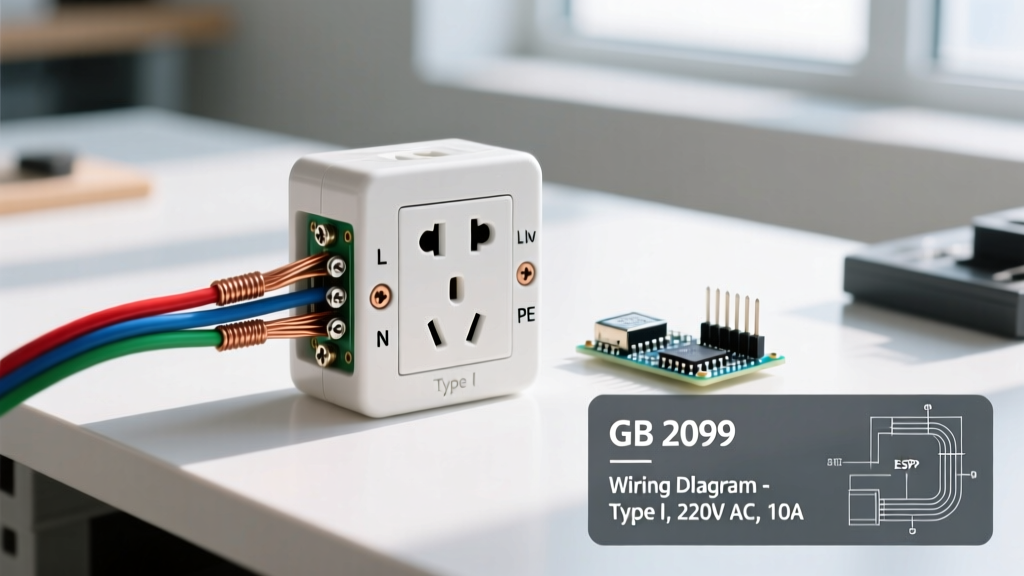
Wiring a 16A Chinese receptacle requires strict adherence to the GB/T 6995 color code standard for electrical cables. If you are adapting this to a North American or European junction box, you must translate the color codes accurately to prevent reverse polarity or ungrounded chassis faults.
Terminal Identification and Color Codes
When looking at the back of a standard CCC-certified (China Compulsory Certification) 16A receptacle, the terminal layout is standardized:
- Earth (E / PE): Top terminal. Connect the Yellow/Green wire. This pin is physically longer to ensure ground connection is made before line/neutral.
- Neutral (N): Bottom left terminal. Connect the Blue wire. (Note: In older US wiring, this would be the White wire).
- Line (L): Bottom right terminal. Connect the Brown wire. (Note: In older US wiring, this would be the Black wire).
Critical Safety Warning: China operates on a 220V/50Hz grid. If you are wiring a Chinese-manufactured 220V receptacle into a North American split-phase 120V/240V panel, you must use a dedicated 240V double-pole breaker and ensure the appliance plugged into it is rated for 60Hz operation. Running a 50Hz Chinese compressor motor on 60Hz US power will increase RPM by 20%, leading to overheating and premature failure.
Wire Preparation and Terminal Torque
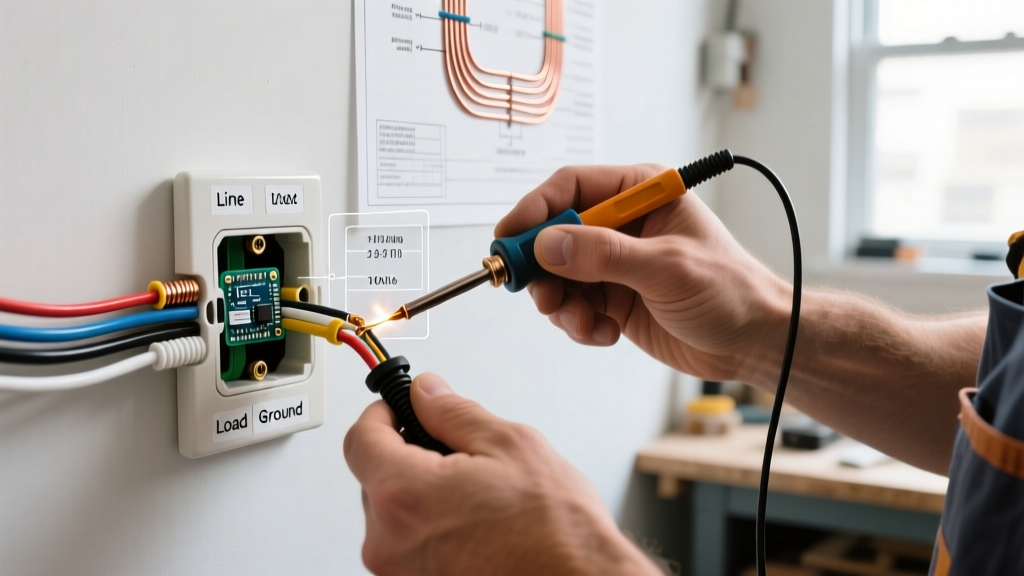
For a secure connection that prevents arcing under heavy loads (such as a 3000W Chinese-manufactured space heater or EV charger), strip exactly 12mm of insulation from the solid copper wire. Insert the wire fully into the clamp terminal. Using a calibrated torque screwdriver, tighten the terminal screws to 0.8 Nm to 1.2 Nm. Under-torquing leads to micro-arcing and carbon buildup; over-torquing can strip the brass threads common in budget imported receptacles.
Integrating Chinese Smart Outlets (Tuya/Sonoff) into DIY Panels
Many DIYers purchase Chinese-manufactured smart sockets (like those based on the Tuya Zigbee platform or Sonoff Wi-Fi modules) to integrate into custom control panels. These devices often contain internal 16A/250VAC relays (such as the Hongfa HF46F-G or Omron G5Q series) and require specific hardwiring techniques when removed from their plastic enclosures for flush mounting.
Bypassing and Hardwiring Smart Relays
When tearing down a Tuya-based smart plug to hardwire it into a custom 3D-printed enclosure or DIN rail:
- Identify the HLK Power Module: Most Chinese smart plugs use an HLK-PM01 or HLK-5M05 AC-DC step-down converter to power the ESP8266/ESP32 or Zigbee chip. Ensure this module has adequate clearance (at least 5mm) from high-voltage traces to prevent dielectric breakdown.
- Relay Line Routing: The internal relay only switches the Line (L) conductor. The Neutral (N) must be spliced directly through the module to power both the internal logic board and the downstream load.
- Thermal Management: Chinese smart relays rated for 16A often operate at their absolute thermal limit at that draw. If hardwiring a continuous 12A+ load, solder a small aluminum heatsink to the relay's plastic casing or apply thermal paste to the enclosure wall to dissipate heat.
Troubleshooting Common Failures in Imported Sockets
When working with bulk-imported electrical components, quality control can vary wildly. Here are the most common failure modes and how to diagnose them:
- Thermal Runaway on 10A Sockets: If a 10A socket feels hot to the touch at a mere 8A draw, the internal phosphor bronze contacts lack sufficient spring tension. This is common in non-CCC certified clones. Fix: Replace immediately with a reputable brand like Chint or Bull, ensuring the CCC mark is molded into the plastic, not just printed.
- Earth Pin Deflection: In cheap Type I sockets, the earth pin receptacle may be misaligned by 1-2mm. This causes the earth pin to bend upon insertion, eventually snapping off inside the plug. Fix: Use a digital caliper to verify the earth pin hole is perfectly centered relative to the L/N slots before installation.
- Loose Screw Terminals: Many imported sockets use soft zinc-alloy screws instead of brass or steel. These strip easily. Fix: Upgrade the terminal screws to M3.5 stainless steel machine screws before mounting the receptacle in the wall box.
Compliance and Certification Marks
Never install an electrical outlet in a permanent structure without verifying its certification. For Chinese outlets, the CCC (China Compulsory Certification) mark is mandatory. You can verify a manufacturer's CCC certificate number through the CNCA (Certification and Accreditation Administration of China) database. If you are installing these in a region governed by the NFPA National Electrical Code (NEC), be aware that CCC-listed components are generally not UL/ETL listed, which may void your local insurance coverage if used in permanent residential wiring. For DIY test benches, portable smart panels, or off-grid setups, they are perfectly viable when wired with strict adherence to safety margins.
Frequently Asked Questions (FAQ)
Can I wire a Chinese 220V outlet to a US 120V circuit?
Physically, yes. The receptacle will accept the wires, and 120V will safely pass through a 250V-rated Chinese socket. However, the physical plug shape (Type I) will not accept standard US NEMA 1-15 or 5-15 plugs without an adapter. It is highly discouraged to mix plug types on a single voltage grid, as it creates a severe shock and equipment damage hazard for future users.
What is the difference between the Chinese Type I and Australian Type I?
While they look identical at a glance, the Chinese GB 1002 standard requires the earth pin to be slightly longer (21mm vs 20mm) and the plug face is often molded with a specific CCC indentation. Furthermore, Australian sockets often feature integrated physical shutters on the Line and Neutral slots, which are not universally mandated on older Chinese GB 2099.1-2008 designs, though newer 2021+ updates are beginning to require them.
Do I need a special wall box for Chinese outlets?
Chinese wall boxes (dark boxes) are typically standardized to 86mm x 86mm (the '86 type' box), which is very close to the UK standard but slightly different from the US single-gang rectangular box. If mounting a Chinese 86-type faceplate in a US drywall setup, you will need an 86mm-to-US-gang adapter plate, or you must cut a custom square hole in the drywall and use a specialized 86mm mounting bracket.