
The Ultimate Tool & Material Guide for EV Receptacle Installation
As electric vehicle adoption accelerates in 2026, upgrading your home with a dedicated Level 2 charging station is no longer a luxury—it is a necessity. While hardwiring an EVSE (Electric Vehicle Supply Equipment) is often recommended, many homeowners prefer the flexibility of a 240V receptacle. Installing a heavy-duty electrical outlet for car charger applications requires strict adherence to the National Electrical Code (NEC), specific heavy-gauge wiring, and industrial-grade materials. Standard household receptacles will melt under the continuous high-amperage draw of an EV.
This comprehensive guide details the exact tools, materials, and Bill of Materials (BOM) required to safely install a 50-amp NEMA 14-50 or 6-50 receptacle. According to the U.S. Department of Energy, Level 2 home charging can add up to 30 miles of range per hour, but only if the underlying infrastructure is built to handle continuous thermal loads without degradation.
The NEC Code Reality: Continuous Loads and GFCI Mandates
Before purchasing materials, you must understand two critical NEC rules that dictate your BOM:
The 80% Continuous Load Rule (NEC Article 210.20): EV charging is classified as a continuous load (operating for 3 or more hours). Therefore, a 40-amp EV charger requires a 50-amp breaker, and 6 AWG copper wire rated for at least 65 amps at 75°C.
The GFCI Receptacle Dilemma: Recent NEC cycles mandate Ground Fault Circuit Interrupter (GFCI) protection for 50A EV receptacles. This means you cannot use a standard 50A breaker; you must purchase a 50A GFCI breaker. Warning: Some older EVSE units have internal GFCI sensors that can cause nuisance tripping when paired with a GFCI breaker. Always verify your EVSE manual before installation.
Receptacle Selection Matrix: Avoiding Thermal Failure
The most common point of failure in an electrical outlet for car charger setups is the receptacle itself. Cheap, residential-grade receptacles lack the internal bus bar tension required to maintain a cool connection over a 10-hour charging session. Below is a comparison of the most common 50-amp receptacles on the market in 2026.
| Brand & Model | Grade | Terminal Type | Thermal Performance | Est. Price (2026) |
|---|---|---|---|---|
| Hubbell 9450A | Industrial | Back-wired / Screw | Excellent (Gold Standard) | $95 - $120 |
| Bryant 9450FR | Industrial | Back-wired / Screw | Excellent (Identical to Hubbell) | $85 - $105 |
| Leviton 279-S00 | Residential | Side-wired | Poor (Prone to melting) | $12 - $18 |
| Cooper 5754N | Commercial | Back-wired | Good | $45 - $60 |
Expert Recommendation: Exclusively use the Hubbell 9450A or its sibling, the Bryant 9450FR. The Alternative Fuels Data Center and independent EV forums consistently flag the Leviton 279-S00 for thermal runaway and melted faceplates when subjected to 40A continuous draws. The Hubbell/Bryant units feature massive brass contact blades that grip the EV plug tightly, minimizing resistance and heat.
Wire Sizing and Conduit Requirements
For a 50-amp circuit, your wire gauge depends on the installation method and run length.
Option A: THHN Copper in Conduit (Recommended for Indoors/Garages)
- Wire: 6 AWG THHN/THWN-2 Copper (Black, Red, Green). If the run exceeds 75 feet, upsize to 4 AWG to mitigate voltage drop.
- Neutral: If installing a NEMA 14-50 (which includes a neutral), you must pull a 6 AWG white neutral wire, even if your EVSE does not use it. The NEC requires the receptacle to be fully wired to its rating.
- Conduit: 3/4-inch EMT (Electrical Metallic Tubing) or Schedule 80 PVC.
Option B: SER Cable (Service Entrance Cable)
- Wire: 4-4-4-6 Aluminum SER cable. Aluminum is highly cost-effective for long runs, but you must use 4 AWG to achieve the necessary ampacity, and you must apply anti-oxidant paste (Noalox) to the terminals to prevent galvanic corrosion.
Essential Tools Checklist for EV Outlet Installation
Installing a 240V, 50-amp circuit is not a standard DIY outlet swap. The torque requirements and wire thickness demand specialized tools.
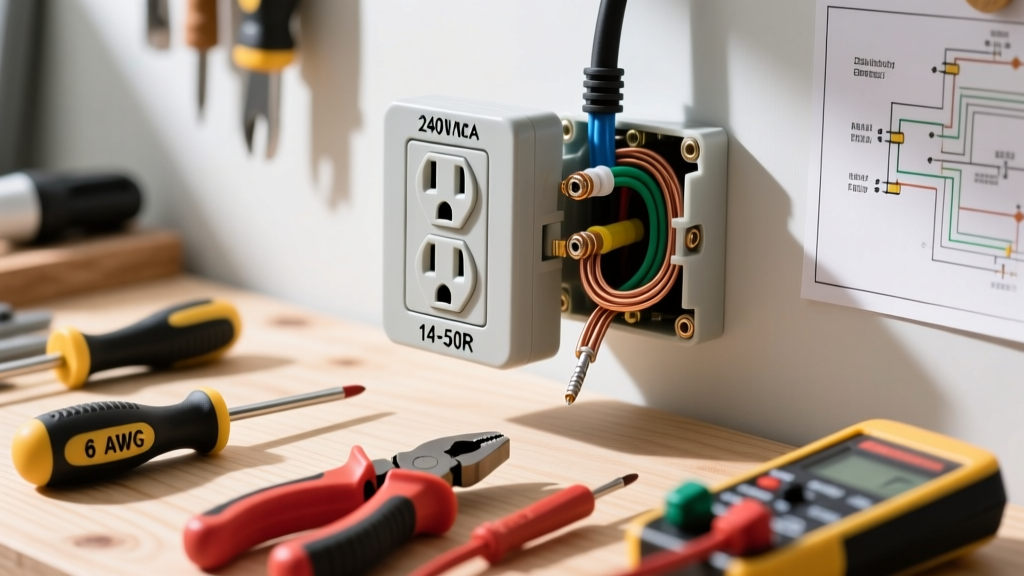
- Torque Screwdriver (e.g., CDI 1002MFRMH): The Hubbell 9450A requires exactly 75 in-lbs of torque on its terminal screws. Under-torquing causes arcing; over-torquing strips the brass threads.
- Heavy-Duty Wire Strippers (e.g., Klein Tools 11063W): Standard strippers will fail on 6 AWG and 4 AWG wire. You need a ratcheting or heavy-leverage stripper.
- Non-Contact Voltage Tester & Multimeter (e.g., Fluke 117): Mandatory for verifying zero voltage at the panel and testing the 240V split-phase output at the receptacle.
- Conduit Bender & Hacksaw: If running EMT conduit, a 3/4-inch EMT bender and a fine-tooth hacksaw or reciprocating saw are required.
- Anti-Oxidant Paste (Noalox): Strictly required if terminating aluminum SER wire onto copper or brass receptacle terminals.
- Wire Pulling Lubricant (e.g., Polywater J): Essential when pulling three or four 6 AWG wires through 3/4-inch conduit over long distances.
2026 Material Bill of Quantities (BOM) & Cost Estimate
Below is a realistic material cost breakdown for a standard 40-foot garage installation using copper THHN in EMT conduit, terminating at a Hubbell 14-50 receptacle.
| Material | Specification | Quantity | Est. Cost |
|---|---|---|---|
| GFCI Breaker | 50A 2-Pole GFCI (Eaton BR250GFI or Square D HOM250GFIC) | 1 | $115.00 |
| Receptacle | Hubbell 9450A (NEMA 14-50R) | 1 | $105.00 |
| THHN Wire | 6 AWG Copper (Black, Red, White, Green) | 160 ft | $140.00 |
| Conduit & Fittings | 3/4" EMT, straps, sweep elbows, connectors | 1 Lot | $65.00 |
| Deep Gang Box | 4-inch square, 2-1/8" deep steel box | 1 | $12.00 |
| Faceplate | Stainless Steel 2-Gang (Hubbell/Bryant) | 1 | $8.00 |
| Misc. Hardware | Wire staples, pulling lube, Noalox, torque seal | 1 Lot | $35.00 |
| Total Estimated Material Cost (Excluding Panel Upgrade) | $480.00 | ||
Critical Edge Cases and Failure Modes
1. The 'Unused Neutral' Code Violation
Many EVSE manufacturers state in their manuals that the neutral wire is not required for their specific 14-50 plug. However, the NEC requires that if you install a NEMA 14-50 receptacle, it must be wired completely, including the neutral. If you do not need a neutral, you should install a NEMA 6-50 receptacle instead, which only requires two hots and a ground. Leaving a 14-50 neutral terminal empty while using a 14-50 plug is a direct code violation and will fail inspection.
2. Panel Capacity and Load Calculations
Before buying a single wire, perform an Article 220 Residential Load Calculation. Adding a 40A continuous EV load to an older 100-amp or 150-amp panel that is already supporting electric resistance heating, an electric oven, and a dryer will likely exceed the main breaker's capacity. If your load calculation fails, you will need to either install an automated EV energy management system (EVEMS) like the Wall Connector with Grid-Tie or upgrade your main service to 200A.
3. Thermal Seal Verification
After 30 days of use, use an infrared thermal camera (like the FLIR One) to scan the receptacle faceplate during a peak charging session. The temperature delta between the receptacle face and the ambient wall should not exceed 15°F. If the receptacle is hot to the touch, the terminal torque was likely incorrect, or the EV plug pins are worn and failing to make full contact with the Hubbell internal wipers.
Final Thoughts on Safety and Inspection
Installing an electrical outlet for car charger use is a high-stakes electrical project. The combination of continuous high-current draw and the potential for thermal degradation means that cutting corners on materials is dangerous. Always pull a local permit, use industrial-grade receptacles like the Hubbell 9450A, torque all connections to the manufacturer's exact inch-pound specifications, and ensure your GFCI breaker matches your panel's specific bus bar architecture. When executed correctly, a properly spec'd 50A receptacle will provide decades of safe, rapid Level 2 charging for your home.