
The Critical Importance of Correct Plug Wire Identification
Replacing a damaged plug or wiring a new piece of equipment seems straightforward until you strip back the outer jacket and are confronted with a bundle of coloured conductors. Misinterpreting electric plug wiring colours is one of the leading causes of reverse polarity, equipment damage, and severe electrical shock. In 2026, with global supply chains offering a mix of imported appliances and domestic wiring standards, understanding the material science and regional colour codes of flexible cords is more vital than ever.
This guide serves as your definitive tool and material reference. We will dissect North American (NEMA/NEC), British (BS), and European (IEC) colour standards, evaluate the specific cable types you should be purchasing, and recommend the exact tools required for a code-compliant termination.
The Global Divide: Regional Colour Code Matrix
Before purchasing materials, you must identify the regional standard of the plug and cable you are working with. A wire that is 'Neutral' in the United States could be a lethal 'Hot' line in an older Australian installation. Below is the definitive 2026 reference matrix for single-phase AC plug wiring.
| Region / Standard | Line / Hot (Phase) | Neutral | Earth / Ground | Voltage Context |
|---|---|---|---|---|
| US & Canada (NEC) | Black (or Red/Blue) | White (or Grey) | Bare Copper / Green | 120V / 240V |
| UK (BS 7671) | Brown | Blue | Green & Yellow Stripe | 230V |
| EU (IEC 60446) | Brown | Blue | Green & Yellow Stripe | 230V / 400V |
| Australia / NZ | Red (or Brown) | Black (or Blue) | Green & Yellow Stripe | 230V |
Material Deep Dive: Selecting the Right Flexible Cord
Understanding electric plug wiring colours is useless if you are using the wrong cable jacket for the application. Fixed in-wall wiring (like NM-B Romex) must never be used to wire a portable plug. You need flexible, stranded cord. Here are the material specifications you need to source from your electrical supplier.
North American Standards: SJT and SJTW Cords
For standard 15A and 20A NEMA 5-15P or 5-20P plug replacements, SJT (Service Junior Thermoplastic) or SJTW (the 'W' denotes weather/water resistance for outdoor use) is the mandatory material.
- 14 AWG (14/3 SJTW): Rated for 15 Amps. Ideal for standard household appliances, power tool chargers, and IT equipment. Expect to pay around $0.65 to $0.85 per linear foot in 2026.
- 12 AWG (12/3 SJTW): Rated for 20 Amps. Required for heavy-duty equipment like table saws, large air compressors, and RV shore power adapters. Costs approximately $1.10 to $1.40 per foot.
International Standards: Harmonised H05 and H07 Cords
If you are wiring a UK BS 1363 (13A) or European Schuko plug, you must use harmonised PVC or rubber flex.
- H05VV-F (PVC Flex): Light-duty, 3-core 1.5mm² cable. Rated for up to 10A-13A depending on the fuse. Perfect for desk lamps, computers, and light domestic appliances.
- H07RN-F (Rubber Flex): Heavy-duty, ruggedized jacket. 3-core 2.5mm². Essential for outdoor equipment, stage lighting, and high-draw workshop machinery. The rubber resists abrasion and UV degradation far better than PVC.
The Professional's Tool Kit for Plug Termination
Stranded wire requires different handling than solid core wire. Nicks in stranded copper reduce the wire's ampacity and create hot spots. Equip your bench with these specific tools:
- Wire Strippers (Stranded Optimized): The Klein Tools 11063W Katapult (approx. $38) is engineered specifically to strip 10-22 AWG stranded wire without catching or tearing the copper strands. Avoid cheap dial strippers that crush the cord jacket.
- Ferrule Crimper (For EU/UK Plugs): European screw terminals often require wire ferrules to prevent stray strands from causing short circuits. The IWISS SN-2550 (approx. $28) paired with 1.5mm² and 2.5mm² bootlace ferrules ensures a gas-tight, professional connection.
- Digital Multimeter: The Fluke 117 True-RMS Multimeter (approx. $215) features non-contact voltage detection (VoltAlert) and low-impedance testing to eliminate phantom voltage readings when verifying your newly wired plug.
- Torque Screwdriver: While often overlooked in DIY, the NFPA NEC guidelines increasingly emphasize proper terminal torque. A Wiha 610P1 torque driver set to 0.8 Nm (7 in-lbs) ensures the brass terminal screws are tight enough to prevent arcing, but not so tight that they shear the stranded wire.
Edge Cases and Common Failure Modes
Even seasoned electricians encounter edge cases when dealing with electric plug wiring colours. Here is how to navigate the most common traps:
The 'Tinned Copper' Confusion
Many high-quality marine and outdoor SJTW cables use tinned copper to prevent oxidation. When you strip the jacket, the Hot, Neutral, and Ground wires will all look identical (silver/grey). Solution: You must use the printed tracer thread inside the jacket or rely on the subtle ridge on the neutral conductor's insulation to identify the wires before stripping the individual conductors.
Stranded Wire 'Birdcaging' Under Screws
When wrapping stranded wire around a North American NEMA plug terminal screw, the strands often splay out ('birdcage') when the screw is tightened, reducing the contact area and creating a fire hazard. Solution: Always twist the stripped strands tightly clockwise before forming the hook. Alternatively, use a crimp-on ring terminal (14 AWG or 12 AWG vinyl-insulated ring) for a vastly superior mechanical connection.
Old UK / Pre-2006 Colour Legacy
If you are repairing a vintage British appliance, the old colour code was Red (Live), Black (Neutral), and Green (Earth). If you are splicing a modern H05VV-F cable (Brown/Blue/Green-Yellow) onto an old appliance's internal wiring, you must map Brown to Red, and Blue to Black. Miswiring this will send 230V directly to the appliance chassis.
Step-by-Step: Wiring a Heavy-Duty 15A NEMA Plug
Follow this precise workflow to ensure a safe, durable termination using a Leviton 5266-C or Hubbell 5266C plug body.
- Jacket Stripping: Use a cable ripper or the notch on your Klein pliers to slit the outer jacket exactly 1.5 inches from the end. Peel back and snip the jacket cleanly. Do not score the inner insulation.
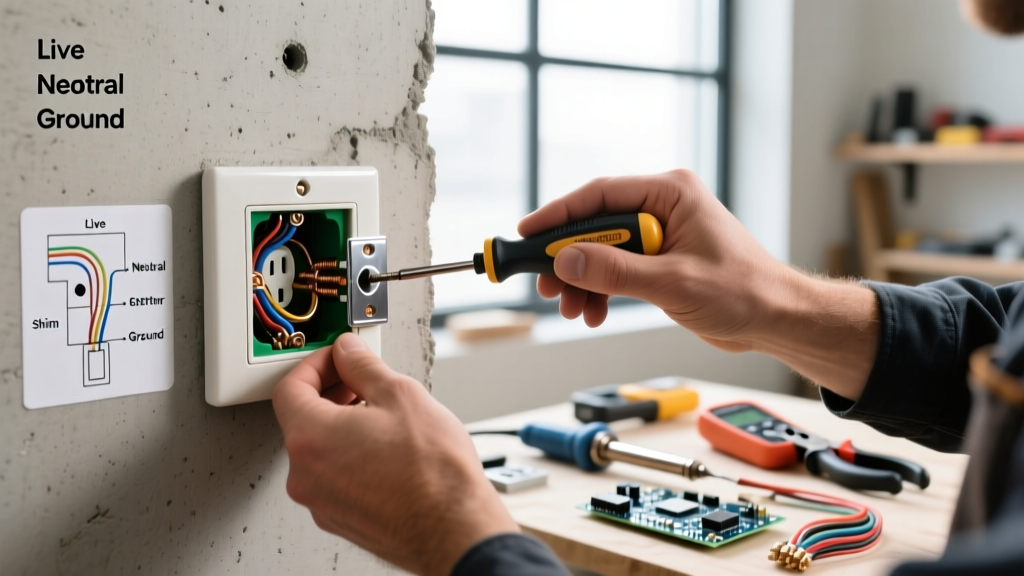
- Conductor Prep: Strip exactly 3/8 inch of insulation from the Black, White, and Green wires. Twist each stranded bundle tightly clockwise.
- The Ground First: Always terminate the Green (Ground) wire to the green terminal screw first. This provides physical strain relief and ensures safety continuity even if the cord is yanked.
- Neutral and Hot: Form a tight clockwise hook with the White (Neutral) wire and loop it around the silver screw. Repeat with the Black (Hot) wire on the brass screw. Why clockwise? As you tighten the screw clockwise, the loop pulls tighter around the shaft rather than being pushed out.
- Strain Relief: Tighten the internal cord clamp bar over the outer jacket of the cable, never over the individual coloured wires. The jacket must bear the mechanical pull, not the copper conductors.
Authoritative References & Compliance
When designing custom cords or wiring industrial plugs, always consult the primary regulatory bodies. For flexible cord usage and ampacity derating, refer to OSHA Standard 1910.305 regarding wiring methods, components, and equipment for general use. For international harmonised cable manufacturing specs, consult the IEC 60227 standards. Furthermore, UK practitioners must adhere to the Electrical Safety First guidelines and the IET 18th Edition BS 7671 regulations regarding plug top replacements and fused connection units.
Pro Tip for 2026: With the rising cost of pure copper, the market has seen an influx of Copper-Clad Aluminum (CCA) flexible cords. CCA is brittle, has higher resistance, and is prone to snapping under the strain-relief bar of a plug. Always buy from reputable suppliers (like Southwire, Carol Cable, or Prysmian) and verify the wire is pure bare or tinned copper by scratching the cut end with a utility knife.