
Navigating Electric Car Outlet Requirements and NEC Article 625
As electric vehicle (EV) adoption accelerates through 2026, upgrading your home's electrical infrastructure to support Level 2 charging is one of the most common residential electrical projects. However, installing an EV charger is not as simple as plugging in a new appliance. The National Electrical Code (NEC) categorizes Electric Vehicle Supply Equipment (EVSE) under Article 625, which imposes strict safety, sizing, and protection mandates. Failing to meet these electric car outlet requirements can result in failed inspections, voided equipment warranties, or severe fire hazards.
Whether you are wiring a NEMA 14-50 receptacle for a portable charger or hardwiring a 48-amp wall connector, this guide breaks down the exact code requirements, wire gauges, breaker sizing, and GFCI rules you need to know.
The 125% Continuous Load Rule: Sizing Breakers and Wire
The most critical concept in EVSE wiring is the continuous load rule. According to NEC 210.20(A) and NEC 625.41, EV charging is classified as a continuous load because it operates at maximum current for three hours or more. Therefore, the branch circuit must be rated at no less than 125% of the EVSE's maximum continuous draw.
For example, if you purchase a Level 2 charger that draws a continuous 40 amps (like the popular ChargePoint Home Flex configured for 40A), you cannot use a 40-amp breaker. You must multiply 40 by 1.25, which equals 50 amps. This dictates your breaker size, which in turn dictates your wire gauge.
EVSE Amperage, Breaker, and Wire Sizing Matrix
| EVSE Max Output | Required Breaker Size (125% Rule) | Minimum Copper Wire (THHN in Conduit) | Minimum Aluminum Wire |
|---|---|---|---|
| 16 Amps | 20 Amps | 12 AWG | 10 AWG |
| 24 Amps | 30 Amps | 10 AWG | 8 AWG |
| 32 Amps | 40 Amps | 8 AWG | 6 AWG |
| 40 Amps | 50 Amps | 6 AWG | 4 AWG |
| 48 Amps | 60 Amps | 4 AWG | 3 AWG |
Note: While 6 AWG NM-B (Romex) is technically rated for 55 amps and can be used on a 50-amp breaker, many local inspectors in 2026 mandate THHN/THWN wires inside EMT or PVC conduit for 50A+ EV circuits due to superior heat dissipation and physical protection in garage environments.
Receptacle Configurations: NEMA 14-50 vs. NEMA 6-50
If your electric car outlet requirements dictate a plug-in setup rather than a hardwired connection, you will typically choose between two 50-amp, 240-volt configurations. Understanding the difference is vital for passing inspection.
NEMA 14-50 (4-Prong, 50A, 125/250V)
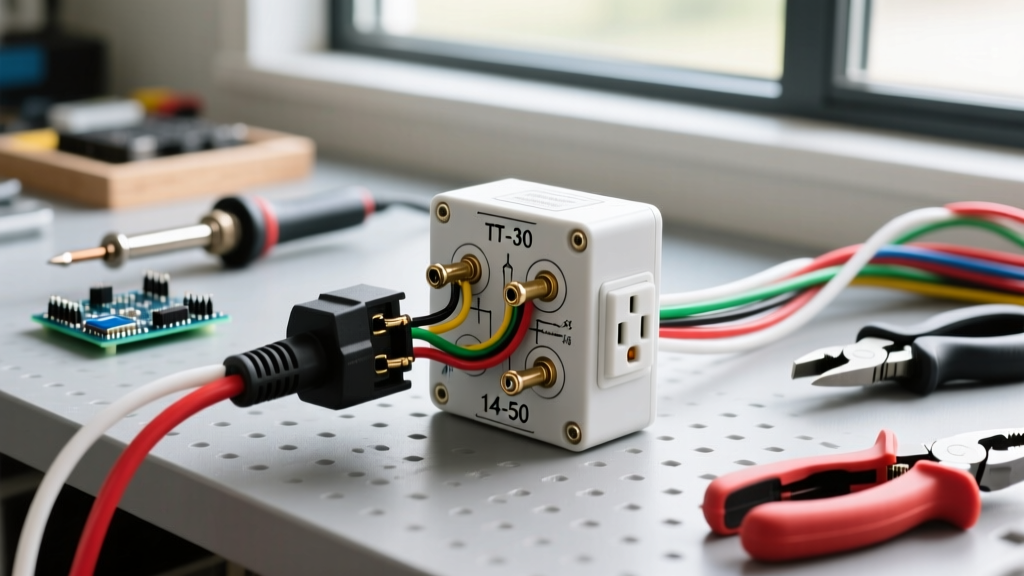
The NEMA 14-50 is the most common receptacle for residential EV charging. It requires four wires: two hots, one neutral, and one ground. Code Trap: Even if your specific EV charger's plug does not utilize the neutral prong, NEC code strictly requires that a neutral wire be pulled to the box and terminated on the receptacle if you are installing a 14-50. You must use a 4-wire cable (e.g., 6/3 with ground). The neutral must be insulated and kept entirely separate from the equipment grounding conductor.
NEMA 6-50 (3-Prong, 50A, 250V)
The NEMA 6-50 requires only three wires: two hots and one ground. Because many modern EVSEs (like the Tesla Mobile Connector with a 6-50 adapter) do not require a neutral, this configuration saves money on wire costs and conduit fill space. However, 6-50 receptacles are less common in residential settings outside of dedicated workshop tools, making the 14-50 the preferred choice for future-proofing and home resale value.
The GFCI Dilemma: NEC 625.54 and Nuisance Tripping
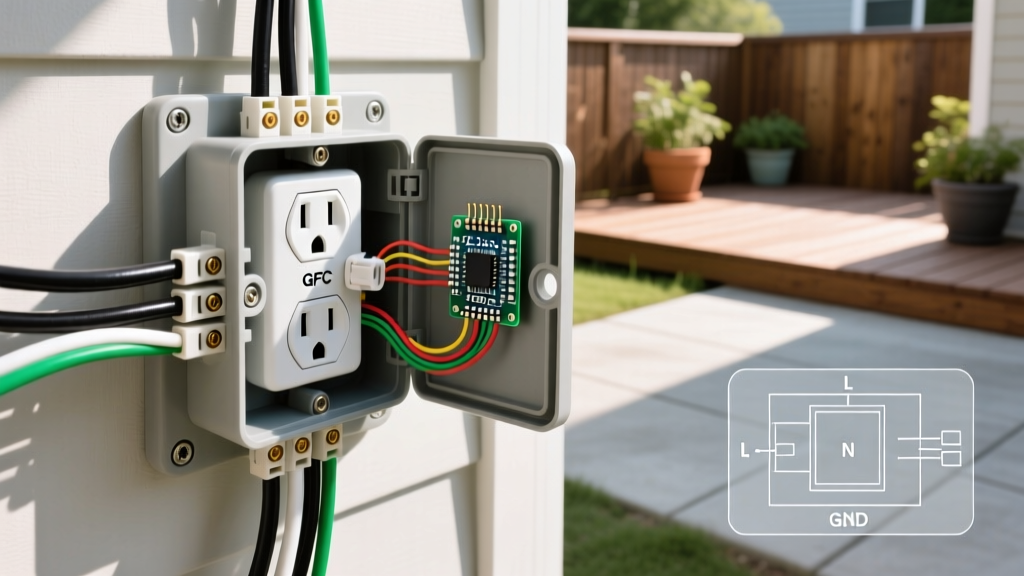
Ground Fault Circuit Interrupter (GFCI) protection is one of the most heavily debated and updated sections regarding electric car outlet requirements. Under NEC 625.54, all EVSE receptacles rated 150 volts to ground or less, and 50 amperes or less, must have GFCI protection for personnel. Furthermore, the 2020 and 2023 NEC cycles expanded GFCI requirements to nearly all 240V receptacles in garages.
Expert Insight: Installing a 50A 2-pole GFCI breaker for a NEMA 14-50 receptacle can lead to 'nuisance tripping.' This happens because the EVSE itself contains internal leakage current detection (CCID). When a GFCI breaker and an EVSE's internal ground-fault protection are stacked, minor, harmless electrical noise can cause the breaker to trip, leaving your car uncharged in the morning.
The Hardwired Solution: To bypass the receptacle GFCI mandate and avoid nuisance tripping, the Department of Energy and most master electricians recommend hardwiring your Level 2 charger. Hardwired EVSEs are covered under different NEC subsections and rely on the charger's internal, highly calibrated ground-fault protection, eliminating the need for an expensive $150+ 50A GFCI breaker at the panel.
Grounding, Bonding, and Torque Specifications
EV chargers draw massive, sustained current, making loose connections a primary failure point that can melt receptacles and cause fires. To combat this, the NEC introduced strict torque requirements.
- NEC 110.14(D): Terminations must be torqued to the manufacturer's specified values using a calibrated torque screwdriver or torque wrench. Hand-tightening a NEMA 14-50 receptacle is no longer code-compliant.
- Grounding Path: The equipment grounding conductor (EGC) must be continuous. For a 50A circuit, NEC Table 250.122 requires a minimum 10 AWG copper ground wire, though many electricians pull a 6 AWG ground alongside the hots for maximum fault-current safety.
- Receptacle Orientation: While the NEC does not mandate a specific orientation (ground pin up or down), many local jurisdictions in 2026 require the ground pin to face UP for 14-50 receptacles. This prevents a falling object from bridging the hot prongs if a plug is partially pulled out.
Panel Capacity and Load Calculations (NEC Article 220)
Before installing any EV outlet, you must verify your main electrical panel has the capacity. Adding a 50-amp circuit to an already maxed-out 100-amp or 150-amp panel is a severe code violation. According to the National Fire Protection Association (NFPA), a proper NEC Article 220 load calculation must be performed. If your panel lacks the headroom, you have two code-compliant options:
- Panel Upgrade: Upgrading to a 200-amp or 400-amp service (Cost: $2,500 - $4,500).
- Automated Energy Management System (AEMS): Devices like the Tesla Wall Connector with power-sharing, or the Emporia Load Management sensor, dynamically throttle the EV charger's amperage based on the home's real-time electrical usage. This allows you to install a high-amp EV circuit without upgrading your main service panel, provided the system is listed and installed per NEC 750.
Permitting and Final Inspection Expectations
Never skip the permitting process for an EVSE installation. Utility companies often require proof of a passed electrical inspection before unlocking special EV time-of-use (TOU) meter rates or issuing rebates. When the inspector arrives, they will check:
- The physical breaker size against the EVSE nameplate rating.
- The wire gauge and type (verifying THHN in conduit vs. NM-B allowances).
- The torque marks on the receptacle terminals (a small dab of torque seal paint is a pro-move to prove compliance).
- Proper separation of neutral and ground bars in subpanels, if applicable.
For comprehensive installation diagrams and specific conduit fill charts, always refer to the manufacturer's official documentation, such as the Tesla Home Charger Installation Guide, which provides excellent visual references for NEC-compliant clearances and mounting heights.
Summary of Costs in 2026
Budgeting for electric car outlet requirements involves more than just the charger. Expect to pay between $150 and $250 for high-grade industrial receptacles (like the Hubbell 9450A, which is heavily recommended over standard residential brands due to its superior heat tolerance). A complete 50-amp circuit installation, including conduit, 6 AWG THHN wire, a standard 50A breaker, and labor, typically ranges from $800 to $1,600, depending on the distance from your electrical panel to the garage mounting location.