
Why Those Tiny Stamped Letters Matter
When you pull a standard 15-amp duplex receptacle out of its cardboard box, you will notice a series of microscopic letters and symbols stamped into the metal yoke or molded into the polycarbonate face. To the untrained eye, these are just manufacturing artifacts. To an electrical inspector or a seasoned journeyman, these electrical outlet symbols are the definitive proof of safety, material compatibility, and National Electrical Code (NEC) compliance.
Ignoring these markings is one of the fastest ways to fail a rough-in or final inspection in 2026. More importantly, misinterpreting terminal compatibility symbols can lead to catastrophic arc faults, especially in older homes with aluminum branch wiring. This guide decodes the critical markings found on modern receptacles, mapping them directly to NEC articles and UL (Underwriters Laboratories) testing standards so you can wire with absolute confidence.
The Big Three: TR, WR, and Hospital Grade Markings
The face of the receptacle and the cardboard packaging will prominently display specific acronyms that dictate where the device is legally permitted to be installed under NEC Chapter 4.
TR (Tamper-Resistant) – NEC 406.12
If you see the letters TR stamped on the yoke, the receptacle is equipped with internal safety shutters. These shutters are typically made from a rigid polyacetal resin and require simultaneous, equal pressure (roughly 1 to 2 pounds per blade) on both the hot and neutral slots to open.
- Code Requirement: NEC Article 406.12 mandates TR receptacles in all dwelling units, including guest rooms, childcare facilities, and preschools.
- Failure Mode: Drywall dust and joint compound can easily jam the internal shutters during new construction. Always keep the plastic face guards on until the final trim-out phase.
- Cost Impact: Standard TR receptacles (e.g., Leviton T5320-W) cost between $1.50 and $3.00, a negligible premium over non-TR models which are now largely obsolete for residential use.
WR (Weather-Resistant) – NEC 406.9
Outdoor receptacles face brutal environmental stressors: UV radiation, extreme temperature cycling, and moisture ingress. The WR symbol indicates the device has been tested to withstand these conditions.
Expert Insight: A WR receptacle features UV-stabilized polycarbonate thermoplastics to prevent the face from becoming brittle and shattering upon impact. More importantly, the internal contacts and terminal screws are heavily nickel-plated or made from corrosion-resistant alloys to prevent galvanic corrosion and subsequent high-resistance heating.
Installing a standard indoor TR receptacle in an exterior in-use bubble cover is a direct violation of NEC 406.9(A) and will result in an immediate inspection failure, as the internal copper alloys will oxidize and arc within 12 to 18 months in humid climates.
The Green Dot (Hospital Grade)
A solid green circle or green dot on the receptacle face signifies Hospital Grade certification under UL 498 Supplement SA. These devices (typically priced between $8.00 and $15.00, like the Hubbell 8300-IG) undergo rigorous mechanical testing.
- Pull-Out Force: The grounding pin retention force is significantly higher than standard commercial grades, ensuring life-support equipment is not accidentally disconnected.
- Fault Current: They are tested to withstand severe fault currents without the internal grounding path melting or compromising the yoke integrity.
- Application: Required in patient care spaces (NEC 517.19) and highly recommended for heavy industrial environments where vibration is constant.
Terminal Material Symbols: The AL-CU vs. CO/ALR Trap
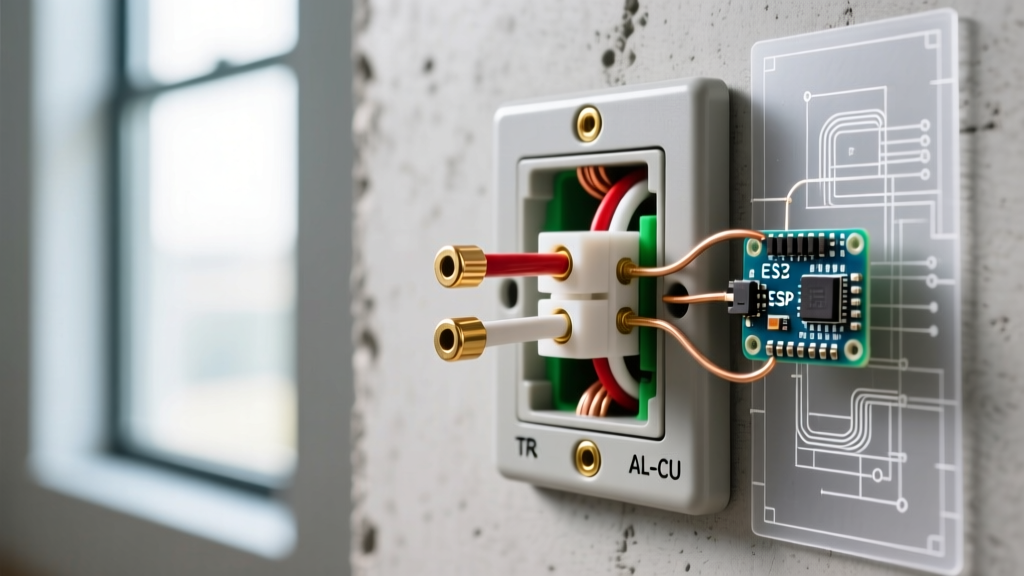
Perhaps the most dangerous electrical outlet symbols to misinterpret are those located on the terminal screws or the back of the yoke, indicating wire compatibility. If you are working on a home built between 1965 and 1973, you are likely dealing with aluminum branch wiring.
| Symbol | Meaning | Modern NEC Compliance & Safety Verdict |
|---|---|---|
| CU | Copper Only | Safe for all modern copper Romex/NM-B. Will fail and cause fires if aluminum wire is terminated here due to galvanic corrosion and thermal expansion mismatch. |
| AL-CU | Aluminum and Copper (Legacy) | DANGER. Found on pre-1980s devices. Not rated for modern AA-8000 series aluminum wire. Do not use. Replace immediately. |
| CO/ALR | Copper/Aluminum Revised | The minimum acceptable standard for direct aluminum termination. Features deeper grooves and specific torque tolerances to handle aluminum 'creep'. |
The 2026 Best Practice: While CO/ALR receptacles are legally code-compliant for direct aluminum wire termination, most master electricians and AHJs (Authorities Having Jurisdiction) strongly advise against direct termination. Aluminum wire expands and contracts at a different rate than brass terminal screws, leading to 'cold creep' and loose connections over time. The industry gold standard is to use AlumiConn lug connectors or Ideal 65 Purple wire nuts to pigtail the aluminum wire to a short copper jumper, which then terminates into a standard, high-quality CU or CO/ALR receptacle.
NEMA Configurations and Amperage Markings
Look closely at the slots of the receptacle face. You will see amperage and voltage ratings stamped into the plastic, typically reading 15A/125V or 20A/125V. These correspond to NEMA (National Electrical Manufacturers Association) configurations.
The 15-Amp Receptacle (NEMA 5-15R)
Features two parallel vertical slots (one slightly wider for neutral) and a U-shaped ground. It must be installed on a 15-amp circuit (14 AWG wire minimum). However, per NEC 210.21(B)(3), a 15-amp receptacle is also legally permitted on a 20-amp circuit (12 AWG wire), provided it is part of a multi-outlet branch circuit serving multiple cord-and-plug connected loads.
The 20-Amp Receptacle (NEMA 5-20R)
Identifiable by the 'T' shaped neutral slot. This allows it to accept both standard 15-amp plugs and specialized 20-amp plugs (like those on heavy-duty window AC units or commercial power tools). If you install a NEMA 5-20R receptacle, NEC 210.21(B)(1) dictates it must be on an individual 20-amp branch circuit, or if on a multi-outlet circuit, the circuit must be rated for 20 amps using 12 AWG or 10 AWG wire.
For a comprehensive breakdown of NEMA wiring device standards, refer to the NEMA Standards Portal.
The 'Listing' Mark: UL, ETL, and CSA (NEC 110.2)
NEC Article 110.2 is absolute: Conductors and equipment shall be acceptable only if approved. In the United States, 'approved' means tested and listed by a Nationally Recognized Testing Laboratory (NRTL).
- UL (Underwriters Laboratories): The most common mark. Indicates compliance with UL 498.
- ETL (Intertek): Legally equivalent to UL in the eyes of the NEC and OSHA. ETL tests to the exact same UL 498 standards.
- CSA (Canadian Standards Association): Acceptable in the US if it bears the 'cUL' or 'cCSAus' mark, indicating it has been tested to US safety standards as well as Canadian ones.
Warning: Never install 'CE' marked receptacles purchased from overseas marketplaces (like Amazon or AliExpress) that lack a UL, ETL, or CSA mark. The CE mark is a self-declaration of European conformity and is not recognized by the NEC as proof of safety testing. Installing unlisted devices voids your homeowner's insurance in the event of an electrical fire. The Consumer Product Safety Commission (CPSC) regularly issues recalls and warnings regarding unlisted, counterfeit electrical devices that bypass internal thermal cutoffs.
Common Inspection Failures Related to Outlet Symbols
When an inspector walks your job site, they are actively looking for symbol mismatches. Avoid these common pitfalls:
- Missing TR in Required Zones: Failing to use TR receptacles in a newly finished basement living space or a renovated bathroom. (All 125V, 15A and 20A receptacles in dwelling units must be TR).
- Standard Receptacles in Damp Locations: Using an indoor TR receptacle behind an exterior in-use cover. The inspector will check the yoke for the WR stamp.
- 20-Amp Receptacles on 15-Amp Circuits: Installing a NEMA 5-20R (T-slot) receptacle on a breaker sized for 15 amps. This is a severe code violation as it allows a user to plug in a 20-amp load that will continuously overload the 14 AWG wire and the 15-amp breaker.
- Isolated Ground (IG) Misuse: Using an orange-faced Isolated Ground receptacle (marked with an orange triangle) in a standard residential setting. IG receptacles are designed for sensitive electronic equipment in commercial settings to bypass panel-ground noise; they require a dedicated, insulated grounding conductor run back to the panel ground bus.
Frequently Asked Questions
Can I use a WR (Weather-Resistant) receptacle indoors?
Yes. A WR receptacle exceeds the material durability requirements for indoor use. However, they are typically more expensive and sometimes feature stiffer internal contacts, making them unnecessary for standard interior drywall applications.
What does the 'Spec Grade' label mean on outlet packaging?
'Spec Grade' (Specification Grade) is not an NEC code term, but rather a manufacturer designation indicating the receptacle exceeds standard residential builder-grade tolerances. Spec Grade devices (usually $3.50 to $6.00) feature thicker brass contact blades, reinforced nylon yokes, and higher screw-terminal torque tolerances. They are highly recommended for high-traffic areas like kitchens and garages.
Where can I verify the latest NEC receptacle requirements?
The National Fire Protection Association (NFPA) publishes and updates the NEC every three years. You can review the current adopted codes and safety bulletins directly via the NFPA National Electrical Code portal. Always check with your local municipality, as local AHJs may adopt specific versions of the NEC with regional amendments.