
Understanding Split-Phase 240V Power Architecture
Wiring a 240 volt electrical outlet is fundamentally different from standard 120V receptacles. While a standard outlet utilizes one hot wire and a neutral, a 240V circuit leverages the split-phase power system provided by your utility transformer. By drawing power from both the L1 and L2 busbars in your main electrical panel, you achieve a 240V potential difference without needing a neutral wire for pure 240V loads. However, modern 120/240V appliances (like dryers and ranges) require a neutral to power internal 120V control boards and timers.
Mistakes in 240V wiring do not just trip breakers; they can cause catastrophic thermal events, appliance destruction, or fatal shocks. This wiring diagram reference provides the exact terminal mappings, wire gauge requirements, and critical National Electrical Code (NEC) mandates you need to execute these installations safely and legally.
NEMA Configuration Matrix: Common 240V Receptacles
Before pulling wire, you must identify the correct National Electrical Manufacturers Association (NEMA) configuration for your specific load. Below is the definitive reference chart for the most common residential and light-commercial 240V outlets.
| NEMA Config | Amperage | Poles / Wires | Primary Application | Min Copper Wire (THHN) | Breaker Size |
|---|---|---|---|---|---|
| 6-20R | 20A | 2P / 3W (No Neutral) | Window ACs, TIG Welders, Air Compressors | 12 AWG | 20A 2-Pole |
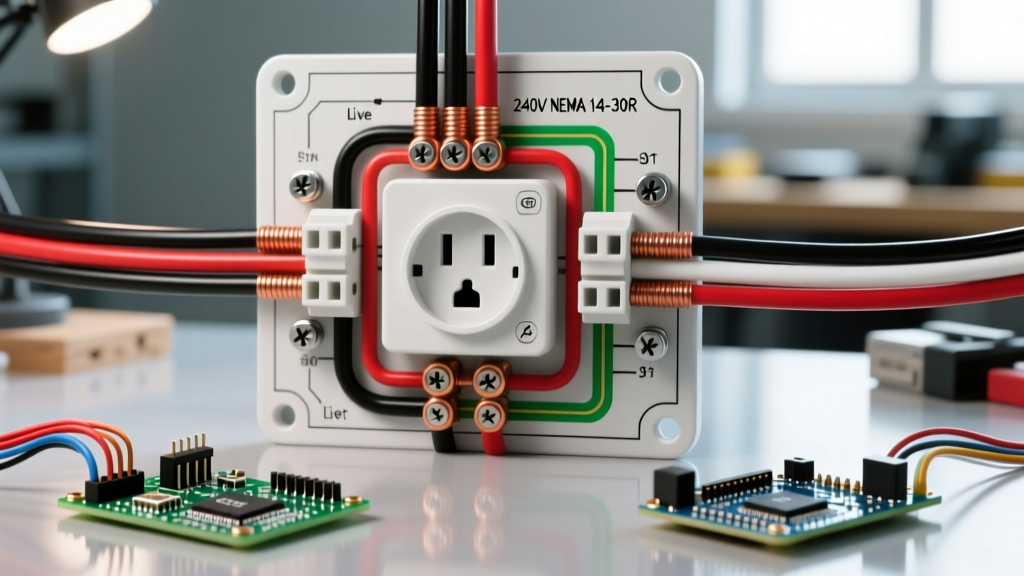
| 14-30R | 30A | 3P / 4W (With Neutral) | Electric Clothes Dryers | 10 AWG | 30A 2-Pole |
| 14-50R | 50A | 3P / 4W (With Neutral) | EV Chargers, Electric Ranges, RV Hookups | 6 AWG | 50A 2-Pole |
| 6-50R | 50A | 2P / 3W (No Neutral) | Heavy Welders, Plasma Cutters | 6 AWG | 50A 2-Pole |
Wiring Diagram Reference: NEMA 14-50R (50 Amp, 4-Wire)
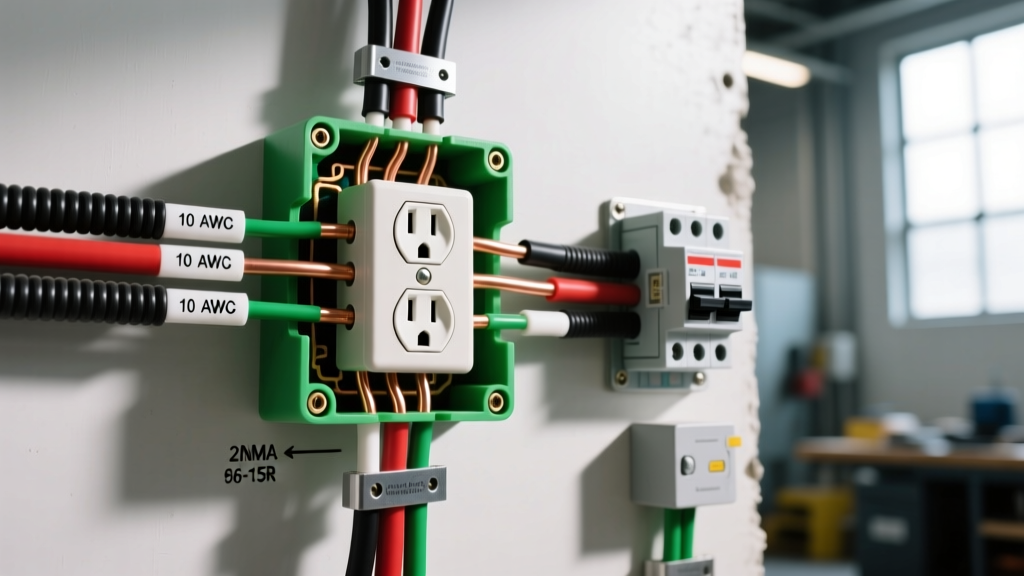
The NEMA 14-50R is the undisputed heavyweight of the modern home, serving as the standard for Level 2 Electric Vehicle (EV) chargers, large electric ranges, and RV pedestals. It requires four wires: two hots, one neutral, and one ground.
Terminal Mapping and Color Codes
- X Terminal (Left Hot): Connect to Black wire (L1 Busbar). Delivers 120V to neutral.
- Y Terminal (Right Hot): Connect to Red wire (L2 Busbar). Delivers 120V to neutral, 180 degrees out of phase with X.
- W Terminal (Bottom Neutral): Connect to White wire (Neutral Busbar). Required for 120V appliance logic.
- G Terminal (Top Ground): Connect to Bare or Green wire (Ground Busbar). The critical safety fault path.
Expert Note on Wire Sizing: While 6 AWG copper THHN in conduit is rated for 75A at 90°C, NEC Article 240.4(B) and 110.14(C) dictate that termination temperature limits restrict standard 50A breakers and receptacles to the 60°C or 75°C column. Therefore, 6 AWG copper is the absolute minimum for a 50A circuit. If using NM-B (Romex) cable, you are strictly bound to the 60°C column, making 6 AWG mandatory. For runs exceeding 100 feet, upsize to 4 AWG copper to mitigate voltage drop below the recommended 3% threshold.
The EV Charging Receptacle Crisis: Industrial vs. Residential Grade
If you are installing a NEMA 14-50R specifically for an EV charger (EVSE), you must understand a critical hardware failure mode that has plagued DIYers over the last few years. Standard residential-grade receptacles (such as the widely available Leviton 279-S00, which costs around $12) are tested and rated for intermittent 50A loads, like plugging in an RV for a weekend or running an electric oven for an hour.
However, EV charging represents a continuous load (defined by the NEC as lasting 3 hours or more). Pushing 40A continuously through a residential-grade 14-50R for 8 hours every night causes thermal creep. The internal brass contacts lose their clamping tension, resistance increases, and the receptacle can literally melt into the plug, causing a fire hazard.
The Solution: Specify Industrial-Grade Hardware
For EVSE installations, bypass the big-box store residential options. You must specify an industrial-grade receptacle designed for high thermal tolerance and sustained clamping force. Look for these specific models:
- Hubbell 9450A: The gold standard for EV charging. Features massive internal contacts and high-heat thermoset materials. (Retail: ~$85 - $110).
- Bryant 9450FR: Virtually identical internal architecture to the Hubbell (Hubbell owns Bryant), often available for slightly less. (Retail: ~$75 - $90).
- Cooper/Arrow Hart 5754N: Another heavy-duty alternative with excellent thermal dissipation. (Retail: ~$65).
According to the Alternative Fuels Data Center, ensuring your infrastructure is rated for continuous duty is just as critical as the wire gauge itself when deploying home charging networks.
Wiring Diagram Reference: NEMA 6-20R (20 Amp, 3-Wire)
The NEMA 6-20R is a pure 240V outlet with no neutral wire. It is commonly used for heavy-duty window air conditioners, portable TIG welders, and commercial shop equipment. Because there is no neutral, the receptacle only has three terminals.
Terminal Mapping
- X Terminal (Hot 1): Connect to Black wire.
- Y Terminal (Hot 2): Connect to White wire. CRITICAL: Because this is a 240V-only circuit, the white wire is acting as a hot conductor. You must re-identify it by wrapping both ends with black or red electrical tape, or using a black marker, as mandated by NEC 200.7(C).
- G Terminal (Ground): Connect to Bare or Green wire.
This circuit requires a 20A 2-pole breaker and a minimum of 12 AWG copper wire. The unique physical shape of the 6-20R (one horizontal slot, one vertical slot) prevents accidental insertion of standard 120V plugs.
Critical NEC Code Mandates & Torque Specifications
Modern electrical inspections are no longer just about wire color and breaker size. To pass inspection and ensure safety, your 240 volt electrical outlet installation must comply with the following stringent NEC requirements.
1. GFCI Protection for Garages and Outdoors
Under NEC Article 210.8(F), all 125-volt through 250-volt receptacles supplied by single-phase branch circuits rated 150 volts or less to ground, 50 amperes or less, installed in garages, outdoors, or crawl spaces must have Ground-Fault Circuit Interrupter (GFCI) protection. If you are wiring a 14-50R in a garage for an EV charger or an RV, you must use a 50A 2-pole GFCI breaker. These breakers are significantly more expensive (often $100 to $150) than standard breakers, but they are legally non-negotiable in these locations.
2. Calibrated Torque Requirements (NEC 110.14(D))
The era of tightening terminal screws "until they feel tight" is over. NEC 110.14(D) requires that all terminations be tightened to the manufacturer's specified torque using a calibrated torque tool. Loose connections on a 50A circuit generate massive heat due to increased resistance (I²R losses).
- Most 50A receptacle terminals require between 35 in-lbs and 45 in-lbs of torque.
- Use a dedicated torque screwdriver, such as the Klein Tools 69015 or CDI 401SM, to achieve exact specifications.
- For further safety guidelines on electrical terminations and lockout/tagout procedures during installation, refer to the OSHA Electrical Safety standards.
3. The Death of the 3-Wire Dryer/Range Outlet
If you are upgrading an older home, you may encounter a NEMA 10-30R (3-wire, no ground). Pre-1996 NEC allowed the appliance frame to be bonded to the neutral wire. This is now considered highly dangerous; if the neutral wire breaks, the entire metal chassis of the dryer becomes energized at 120V. When replacing a 10-30R with a modern 14-30R or 14-50R, you must pull a new 4-wire cable from the panel. You cannot simply bootleg a ground from a nearby water pipe. For comprehensive code definitions, consult the National Fire Protection Association (NFPA) NEC database.
Troubleshooting Matrix: Common 240V Wiring Failures
Even with perfect diagrams, field conditions introduce variables. Use this troubleshooting matrix to diagnose issues before calling an inspector or destroying an appliance.
| Symptom | Probable Cause | Diagnostic & Fix |
|---|---|---|
| Breaker trips immediately upon plugging in appliance. | Short circuit between X and Y hots, or hot to ground. | Verify no stray wire strands are touching adjacent terminals. Check for damaged wire insulation inside the junction box. |
| Appliance powers on, but control board/timer is dead. | Open Neutral (W terminal). | The appliance gets 240V for the heating element, but lacks the 120V return path for the logic board. Check neutral termination at both panel and receptacle. |
| Receptacle face feels hot to the touch during use. | Undersized wire, loose terminal torque, or continuous load on residential-grade hardware. | Measure voltage drop under load. Retorque terminals to 40 in-lbs. Upgrade to Hubbell/Bryant industrial receptacle if used for EV charging. |
| GFCI breaker nuisance trips when EV charger is connected. | Ground leakage in EVSE, or shared neutral/ground bond at the receptacle. | Ensure the neutral busbar and ground busbar are completely isolated in the subpanel (if applicable). Verify no neutral-to-ground bond exists at the receptacle. |
Final Execution Checklist
Before energizing your new 240 volt electrical outlet, run through this final verification sequence:
- Visual Inspection: Confirm no copper is exposed outside the terminal clamps. Ensure the ground wire is securely bonded to the metal box (if using a metal junction box) via a green grounding screw and pigtail.
- Multimeter Test (Power Off): Set your multimeter to continuity. Test between the Ground terminal and the Neutral terminal. There should be zero continuity (infinite resistance). If there is continuity, you have an illegal neutral-ground bond that will trip a GFCI breaker and create a shock hazard.
- Voltage Test (Power On): With the breaker on and safety glasses worn, measure between X and Y (should read ~240V). Measure X to Ground (~120V), Y to Ground (~120V), and X to Neutral (~120V).
By adhering strictly to these wiring diagrams, utilizing industrial-grade hardware for continuous loads, and respecting modern NEC torque and GFCI mandates, your 240V installation will deliver safe, reliable power for decades.