
The Anatomy of a Dead Electrical Outlet: Beyond a Tripped Breaker
When you plug in a device and nothing happens, the immediate assumption is often a tripped breaker or a blown fuse. However, a dead electrical outlet is frequently a symptom of a deeper, systemic wiring flaw or a direct violation of the National Electrical Code (NEC). As electrical systems age and load demands increase, marginal wiring practices that barely passed inspection decades ago begin to fail, resulting in open neutrals, thermal degradation, and completely dead receptacles.
Understanding why an outlet loses power requires looking past the faceplate and examining the circuit's compliance with modern safety standards. According to the NFPA NEC guidelines, proper termination, grounding, and fault protection are not just recommendations—they are strict legal requirements designed to prevent electrical fires and shock hazards. This guide breaks down the specific code violations that cause dead outlets and provides a professional-grade diagnostic workflow to restore power safely.
Top NEC Code Violations That Cause (or Mask) Dead Outlets
1. Backstabbed Connections and Thermal Cycling (NEC 110.3(B))
The most common culprit behind a randomly dead electrical outlet in homes built between 1970 and 2010 is the use of push-in "backstab" terminals. While Underwriters Laboratories (UL) historically allowed push-in connections for 14 AWG solid copper wire on 15-amp devices, the mechanical spring contacts inside these terminals are highly susceptible to thermal cycling. As the circuit heats up under load and cools down, the metal expands and contracts, eventually causing the spring to lose tension.
Code Violation Insight: NEC Article 110.3(B) mandates that listed equipment must be installed in accordance with the instructions included in the listing. Many modern 20-amp receptacles explicitly forbid backstabbing in their manufacturer instructions. When a backstabbed neutral fails, it creates an "open neutral" condition, killing power to the affected outlet and any downstream receptacles daisy-chained to it.
The Fix: Strip the wires and terminate them under the side screw terminals, or use a pigtail wire nut connection to free up space in the junction box. Torque the screws to the manufacturer's specification (typically 10 to 14 in-lbs for standard 15A/20A receptacles) using a calibrated torque screwdriver to comply with NEC 110.14(D).
2. Multi-Wire Branch Circuit (MWBC) Open Neutrals (NEC 210.4)
If your dead outlet is part of a Multi-Wire Branch Circuit (two hot wires sharing a single neutral), an open or disconnected neutral is a catastrophic failure mode. If a previous DIYer removed the receptacle to replace it and broke the neutral daisy-chain without installing a pigtail, the circuit loses its return path. Worse, if the two hot legs are on the same phase due to an improper breaker installation, the shared neutral will carry the sum of both currents, overheating and melting the wire insulation until the circuit fails entirely.
Furthermore, NEC 210.4(B) requires a simultaneous disconnect (handle tie) for all ungrounded conductors of an MWBC. If your dead outlet is tied to an MWBC lacking a handle tie, you risk lethal shock from backfed voltage on the supposedly "dead" neutral wire during troubleshooting.
3. GFCI Line/Load Reversal and Daisy-Chain Failures (NEC 210.8)
A dead outlet in a kitchen, bathroom, or garage is often downstream of a tripped Ground Fault Circuit Interrupter (GFCI). However, a pervasive code violation occurs when installers reverse the LINE and LOAD wires on the GFCI receptacle. According to ESFI GFCI safety standards, a reversed GFCI will still provide power to its own faceplate, but it will fail to provide ground-fault protection to downstream outlets. Over time, if a ground fault occurs downstream, the miswired GFCI won't trip, but a localized short or thermal event may sever the connection, leaving downstream outlets dead and unprotected.
Diagnostic Matrix: Code-Compliant Troubleshooting Workflow
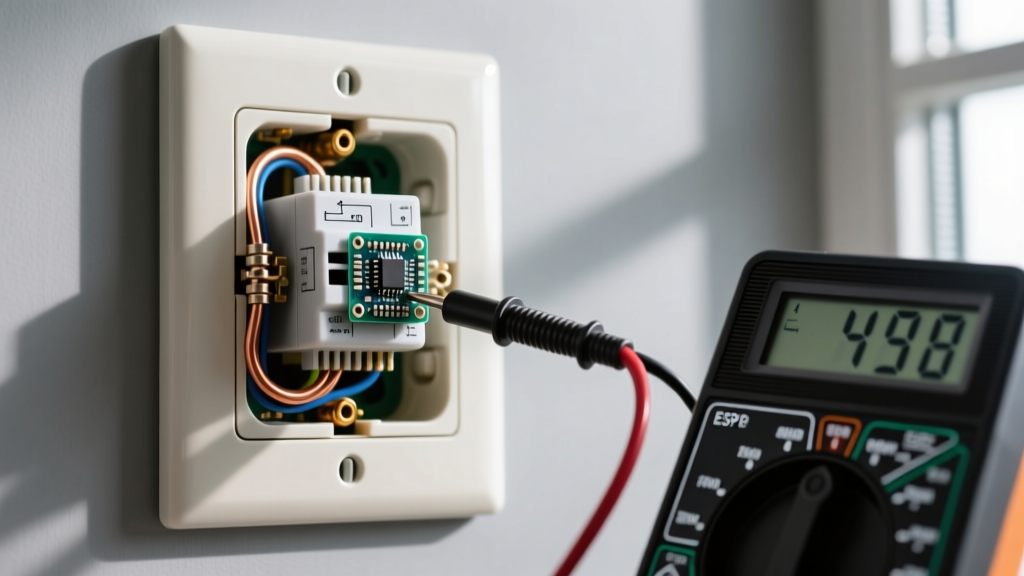
Before touching a screwdriver, use a non-contact voltage tester and a digital multimeter (DMM) to diagnose the root cause. Reference the matrix below to map your symptoms to specific NEC violations.
| Symptom / Reading | Multimeter / Tester Result | Likely NEC Violation | Required Remediation |
|---|---|---|---|
| Outlet dead, downstream outlets also dead | 0V Hot-to-Neutral; 120V Hot-to-Ground | Open Neutral (NEC 300.13) | Locate upstream junction/receptacle; repair broken neutral using wire nuts and pigtails. |
| Outlet dead, GFCI upstream won't reset | GFCI test button yields no click; 0V downstream | Line/Load Reversal or End-of-Life GFCI (NEC 210.8) | Verify LINE/LOAD orientation; replace GFCI with a 20A Tamper-Resistant model (e.g., Leviton GFNT2). |
| Outlet reads 120V but devices don't work | 120V Hot-to-Neutral; High impedance under load | Backstab Thermal Failure / Loose Termination (NEC 110.14) | Remove backstabbed wires; terminate on side screws torqued to 14 in-lbs. |
| Outlet dead, breaker trips immediately upon reset | Bolted fault (0 ohms Hot-to-Neutral) | Short Circuit / Damaged Insulation (NEC 240.4) | Megger test the circuit; replace damaged cable run or receptacle. |
Step-by-Step Remediation: Upgrading to Modern Standards
When you open the junction box to fix a dead electrical outlet, you are legally and ethically bound to bring the immediate work area up to current code. The CPSC electrical safety guidelines emphasize that improper repairs are a leading cause of residential electrical fires.
- De-energize and Verify: Turn off the breaker. Use a CAT III rated multimeter (like the Fluke 117) to verify 0V between Hot-Neutral, Hot-Ground, and Neutral-Ground.
- Inspect the Box Fill: NEC Article 314.16 dictates box fill calculations. If you are adding pigtails to fix a dead outlet, ensure the junction box has adequate cubic inch capacity. A standard single-gang plastic box is typically 18-22 cubic inches; adding too many wire nuts can violate box fill rules and crush wire insulation.
- Eliminate Backstabs: Cut off the ends of any wires previously inserted into push-in terminals. The wire end is often scored or oxidized. Strip back to fresh copper.
- Install Tamper-Resistant (TR) Receptacles: NEC 406.12 requires all 15A and 20A, 125V and 250V receptacles in dwelling units to be tamper-resistant. Ensure your replacement outlet features the "TR" stamp.
- Torque to Spec: Use an insulated torque screwdriver set to the receptacle manufacturer's rating (usually found on the back of the device yoke). This prevents future loosening due to thermal expansion.
Cost and Time Estimates for Code-Compliant Outlet Repair
Budgeting for electrical repairs requires understanding the difference between a simple swap and a code-compliant circuit remediation. Here is what homeowners and DIYers should expect in 2026:
- Basic Receptacle Replacement (Standard TR): $3 - $6 per unit (e.g., Eaton TR15W). Time: 10 minutes.
- GFCI Replacement (20A TR): $18 - $28 per unit (e.g., Leviton GFNT2-W). Time: 20-30 minutes, including Line/Load verification.
- Pigtailing & Box Fill Remediation: $5 - $10 in materials (wire nuts, 12/2 or 14/2 pigtails, deeper junction boxes). Time: 30-45 minutes per box.
- Professional Diagnostic Fee: If the dead outlet stems from a hidden open neutral inside a wall cavity, expect an electrician's diagnostic fee of $150 - $250, plus $100-$150 per hour for tracing and drywall repair.
Frequently Asked Questions
Can a bad ground cause an outlet to stop working?
No. An open or missing equipment grounding conductor (EGC) will not interrupt the flow of current to a standard 120V appliance. If your outlet is dead, the issue is an open hot or an open neutral. However, an open ground is a severe shock hazard and a violation of NEC 250.148, requiring immediate attention even if the outlet appears to function.
Why does my receptacle tester show 'Open Neutral' when the outlet is dead?
A standard 3-light receptacle tester requires a complete circuit to illuminate its neon bulbs. If the neutral wire is disconnected upstream (an open neutral), the tester will not light up at all, or it may show a confusing 'Open Neutral' pattern if there is a high-impedance ghost voltage present. Always verify with a digital multimeter probing Hot-to-Ground to confirm if the hot leg is actually energized.
Is it legal to use a GFCI receptacle to fix a dead outlet with no ground wire?
Yes, under NEC 406.4(D)(2), you can replace an ungrounded (2-prong) outlet with a GFCI receptacle to provide shock protection. The GFCI monitors the imbalance between hot and neutral, functioning perfectly without a ground wire. However, you must apply a "No Equipment Ground" sticker to the faceplate, and this fix does not provide a true ground for surge protectors or sensitive electronics.