
The Baseline: Nominal vs. Actual Voltage in US Receptacles
When discussing the standard electrical outlet voltage in US homes, most electricians and homeowners default to the number 120. However, '120 volts' is merely a nominal designation—a standardized label used for system design and equipment rating. In reality, the actual voltage delivered to your receptacles fluctuates based on grid load, transformer tap settings, and voltage drop across your home's wiring.
To understand what is legally and technically acceptable, we must look at the ANSI C84.1 standard, which the National Electrical Code (NEC) and utility companies use to define voltage tolerances. This standard establishes two operational ranges for a 120V nominal system:
| Range Classification | Voltage at Receptacle | Voltage at Service Entrance | Operational Expectation |
|---|---|---|---|
| Range A (Optimal) | 114V to 126V | 118V to 125V | Equipment operates safely and efficiently. Utility must maintain this range. |
| Range B (Acceptable) | 110V to 127V | 114V to 126V | Occurs during abnormal grid conditions. Equipment may run hotter or dimmer. |
If you measure 116V at a bedroom receptacle, your system is operating perfectly within Range A. However, consistent readings below 114V or above 126V indicate a utility issue, an undersized transformer, or severe voltage drop within your branch circuit wiring.
NEC Code Requirements for Outlet Voltage and Wiring
The NEC strictly regulates how voltage is distributed and utilized in dwelling units. The core rules governing receptacle voltage are found in NEC Article 210 (Branch Circuits).
NEC 210.6: Branch Circuit Voltage Limitations
According to NEC 210.6, the nominal voltage of branch circuits supplying lighting fixtures and receptacles in dwelling units shall not exceed 120 volts. This applies to:
- Cord-and-plug-connected loads rated 1,440 watts or less.
- Motor-driven appliances rated at 1/4 horsepower or less.
- General lighting and standard convenience receptacles (NEMA 1-15 and NEMA 5-15/5-20 configurations).
Code Warning: You cannot wire a standard 120V NEMA 5-15R receptacle to a 240V circuit, even if the device plugged into it has an internal step-down transformer. The receptacle itself must match the circuit voltage to prevent catastrophic shock hazards if a user plugs in a standard 120V appliance.
NEC 210.11 and 210.52: Receptacle Placement and Circuit Sizing
While 210.6 dictates the voltage, 210.52 dictates the placement. Standard 120V, 15-amp or 20-amp receptacles must be installed so that no point along the floor line in any wall space is more than 6 feet from an outlet. These must be fed by 120V branch circuits protected by 15A or 20A breakers, utilizing 14 AWG or 12 AWG copper wire, respectively.
120V vs. 240V: When Higher Voltage is Code-Compliant
While 120V is the standard for general use, the US residential electrical system is a split-phase 240V system. The utility transformer provides two 120V 'hot' legs that are 180 degrees out of phase. Measuring across both hot legs yields 240V.
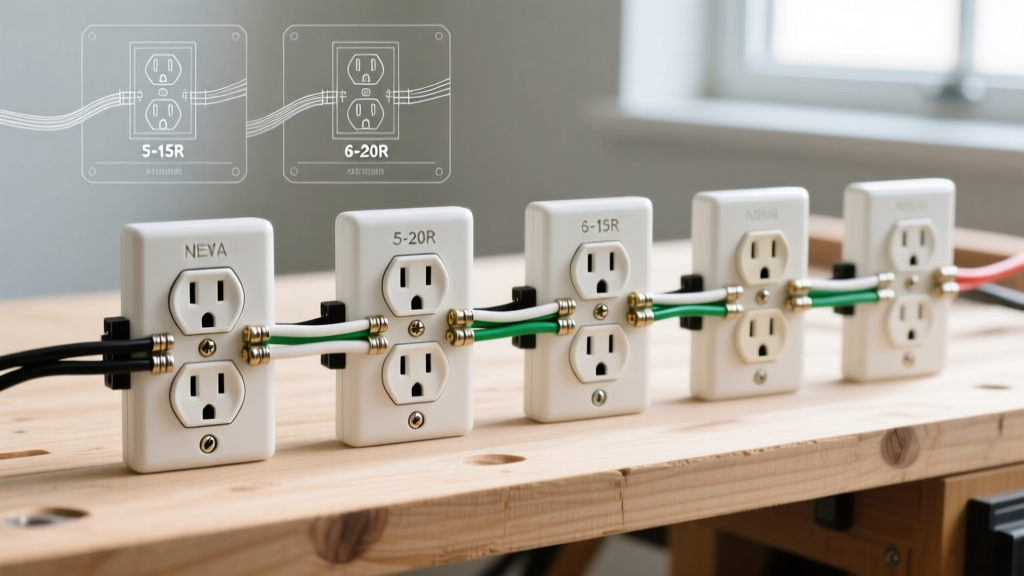
The NEC permits 240V outlets for specific high-wattage appliances. Common configurations include:
- NEMA 14-50R (50A, 125/250V): Required for electric ranges, large RV hookups, and Level 2 Electric Vehicle (EV) chargers. NEC 210.17 mandates that EV charging equipment be supplied by a dedicated branch circuit.
- NEMA 6-20R (20A, 250V): Often used for window air conditioning units or heavy-duty power tools in garages.
- NEMA 10-30R / 14-30R (30A, 125/250V): Standard for electric clothes dryers. (Note: The older 10-30 lacks a dedicated equipment grounding conductor and is no longer permitted for new installations under modern NEC editions).
Measuring and Troubleshooting Voltage Drop (NEC 210.19)
Voltage drop occurs when current travels through the resistance of a wire. While the NEC does not strictly enforce voltage drop as a hard violation for standard residential branch circuits, NEC 210.19(A) Informational Note No. 4 strongly recommends a maximum voltage drop of 3% for the farthest branch circuit and 5% total for the feeder and branch circuit combined.
Real-World Voltage Drop Calculation
Imagine you are wiring a detached garage subpanel. You are running a 120V, 20-amp circuit using 12 AWG copper wire over a distance of 150 feet to power a table saw.
- Current (I): 16 Amps (continuous load derated)
- Wire Resistance (12 AWG): ~1.93 ohms per 1,000 feet
- Total Wire Length (Round Trip): 300 feet
- Calculated Voltage Drop: ~9.2 Volts (7.7%)
A 7.7% drop exceeds the 3% recommendation. The saw will receive only ~110.8V, causing the motor to draw excess current, overheat, and potentially trip the breaker. The fix: Upsize the wire to 10 AWG or even 8 AWG to bring the drop below 3%.
Step-by-Step Receptacle Testing
To verify your electrical outlet voltage in US homes, use a True-RMS digital multimeter, such as the Fluke 117 (approx. $190) or the Klein Tools MM400C (approx. $50). Follow this testing matrix to diagnose wiring faults:
| Probe Placement | Expected Reading | Abnormal Reading & Diagnosis |
|---|---|---|
| Hot (Brass) to Neutral (Silver) | 114V - 126V | 0V: Open hot or open neutral. ~60V: Phantom voltage or high-resistance neutral. |
| Hot (Brass) to Ground (Green) | 114V - 126V | 0V: Open ground or open hot. 120V but Neutral-Ground is 120V: Bootleg ground or swapped neutral/ground. |
| Neutral (Silver) to Ground (Green) | 0V to 2V | >5V: Loose neutral connection at the panel or upstream receptacle causing neutral current to seek the ground path. |
The 'Lost Neutral' Edge Case: When 120V Outlets Receive 240V
One of the most destructive voltage anomalies in US residential wiring is the 'Lost Neutral' scenario. In a split-phase system, the neutral wire carries the unbalanced current between the two 120V hot legs back to the transformer.
If the main neutral connection at the service panel or the utility pole corrodes and breaks, the two 120V circuits in your home effectively become a single 240V series circuit. The voltage at your standard 120V receptacles will no longer be 120V. Instead, it will float based on the resistance of the appliances plugged in.
- A receptacle with a high-wattage appliance (like a space heater) might drop to 40V.
- A receptacle on the opposite phase with a low-wattage appliance (like an LED TV) will spike to 200V, instantly destroying the power supply.
Diagnostic Tip: If you measure 140V or higher at a standard 120V receptacle, or if your lights are glowing blindingly bright while others are dim, turn off the main breaker immediately and call a licensed electrician or your utility provider. As noted in OSHA electrical safety standards, unexpected overvoltage conditions present severe fire and shock hazards that require immediate remediation.
Frequently Asked Questions
Why do some countries use 230V while the US uses 120V?
The US adopted 120V (originally 110V) based on Thomas Edison's early DC and subsequent AC systems, which optimized for the carbon-filament light bulbs of the era. Europe and much of the world later adopted 220V-240V because higher voltage allows the same power to be delivered with thinner, cheaper copper wiring and lower current, reducing I²R heat losses. The US compromised by using 240V for heavy loads and stepping it down to 120V at the panel for safety.
Can I plug a 120V appliance into a 240V outlet?
No. The physical blade configurations (NEMA standards) are designed specifically to prevent this. A standard NEMA 5-15P plug will not physically fit into a NEMA 6-15R or 14-50R receptacle. Forcing a connection or using an improper adapter will result in immediate appliance destruction and a severe arc-flash hazard.
Does a GFCI outlet protect against overvoltage?
No. A Ground Fault Circuit Interrupter (GFCI) monitors current imbalance between the hot and neutral wires to prevent lethal shocks (tripping at a 4mA to 6mA differential). It does not monitor voltage. To protect sensitive electronics from voltage spikes, you must use a Surge Protective Device (SPD) or a whole-home surge protector installed at the main panel, as permitted by NEC 230.67.