
Understanding the Czech Electrical Standard (Type E)
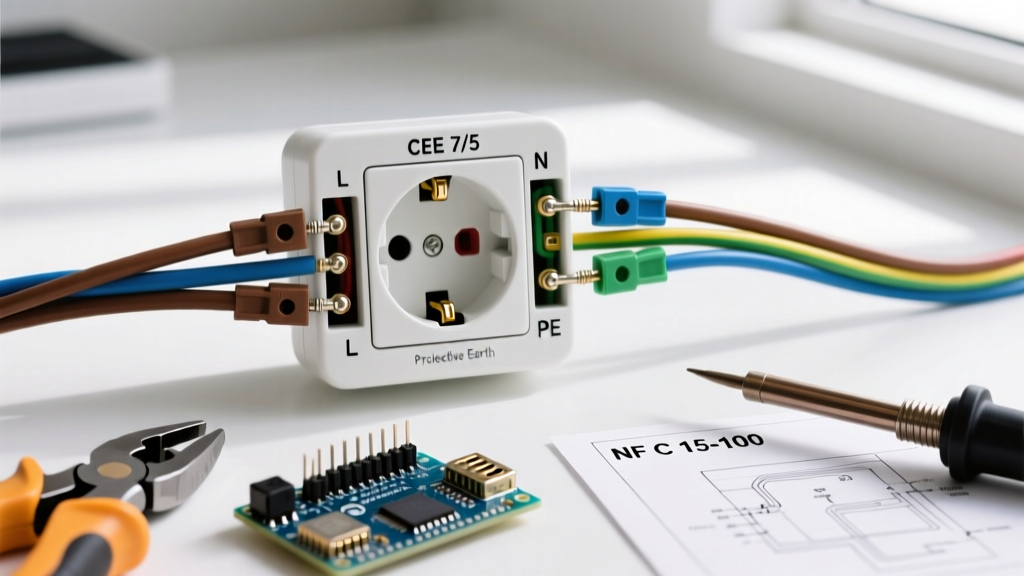
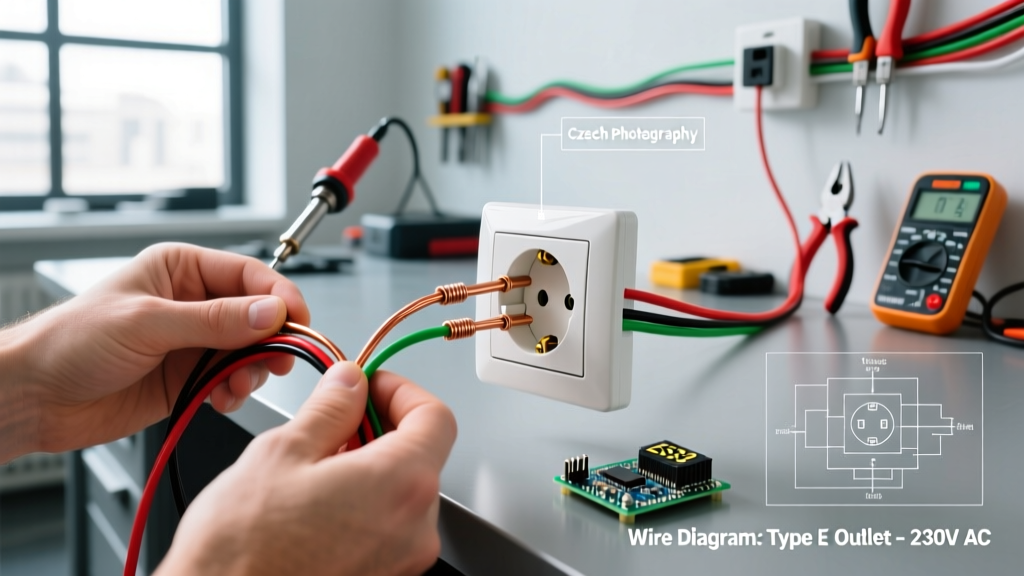
If you are renovating a property in Prague, Brno, or anywhere across the Czech Republic, understanding the local electrical infrastructure is critical. The standard czech electrical outlet is the Type E socket (officially CEE 7/5). While it shares the same 230V/50Hz baseline as most of Europe, its physical design differs significantly from the German Schuko (Type F) or the British BS 1363 (Type G).
According to the International Electrotechnical Commission (IEC), the Czech Republic operates on a harmonized 230V supply voltage. The defining feature of the Type E socket is the protruding male grounding pin located at the top of the receptacle. This pin mates with a corresponding female hole in the plug (CEE 7/7), ensuring the earth connection is established before the live pins make contact. For detailed physical specifications and historical context of this design, refer to the World Standards Type E guide.
Expert Insight: Never attempt to force a UK Type G or US Type B plug into a Czech Type E socket using cheap travel adapters for high-draw appliances (like space heaters or kettles). The internal wiring of standard Czech residential circuits is designed for a maximum continuous draw of 16 Amps (approx. 3680 Watts) per socket circuit.
Tools and Materials Required
Before beginning any electrical work, gather the correct tools. Working with 230V requires precision and adherence to safety protocols. As of 2026, modern European flush-mount boxes and lever connectors have made DIY installations safer than ever, provided you use the right gear.
- Voltage Tester: Fluke 1AC-II VoltAlert (Non-contact) or a standard CAT III multimeter.
- Wire Strippers: Knipex 12 62 180 (set precisely to 1.5mm² or 2.5mm² to avoid nicking the copper).
- Conductors: 2.5mm² solid copper wire (CYKY-J 3x2.5 is the standard Czech cable for socket circuits).
- Connectors: WAGO 221-413 lever nuts (for daisy-chaining multiple sockets in a single wall box).
- Socket Box: Standard European 68mm diameter flush-mount box (krabice pod omítku).
- Receptacle: A certified Type E socket mechanism (e.g., Schneider Electric Odace or Legrand Valena Life).
- Insulated Screwdrivers: VDE-certified flathead and Phillips (1000V rated).
European Wiring Color Codes (IEC 60446)
The Czech Republic follows the harmonized European color code standard for fixed wiring. Misidentifying these wires can lead to catastrophic short circuits or lethal shocks. The harmonized colors are thoroughly documented by safety organizations like Electrical Safety First.
| Wire Color | Function | Czech Label | Terminal Marking |
|---|---|---|---|
| Brown | Line / Phase (Live) | Fáze (L) | L |
| Blue | Neutral | Nulový vodič (N) | N |
| Green/Yellow | Protective Earth (Ground) | Ochranný vodič (PE) | PE or ⏚ |
Note: In older Czech properties (pre-1990s), you may encounter legacy PEN conductors (combined neutral and earth) colored entirely green/yellow or bare copper. If you encounter a two-wire TN-C system, you must consult a licensed Czech electrician (revizní technik) to perform a proper TN-C-S split before installing modern 3-prong Type E sockets.
Step-by-Step Installation Guide
Step 1: Isolate and Verify the Circuit
Navigate to your main distribution board (rozvaděč). Identify the MCB (Miniature Circuit Breaker) controlling the room's sockets. In Czechia, socket circuits are typically protected by a 16A Type B or Type C breaker, paired with a 30mA RCD (Residual Current Device / chránič). Switch the breaker to the OFF (0) position. Use your Fluke voltage tester to confirm the circuit is dead at the wall box.
Step 2: Prepare the Wall Box and Conductors
Clean out any plaster or debris from the 68mm flush-mount box. If your cable is the standard CYKY-J 3x2.5mm², strip the outer grey sheathing back to the edge of the box, leaving about 15cm of individual conductors. Using your Knipex strippers, remove exactly 12mm of insulation from the brown, blue, and green/yellow wires. Stripping too little leaves exposed copper outside the terminal; stripping too much risks a short circuit inside the box.
Step 3: Terminate the Connections
Modern Type E sockets feature quick-insert or screw-terminal blocks on the rear mechanism.
- Connect the Earth (PE): Always start with the green/yellow wire. Insert it into the terminal marked with the earth symbol (⏚). The earth pin on the front of the Czech socket is directly bonded to this rear terminal. Ensure it is seated firmly.
- Connect the Neutral (N): Insert the blue wire into the terminal marked 'N'. In a standard Czech setup, the neutral is positioned on the right side of the socket face (when the ground pin is at the top).
- Connect the Line (L): Insert the brown wire into the terminal marked 'L'. This goes to the left side of the socket face.
If you are daisy-chaining to another socket, use WAGO 221 lever connectors inside the back of the box to splice the incoming and outgoing wires, then run short 12mm pigtails to the socket terminals. This prevents the socket mechanism from bearing the mechanical stress of the main circuit cables.
Step 4: Mounting and Alignment
Carefully fold the wires into the back of the 68mm box using a zig-zag pattern. Do not simply shove them in, as this can pinch the insulation against the metal mounting claws. Align the socket mechanism with the box and drive the two M4 mounting screws into the side lugs. As you tighten, ensure the socket remains perfectly level. Finally, attach the decorative faceplate.
Comparison Matrix: Czech (Type E) vs. Other Common Sockets
Understanding how the czech electrical outlet compares to neighboring standards is vital for expats, digital nomads, or DIYers working on cross-border projects.
| Feature | Czech / France (Type E) | Germany / Austria (Type F) | United Kingdom (Type G) |
|---|---|---|---|
| Standard Voltage | 230V / 50Hz | 230V / 50Hz | 230V / 50Hz |
| Grounding Method | Male pin on socket | Metal clips on sides | Long plastic/brass pin on plug |
| Standard Breaker Size | 16A | 16A | 32A (Ring Main) |
| Plug Compatibility | Accepts CEE 7/7 & CEE 7/16 | Accepts CEE 7/7 & CEE 7/16 | BS 1363 only (Requires adapter) |
| Child Safety Shutters | Optional (Model dependent) | Rare | Mandatory (Built into plug) |
Common Beginner Mistakes and Troubleshooting
1. Reversed Polarity (Swapped L and N)
While alternating current (AC) will technically power a device regardless of polarity, Czech electrical codes (ČSN 33 2000 series) and general European best practices dictate that the Line (brown) must be on the left and Neutral (blue) on the right when the ground pin is at the top. Reversed polarity can cause issues with single-pole switches on appliances, leaving internal components live even when the appliance is switched off.
2. Tripping the RCD (Chránič)
If the circuit immediately trips the 30mA RCD upon turning the breaker back on, you likely have a ground fault. This usually happens if a stray strand of bare copper from the brown or blue wire is touching the metal flush-mount box or the earth terminal. Disconnect power, remove the socket, and inspect the terminal strip for bridging.
3. Upgrading to Smart Sockets (2026 Trends)
If you are installing smart home infrastructure, standard mechanical Type E sockets are being replaced by connected alternatives. Models like the Legrand Valena Life with Netatmo (priced around €65 - €85 in 2026) fit perfectly into standard 68mm Czech boxes. When wiring smart sockets, ensure your circuit has a stable Neutral (blue) wire, as many smart relays require continuous 230V power to maintain their Zigbee or Wi-Fi radios, unlike older smart bulbs that only required a live wire.
Final Safety Verification
Once installed, turn the MCB back on. Use a dedicated socket tester (such as the Beha-Amprobe ST-760) to verify that the wiring is correct. The tester's LED sequence will confirm proper earth continuity, correct polarity, and the absence of dangerous open-neutral conditions. If the tester indicates an open ground, turn the power off immediately and re-check the green/yellow connection at the terminal block.