
The Foundation of Safe Wiring: Matching AWG to Breaker Size
When planning a residential wiring project, selecting the correct wire for electrical outlet circuits is not a matter of guesswork or budget convenience. It is strictly governed by the National Electrical Code (NEC). Using undersized wire creates a severe fire hazard by allowing the breaker to pass more current than the wire can safely dissipate, leading to melted insulation and arc faults. Conversely, while oversized wire is generally safe, it can cause termination failures if the conductor cannot physically fit under the receptacle's binding screws.
As we navigate the 2026 inspection cycles—which heavily enforce the 2023 NEC standards and early adoptions of the 2026 NEC—understanding the relationship between American Wire Gauge (AWG), breaker ampacity, and specific room requirements is critical for passing inspection and ensuring long-term safety.
Standard NEC Ampacity and Wire Sizing Matrix
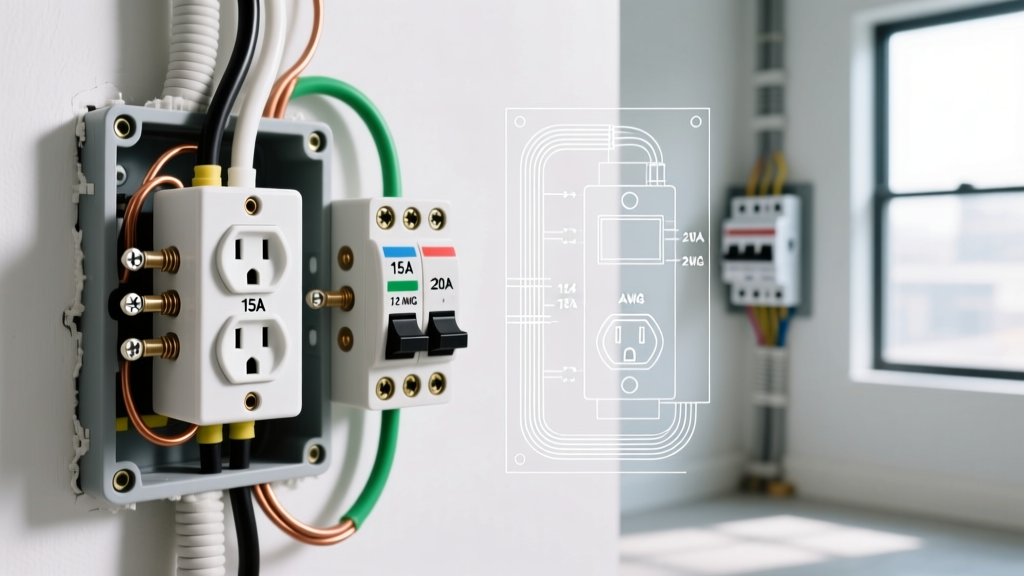
The following table outlines the baseline requirements for copper conductors in standard residential branch circuits, based on NEC Table 310.16 and the overcurrent protection limits of NEC 240.4(D).
| Breaker Size | Minimum Copper AWG | Max Continuous Load (80%) | Typical Application |
|---|---|---|---|
| 15 Amp | 14 AWG | 12 Amps (1440W at 120V) | General Living Rooms, Bedrooms, Hallways |
| 20 Amp | 12 AWG | 16 Amps (1920W at 120V) | Kitchens, Bathrooms, Garages, Laundry |
| 30 Amp | 10 AWG | 24 Amps (2880W at 120V) | RV Receptacles, Heavy-Duty Equipment |
Note: Aluminum wire requires larger gauges for the same ampacity, but pure aluminum is virtually never used for standard 15A/20A residential branch circuits today due to termination risks.
14 AWG vs. 12 AWG: The 15A and 20A Dilemma
The most common debate among DIYers and junior electricians is whether to use 14/2 or 12/2 Non-Metallic (NM-B) sheathed cable. Both contain two current-carrying conductors and a bare ground. The choice dictates your breaker size and where the outlets can legally be installed.
NEC 240.4(D): The Small Conductor Rule
Under NEC 240.4(D), the overcurrent protection for 14 AWG copper wire is strictly capped at 15 amps, and 12 AWG is capped at 20 amps. You cannot legally protect a 14 AWG wire with a 20-amp breaker, even if the connected load is low. If an inspector finds a 14 AWG wire on a 20A breaker, it is an automatic fail and a critical safety violation.
Box Fill Calculations (NEC 314.16)
Choosing the right wire for electrical outlet boxes also impacts your junction box sizing. Thicker wires take up more physical volume inside the box, generating more heat if cramped.
- 14 AWG Wire: Requires 2.0 cubic inches of box volume per conductor.
- 12 AWG Wire: Requires 2.25 cubic inches of box volume per conductor.
If you are wiring a 4-gang box with 12 AWG wire, you must calculate the volume for every hot, neutral, ground (counted as one), and device yoke. Failing to use a deep enough box (e.g., a 2.5-inch deep metal stud box) with 12 AWG wire will result in a box-fill violation.
Mandatory 20A Circuits: Kitchens, Bathrooms, and Laundry
While 14 AWG wire on a 15A breaker is perfectly legal for a bedroom or living room outlet, the NEC explicitly bans it in high-draw areas. According to the National Electrical Code guidelines detailed by EC&M, specific rooms mandate 20-amp circuits, which inherently requires 12 AWG wire.
Kitchen Small-Appliance Branch Circuits
NEC 210.11(C)(1) requires a minimum of two 20-amp small-appliance branch circuits to serve all countertop receptacles in the kitchen. These circuits cannot serve lighting or other rooms. Therefore, 12/2 NM-B is the absolute minimum wire for electrical outlet installations on kitchen counters.
Bathroom and Laundry Mandates
Similarly, NEC 210.11(C)(3) requires at least one 20-amp branch circuit to supply bathroom receptacle outlets. Because modern bathrooms feature high-wattage hair dryers and space heaters, 12 AWG wire is mandatory. Laundry rooms also require a dedicated 20A circuit (NEC 210.11(C)(2)) to handle the startup surge of washing machine motors.
Pro-Tip for 2026 Pricing: As of early 2026, a 250-foot roll of 14/2 NM-B copper wire averages around $115 to $125, while 12/2 NM-B hovers between $145 and $160. While 12 AWG is roughly 25% more expensive, many professional electricians now run 12 AWG for the entire house (excluding 3-way switch loops) to standardize inventory and future-proof the home for higher-draw smart home devices.
Voltage Drop: The Hidden Code Trap for Long Runs
One of the most frequently overlooked aspects of selecting wire for electrical outlet projects is voltage drop over distance. While the NEC ampacity tables assume standard run lengths, pushing current over long distances causes resistance, resulting in a drop in voltage at the receptacle.
NEC 210.19(A) Informational Note No. 4 recommends that branch circuit voltage drop be limited to a maximum of 3% to ensure the reasonable efficiency of operation. If you are wiring an outlet in a detached garage, a shed, or the far end of a large basement, standard wire sizing may not be enough.
When to Upsize Your Wire
Using data from the Southwire Voltage Drop Calculator, we can determine when to step up a wire gauge:
- 15A Circuit (14 AWG): Exceeds 3% voltage drop at approximately 50 feet (one-way run).
- 20A Circuit (12 AWG): Exceeds 3% voltage drop at approximately 60 feet (one-way run).
The Fix: If your run from the panel to the first outlet is 90 feet, you must upsize. For a 15A circuit, upgrade from 14 AWG to 12 AWG. For a 20A circuit, upgrade from 12 AWG to 10 AWG. Remember, when upsizing wire for voltage drop, you must also ensure the receptacle terminals are rated to accept the larger gauge, or use a pigtail reduction method inside a properly sized junction box.
Termination Torque: The NEC 110.14(D) Requirement
Selecting the correct wire for electrical outlet hardware is only half the battle; how you terminate that wire is equally regulated. A major shift in modern electrical inspections is the strict enforcement of NEC 110.14(D), which mandates the use of calibrated torque tools for all electrical terminations.
Most standard 15A and 20A duplex receptacles from manufacturers like Leviton and Hubbell specify a tightening torque between 12 and 14 inch-pounds (in-lbs) on their spec sheets. Hand-tightening with a standard screwdriver often results in under-torqued connections (causing arcing and heat) or over-torqued connections (stripping the binding screw or crushing the copper strands). To pass a rigorous 2026 inspection, you must use an insulated torque screwdriver set to the manufacturer's exact specification.
Summary Checklist for Outlet Wiring Compliance
Before you pull your first foot of cable or schedule your rough-in inspection, verify your project against this NEC compliance checklist:
- Verify Room Requirements: Are the outlets in a kitchen, bathroom, garage, or laundry? If yes, use 12/2 NM-B and a 20A breaker.
- Check Box Fill: Did you calculate the cubic inch requirements for 12 AWG (2.25 cu in) or 14 AWG (2.0 cu in) to ensure your junction boxes are deep enough?
- Calculate Run Length: Is the circuit run longer than 50-60 feet? If so, upsize the wire gauge to mitigate voltage drop.
- Match the Breaker: Confirm that 14 AWG is strictly paired with a 15A breaker, and 12 AWG with a 20A breaker (NEC 240.4(D)).
- Torque to Spec: Use a calibrated torque screwdriver to terminate the wires at the receptacle screws to the exact inch-pound rating listed on the device yoke.
For the most up-to-date and comprehensive code standards, always refer directly to the National Fire Protection Association's NEC portal. Understanding these code requirements ensures your wiring is not only legal but fundamentally safe for decades to come.