
Why Multimeter Testing is a Code Compliance Necessity
While a simple $12 plug-in receptacle tester can confirm basic wiring continuity, it cannot quantify voltage drop, identify high-resistance connections, or detect floating neutrals. For electrical professionals and advanced DIYers, knowing how to check an electrical outlet with a multimeter is the only way to verify compliance with the National Electrical Code (NEC). The transition into the 2026 enforcement cycle of the NEC places heavy emphasis on connection integrity (NEC 110.14(D)) and strict grounding protocols. A digital multimeter (DMM) bridges the gap between a simple 'pass/fail' indicator and true electrical diagnostics, ensuring your branch circuits meet the stringent safety tolerances mandated by the National Fire Protection Association (NFPA).
Selecting the Right Multimeter for NEC Verification
Before probing a 120V or 240V receptacle, your equipment must meet safety standards. The IEC 61010 standard requires that any meter used on branch circuits be rated for at least CAT III 600V. This rating ensures the meter can withstand transient voltage spikes up to 4,000V without catastrophic failure, a critical safety factor emphasized in OSHA electrical safety guidelines.
- Fluke 117 True RMS Multimeter (~$225): The industry standard for commercial electricians. Features non-contact voltage (NCV) detection, AutoVolts, and a low-impedance (LoZ) mode to eliminate ghost voltage readings.
- Klein Tools MM700 True RMS (~$75): A robust, cost-effective alternative for residential diagnostics. Rated CAT III 1000V / CAT IV 600V, it includes a built-in non-contact voltage detector and a durable thermocouple for thermal scanning.
Expert Insight: Never use a CAT II rated automotive multimeter for residential or commercial AC branch circuit testing. The internal arc-gap protection in CAT II meters is insufficient for the fault current available at a main service panel or downstream receptacle.
The 3-Point NEC Voltage & Polarity Matrix
When learning how to check an electrical outlet with a multimeter, you must perform a three-point voltage matrix. According to ANSI C84.1 standards, a nominal 120V circuit must deliver between 114V and 126V at the receptacle. Use this matrix to verify your readings against code requirements.
| Probe Configuration | Expected Reading (120V Nominal) | NEC / Industry Standard Reference | Diagnostic Purpose |
|---|---|---|---|
| Hot (Brass) to Neutral (Silver) | 114.0V - 126.0V | NEC 210.19(A) / ANSI C84.1 | Verifies supply voltage and branch circuit integrity. |
| Hot (Brass) to Ground (Green) | 114.0V - 126.0V | NEC 250.148 | Confirms equipment grounding conductor (EGC) continuity. |
| Neutral (Silver) to Ground (Green) | 0.0V - 2.0V | NEC 250.142(B) | Detects neutral-ground bonds, bootleg grounds, or overloaded neutrals. |
Step-by-Step: How to Check an Electrical Outlet With a Multimeter
Follow this precise procedure to audit a standard 15A or 20A, 120V NEMA 5-15R or 5-20R duplex receptacle. Always wear ANSI Z87.1 safety glasses and ensure your hands are dry.
Step 1: Visual and Mechanical Inspection (NEC 406.4)
Before inserting probes, inspect the receptacle. NEC 406.4(D) requires that any receptacle with a cracked faceplate, missing yoke screws, or loose internal contacts be replaced. Insert a plug; if it slides in without firm mechanical resistance, the internal wipers are fatigued, creating a high-resistance fire hazard.
Step 2: Hot-to-Neutral Voltage Verification
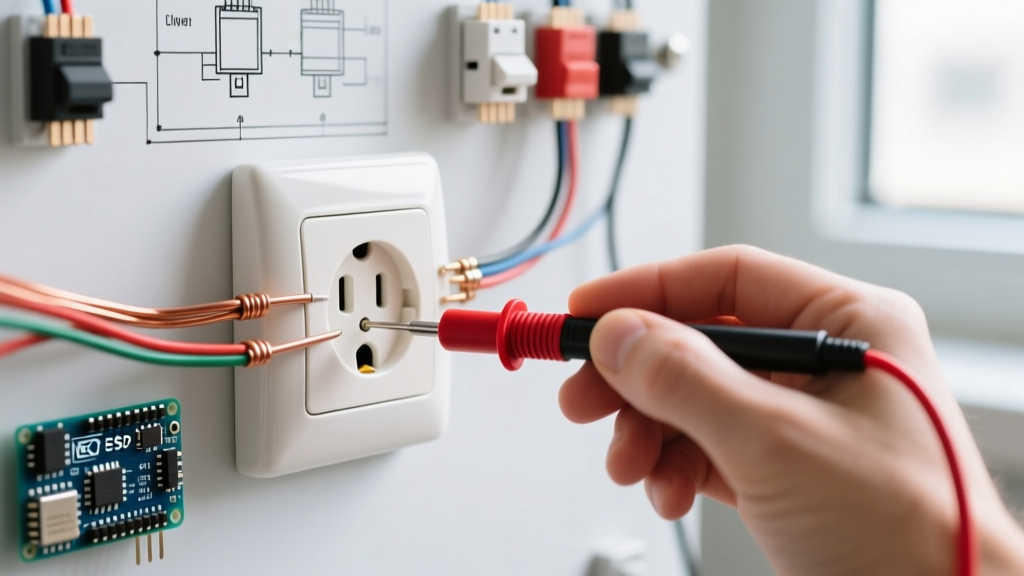
- Set your multimeter dial to V~ (AC Voltage). If your meter has a LoZ (Low Impedance) setting, use it to prevent ghost voltage anomalies.
- Insert the black (common) probe into the longer slot (Neutral).
- Insert the red (V/Ω) probe into the shorter slot (Hot).
- Record the reading. A reading of 121.4V is ideal. If it reads below 114V, you have a voltage drop issue or a utility supply fault.
Step 3: Hot-to-Ground & Ground Impedance Check
- Keep the red probe in the Hot slot.
- Move the black probe to the U-shaped Ground hole.
- The reading should be nearly identical to the Hot-to-Neutral reading (within 0.5V). If Hot-to-Ground reads 0V or significantly lower than Hot-to-Neutral, your equipment grounding conductor (EGC) is open or disconnected, a severe violation of NEC 250.148.
Step 4: The Floating Neutral / Bootleg Ground Test
- Move the red probe to the Neutral slot.
- Keep the black probe in the Ground hole.
- The reading must be close to 0.0V (typically 0.2V to 1.5V under load). If it reads 120V, the hot and neutral are reversed. If it reads 0V but a plug-in tester indicates an 'Open Ground', you likely have a bootleg ground (a jumper wire connecting neutral to ground behind the yoke), which is strictly prohibited by NEC 250.142(B).
Decoding Anomalies: Common Code Violations Revealed by Multimeter
Understanding how to check an electrical outlet with a multimeter allows you to identify specific wiring faults that standard testers miss. Here is how to interpret anomalous data based on Electrical Contractor Magazine's code enforcement analyses.
Anomaly 1: High Neutral-to-Ground Voltage (Above 2.0V)
The Code Issue: A Neutral-to-Ground reading above 2.0V (without a heavy load applied) indicates high impedance in the neutral return path or a shared-neutral (multi-wire branch circuit) imbalance. Under NEC 300.13(B), the continuity of the grounded conductor (neutral) must not depend on device yokes. If the neutral is pigtailed incorrectly or daisy-chained through the receptacle screws and a connection loosens, the impedance rises, causing voltage to bleed onto the ground wire.
The Fix: Remove the receptacle and verify that all neutrals are secured with proper wire nuts or push-in connectors (like Wago 221 series) and that a dedicated pigtail feeds the receptacle's silver terminal.
Anomaly 2: Hot-to-Ground Reads 0V, Hot-to-Neutral Reads 120V
The Code Issue: Open Equipment Ground. The circuit has no path to earth. If a fault occurs inside an appliance plugged into this outlet, the breaker will not trip, and the appliance chassis will become energized at 120V.
The Fix: Trace the EGC back to the panel. If upgrading the ground wire is physically impossible without tearing into drywall, NEC 406.4(D)(2) permits the installation of a GFCI receptacle labeled 'No Equipment Ground' as a remediation measure, though this does not fix the underlying lack of a ground path for surge protectors.
Advanced Diagnostic: Testing Voltage Drop Under Load
NEC 210.19(A) Informational Note recommends that branch circuit voltage drop not exceed 3% (3.6V on a 120V circuit). A multimeter reading of 122V at an empty receptacle means nothing if the voltage collapses to 105V when a microwave turns on. To test for high-resistance connections or undersized wire runs:
- Measure the baseline Hot-to-Neutral voltage (e.g., 122.0V).
- Plug a known 15A resistive load (such as a 1500W space heater or a 12A hair dryer) into the bottom half of the duplex receptacle.
- Immediately measure the Hot-to-Neutral voltage on the top half using your multimeter probes.
- Calculate the drop. If the baseline was 122.0V and it drops to 115.0V under a 12A load, you have a 7V drop (5.7%). This exceeds the 3% NEC recommendation and indicates undersized wiring (e.g., 14 AWG wire on a 100-foot run) or a corroded connection at the panel bus bar.
Frequently Asked Questions (FAQ)
Can I use a non-contact voltage tester instead of a multimeter?
No. A non-contact voltage (NCV) tester only detects the presence of an electromagnetic field. It cannot measure exact voltage, verify polarity, check ground continuity, or identify reverse polarity, all of which are required for NEC compliance verification.
Why does my multimeter read 60V on a disconnected wire?
This is 'ghost voltage' caused by capacitive coupling from adjacent live wires in the same conduit or cable sheath. To eliminate this false reading, use a multimeter with a LoZ (Low Impedance) setting, which places a small load on the circuit to bleed off the phantom voltage.
Is it safe to test a 240V outlet with a standard multimeter?
Yes, provided your multimeter is rated CAT III 600V or higher, and you use properly insulated test leads. When testing a NEMA 14-50 (240V/120V) receptacle, you must measure Hot-to-Hot (expect ~240V), Hot-to-Neutral (expect ~120V on both legs), and Hot-to-Ground (expect ~120V on both legs).
Summary
Mastering how to check an electrical outlet with a multimeter elevates your troubleshooting from basic guesswork to precise, code-compliant diagnostics. By verifying the 3-point voltage matrix, testing under load, and understanding the NEC articles governing grounding and voltage tolerances, you ensure that your electrical infrastructure is not only functional but fundamentally safe. Always prioritize CAT-rated equipment and adhere to local electrical codes when performing live circuit diagnostics.