
The Reality of Receptacle Degradation
To answer the fundamental question: can an electrical outlet go bad? The definitive answer is yes. While electrical receptacles have no moving parts in the traditional sense, they are mechanical devices subject to physical wear, thermal cycling, and environmental degradation. A standard 15-amp duplex receptacle relies on internal brass alloy wipers to maintain a friction-fit connection with the male blades of a plug. Over time, these wipers lose their spring tension, leading to increased electrical resistance, arcing, and eventual thermal failure.
However, simply swapping a bad outlet for an identical new one is no longer legally or safely permissible in most jurisdictions. The National Electrical Code (NEC) has evolved significantly. When an outlet fails, the act of replacing it triggers specific code upgrade mandates. This guide explores the exact failure modes of receptacles and breaks down the NEC code requirements you must follow when replacing them in 2026.
Anatomy of Failure: Why Outlets Go Bad
Receptacles do not typically fail spontaneously; they degrade due to specific mechanical and thermal stresses. Understanding these failure modes is critical for diagnosing bad outlets and preventing electrical fires.
1. Wiper Fatigue and Loss of Tension
The internal contacts (wipers) in a standard NEMA 5-15R receptacle are designed to grip plug blades with a specific extraction force. According to UL 498 testing standards, a new receptacle requires between 3 to 8 pounds of force to extract a standard plug. After roughly 1,000 to 2,000 insertion cycles, cheaper commercial-grade receptacles experience brass fatigue. The grip loosens, creating a high-resistance connection that generates excessive heat under continuous loads (like space heaters or window AC units).
2. Thermal Degradation from 'Backstabbing'
Push-in (backstab) wiring terminals are notorious for causing outlets to go bad prematurely. While NEC Article 110.14 permits the use of listed push-in connectors for 14 AWG solid copper wire, the internal spring-steel clamps can loosen over time due to thermal expansion and contraction. A loose backstabbed connection will arc internally, melting the polycarbonate face of the receptacle and eventually causing an open circuit.
3. Environmental and Corrosion Damage
Outlets in high-humidity areas (garages, exteriors, bathrooms) suffer from galvanic corrosion, particularly if aluminum wiring or dissimilar metals are involved. Corrosion increases contact resistance, leading to voltage drops and localized heating.
| Failure Mode | Primary Cause | Diagnostic Symptom | Immediate Action Required |
|---|---|---|---|
| Wiper Fatigue | Repeated plug insertion/removal | Plugs fall out easily; warm faceplate | Replace receptacle immediately |
| Backstab Arcing | Thermal cycling of spring clamps | Flickering lights; buzzing sound; melted plastic | Cut power; inspect wire insulation |
| Neutral Lift | Loose terminal screw or broken wire | 120V drops to 0V or surges to 240V (multi-wire) | Shut off breaker; re-terminate all connections |
| GFCI Sensor Failure | Moisture intrusion or component aging | Test button fails to trip; won't reset | Replace with new GFCI receptacle |
NEC Article 406.4(D): The Law of Receptacle Replacement
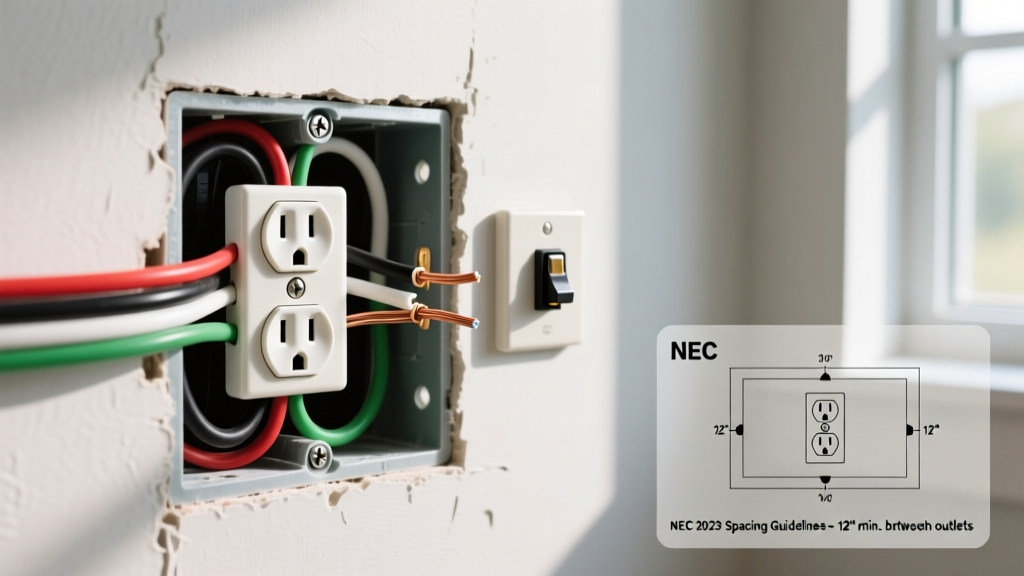
When you determine that an electrical outlet has gone bad, you cannot simply replace it with the exact same model you bought 20 years ago. The NEC treats the replacement of an existing receptacle as a trigger event for modern safety upgrades. NFPA 70 (National Electrical Code) outlines these mandates in Article 406.4(D).
The Tamper-Resistant (TR) Mandate
Under NEC 406.4(D)(5), any receptacle replaced in areas specified by NEC 406.12 (which includes virtually all 15A and 20A, 125V and 250V non-locking receptacles in residential dwellings) must be replaced with a listed Tamper-Resistant (TR) receptacle. TR receptacles feature internal shutters that only open when equal pressure is applied to both blades simultaneously, preventing children from inserting foreign objects. If your 1990s home has a bad standard outlet, installing a non-TR replacement is a direct code violation.
GFCI and AFCI Upgrade Triggers
The code requires that replacement receptacles must comply with the current protection requirements for new installations in that specific location.
- GFCI Protection (NEC 406.4(D)(3)): If a bad outlet is located in an area currently requiring Ground-Fault Circuit Interrupter protection (kitchens, bathrooms, garages, outdoors, crawlspaces, unfinished basements, and within 6 feet of a sink), the replacement must be a GFCI receptacle or protected by a GFCI breaker. You cannot install a standard receptacle in these zones anymore.
- AFCI Protection (NEC 406.4(D)(4)): If you are replacing a bad receptacle in living rooms, bedrooms, or hallways, and the branch circuit lacks Arc-Fault Circuit Interrupter (AFCI) protection, the replacement receptacle must be an AFCI receptacle, or the circuit breaker must be upgraded to an AFCI type. This is a massive shift from older codes and catches many DIYers off guard.
Code Insight: According to the Consumer Product Safety Commission (CPSC), GFCI receptacles have a functional lifespan of about 10 to 15 years. If your GFCI outlet has gone bad and will no longer reset, it has likely reached the end of its internal sensor life and must be replaced with a modern, self-testing TR GFCI model.
The Backstab Controversy: Wiring Methods for Longevity
When replacing a bad outlet, the wiring method you choose dictates the lifespan of the new installation. While push-in (backstab) terminals are technically permitted by UL for 14 AWG solid wire under specific conditions, master electricians overwhelmingly avoid them.
Why Side-Wiring (Screw Terminals) is Superior
Side-wiring involves wrapping the stripped wire clockwise around the brass (hot) and silver (neutral) terminal screws. When tightened, the screw head clamps the wire firmly against the steel mounting yoke. This creates a massive surface area for electrical contact, virtually eliminating the risk of thermal arcing.
Pro-Tip for 2026 Installations: Use a wire stripper with a built-in gauge to ensure exactly 5/8 inch of insulation removal for 14 AWG and 12 AWG wires. Exposed copper beyond the terminal screw creates a shock hazard, while insulation tucked under the screw head causes a high-resistance 'bad' connection from day one.
When to Use Pigtailing
If the bad outlet was part of a daisy-chain (feed-through) and the box is crowded, use a WAGO 221-series lever nut or a properly torqued wire nut to pigtail the hot and neutral wires. Never use the receptacle itself as the sole splice point for downstream devices if the box fill calculations (NEC Article 314.16) are borderline.
Diagnostic Protocol: Confirming the Outlet is Actually Bad
Before ripping out the receptacle, verify that the outlet itself is the failure point, rather than a tripped breaker, a loose wire nut upstream, or a failed GFCI device earlier in the circuit.
- Visual Inspection: Remove the faceplate. Look for brown scorch marks, melted polycarbonate, or a distinct 'fishy' or ozone smell, which indicates active arcing.
- Voltage Testing: Use a non-contact voltage tester (NCVT) like the Fluke 2AC VoltAlert to confirm the circuit is dead after turning off the breaker. Then, use a digital multimeter (DMM) to measure Hot-to-Neutral (should be ~120V), Hot-to-Ground (~120V), and Neutral-to-Ground (should be < 2V).
- Load Testing: If voltage reads correctly but devices fail to operate, the internal wipers are likely fatigued. Plug in a Gardner Bender GRT-500 receptacle tester with a GFCI test button to verify proper grounding and functional integrity under a slight load.
2026 Material Cost Guide for Code-Compliant Replacements
Upgrading to current NEC standards costs slightly more than buying legacy parts, but it ensures legal compliance and maximum safety. Below is a pricing matrix for premium, contractor-grade replacements (prices reflect average 2026 retail costs at major electrical suppliers).
| Receptacle Type | Example Model (Leviton/Eaton) | Average Cost | NEC Application Trigger |
|---|---|---|---|
| Standard 15A TR Duplex | Leviton Decora 5320-WMP | $2.50 - $4.00 | General living areas (Bedrooms, Hallways) |
| 20A TR Duplex | Leviton 5362-W | $4.00 - $6.00 | Kitchen small appliance circuits, Garage |
| 15A TR GFCI | Eaton GFNT2-W | $16.00 - $22.00 | Bathrooms, Outdoors, Crawlspaces, Kitchens |
| 15A Dual-Function (AFCI/GFCI) | Leviton AGFTR1-W | $35.00 - $45.00 | Kitchens/Laundry where both protections are mandated |
For comprehensive safety guidelines on ground-fault protection and preventing electrical shocks in wet areas, refer to the Electrical Safety Foundation International (ESFI) resources on GFCI technology and testing protocols.
Frequently Asked Questions (FAQ)
Can a bad outlet cause a breaker to trip?
Yes. If the internal wipers of an outlet degrade to the point of severe arcing, it can create a ground fault or an arc fault, tripping a GFCI or AFCI breaker. In extreme cases, a dead short caused by melted internal insulation will trip a standard thermal-magnetic breaker instantly.
Is it safe to replace a 2-prong ungrounded outlet with a 3-prong outlet?
Under NEC 406.4(D)(2), you can replace a bad 2-prong ungrounded receptacle with a 3-prong grounding type only if it is GFCI protected and marked with a 'No Equipment Ground' sticker. You cannot legally or safely install a standard 3-prong outlet without an actual equipment grounding conductor (EGC) present in the box.
Why does my new outlet feel warm to the touch?
A warm outlet is a massive red flag. It indicates either a loose terminal screw connection, backstabbed wires failing under load, or a circuit overloaded beyond 80% of its continuous rating (e.g., pulling 1500W continuously on a 15A circuit). Turn off the breaker immediately and re-terminate the wiring using side-screw connections.
Final Thoughts on Receptacle Lifespan
Electrical outlets absolutely go bad. They are mechanical wear items that degrade with every plug insertion and every thermal cycle. When you encounter a failed receptacle, view it not just as a repair job, but as an opportunity to bring that specific point of your electrical system up to modern 2026 NEC safety standards. By mandating Tamper-Resistant, GFCI, and AFCI technologies upon replacement, the code ensures that the replacement outlet will not only restore power but actively protect your home from the next generation of electrical hazards.