
Introduction to Budapest's Electrical Landscape
Budapest is a city of striking architectural contrasts, and its electrical infrastructure reflects this duality. From the grand 19th-century apartments of the Pest side to the contemporary builds in the Buda hills, wiring scenarios vary wildly. When planning to install or upgrade a Budapest electrical outlet, electricians and advanced DIYers must navigate a complex transition between aging socialist-era infrastructure and modern European Union safety standards. In 2026, understanding the local nuances of the Hungarian electrical grid, specific MSZ (Magyar Szabvány) standards, and the physical requirements of Schuko receptacles is critical for safe, code-compliant installations.
The Standard: Type F (Schuko) Specifications
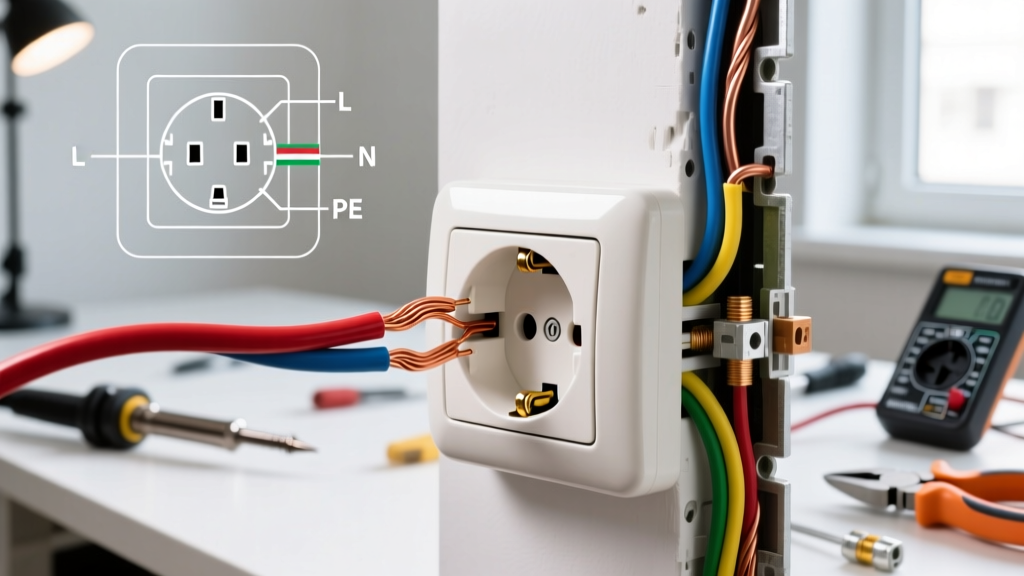
Hungary utilizes the Type F electrical outlet, commonly known as the 'Schuko' (Schutzkontakt). This standard is shared across most of continental Europe and is defined by the CEE 7/3 specification.
- Voltage & Frequency: 230V AC at 50Hz.
- Amperage: Standard residential circuits are protected by 16A breakers (kismegszakító).
- Grounding Mechanism: Unlike the French/Belgian Type E (which uses a protruding earth pin), the Type F Schuko outlet features two earth clips on the top and bottom edges of the recessed socket cavity.
- Recess Depth: The socket is recessed by approximately 15mm to ensure that the plug's earth clips make contact before the live pins engage, a vital safety feature.
CRITICAL SAFETY WARNING: Never attempt to install a modern 3-pin Schuko outlet on an ungrounded 2-wire system and 'bootleg' the ground by bridging the Neutral and Earth terminals. If the neutral wire breaks or is reversed at the panel, the exposed metal chassis of any plugged-in appliance will become energized at 230V, posing a lethal shock hazard.
Scenario 1: Upgrading Ungrounded Outlets in Classic Pest Apartments
In central Pest districts (such as V, VI, VII, and VIII), many buildings constructed before the 1980s still rely on original 2-wire aluminum (alumínium) wiring. These systems typically lack a dedicated Protective Earth (PE) conductor.
The 2-Wire Dilemma and Safe Upgrades
If a full rewire to copper is not financially feasible for a renovation, you must address the lack of grounding safely. The Hungarian electrical code mandates the use of an Áram-védőkapcsoló (ÁVK), which is the local term for a Residual Current Device (RCD) or Ground Fault Circuit Interrupter (GFCI).
- Install an ÁVK (RCD): Upgrade the main distribution board (elosztó) to include a 30mA ÁVK for all socket circuits. This provides life-saving shock protection even without a physical earth wire.
- Leave Earth Unconnected: Wire the new Schuko outlet's Line (L) and Neutral (N) terminals only. Leave the PE terminal empty.
- Labeling: Apply a 'No Earth' warning sticker on the faceplate, a standard requirement under EU-OSHA electrical safety guidelines for RCD-protected ungrounded receptacles.
Aluminum to Copper Transitions
Older Budapest apartments often feature 2x2.5mm² or 2x4mm² solid aluminum wires. Modern outlets use copper screw terminals. Directly clamping copper to aluminum causes galvanic corrosion, leading to high resistance and arc faults. If you must pigtail old aluminum to a new copper outlet wire, use WAGO 221-412 lever connectors filled with WAGO Alu-Plus contact paste to prevent oxidation. However, complete replacement with 3x2.5mm² copper (NYM-J or MTK cable) is the only 2026-compliant permanent solution.
Scenario 2: Modern TN-S Installations in Buda Hills Homes
New builds and fully renovated properties in the Buda side (Districts II, XII) utilize modern TN-S earthing systems with 3-wire copper setups. Wiring a Budapest electrical outlet in these environments is straightforward and aligns with standard IEC practices.
Step-by-Step Schuko Wiring
- Prepare the Cable: Strip the outer sheath of the 3x2.5mm² copper cable, leaving about 150mm of working length inside the flush-mounted box (süllyesztő doboz).
- Strip the Conductors: Strip 12mm of insulation from the Brown (Phase), Blue (Neutral), and Yellow/Green (Earth) wires.
- Connect Earth (PE): Insert the Yellow/Green wire into the central earth screw terminal of the Schuko mechanism. Tighten to 1.2 Nm.
- Connect Neutral (N): Insert the Blue wire into the left terminal (when facing the outlet).
- Connect Phase (L): Insert the Brown wire into the right terminal.
- Secure the Mechanism: Use the claw grips (karmok) or M3.5 machine screws to secure the outlet to the drywall or masonry box. Ensure the mechanism is perfectly level before tightening the faceplate.
Hungarian Wire Color Codes: Old vs. Harmonized
One of the most dangerous aspects of working in older Budapest properties is encountering legacy color codes. Hungary adopted the harmonized European color standard (MSZ HD 308 S2) in the early 2000s, but legacy wiring remains prevalent. Always verify wires with a multimeter or voltage tester before touching them.
| Function | Modern Harmonized (MSZ HD 308 S2) | Legacy Hungarian (Pre-2000s) | Soviet-Era Aluminum (Common in 1970s Builds) |
|---|---|---|---|
| Phase (Line / L) | Brown (or Black/Gray in 3-phase) | Black or Red | Black or White (Insulation often degraded) |
| Neutral (N) | Blue | Blue or Light Blue | Blue or Bare Wire |
| Protective Earth (PE) | Yellow/Green | Yellow/Green (Rare in old builds) | Non-existent (2-wire systems) |
For a comprehensive breakdown of European wiring colors and safety transitions, refer to the Electrical Safety First wiring color guide, which details the harmonization timeline across the continent.
Recommended Materials for 2026 Renovations
When sourcing materials for a Budapest electrical outlet installation, local hardware stores (like Bauhaus or OBI) and specialized electrical suppliers (such as Lumen or Elektro-Install) stock several reliable brands. Pricing in 2026 reflects current supply chain realities:
- Legrand Valena Next (White): The premium choice for modern apartments. Features robust polycarbonate housing and quick-connect terminals. Price: ~4,500 - 6,000 HUF per complete set.
- Schneider Electric Asfora: Excellent mid-range option with a sleek, low-profile design. The screwless terminal blocks make solid copper wiring incredibly fast. Price: ~2,800 - 3,500 HUF per complete set.
- Prodax Classic: A legacy Hungarian brand. While cheaper (~1,500 HUF), the internal mechanisms feel dated compared to Western European equivalents. Recommended only for budget utility rooms or garages.
- Flush Boxes (Süllyesztő doboz): Use standard 65mm deep drywall boxes for plasterboard, or heavy-duty PVC masonry boxes with pre-molded screw bosses for brick walls.
High-Load Scenarios: Kitchen and HVAC Outlets
Standard 16A Schuko outlets are insufficient for heavy appliances like induction cooktops or modern electric vehicle (EV) chargers.
Induction Cooktops (Főzőlap)
Most modern induction hobs in Budapest require a 3-phase (400V) connection. This requires running a 5x2.5mm² or 5x4mm² copper cable from a dedicated 3x16A or 3x20A breaker. The termination is typically done at a specialized connection box (csatlakozódoboz) rather than a standard wall outlet, though some 3kW single-zone hobs can use a heavy-duty 20A Schuko variant.
EV Charging (Wallbox)
With EV adoption rising in Hungary, installing a dedicated Wallbox is common. While some portable chargers use a standard Schuko plug, continuous 16A draw for 8+ hours will melt standard outlet terminals. For EV charging, install an industrial CEE 7/5 or a hardwired Wallbox on a dedicated 3x6mm² circuit with a Type B ÁVK (RCD) to handle DC fault currents.
Frequently Asked Questions
Can I use a US 110V appliance in a Budapest electrical outlet?
No. Budapest operates on 230V. Plugging a strictly 110V US appliance into a Type F outlet using only a physical plug adapter will instantly destroy the appliance and may cause a fire. You must use a step-down voltage transformer. Always check the appliance's power supply label; most modern laptop and phone chargers are dual-voltage (100-240V) and only require a cheap Type F physical adapter.
What is the standard breaker size for a Budapest outlet circuit?
The standard is a 16A B-type or C-type miniature circuit breaker (MCB / kismegszakító). A 2.5mm² copper wire can technically handle up to 20A-24A depending on installation method, but Hungarian code strictly limits the breaker to 16A for standard socket circuits to protect the plug/receptacle interface, which is rated for a maximum of 16A continuous.
How do I test if an older Budapest outlet is properly grounded?
Use a dedicated Schuko socket tester (dugvilla tesztelő) with three LED indicators. Insert it into the outlet. If the 'Earth' LED does not illuminate, the outlet is ungrounded. For a definitive measurement, use a loop impedance tester to measure the resistance between the Phase and the Earth clips; a high resistance reading indicates a faulty or missing ground path back to the distribution panel.