
Navigating the Amsterdam Electrical Outlet Landscape
Whether you are renovating a historic canal house (grachtenpand) or upgrading a modern apartment, understanding the local electrical code is non-negotiable. The amsterdam electrical outlet ecosystem operates under entirely different standards than the North American NEC or British BS 7671. In the Netherlands, all low-voltage electrical installations are governed by NEN 1010, the national standard based on the European IEC 60364 framework.
For DIY enthusiasts and expats, attempting to wire a standard US-style NEMA 5-15R receptacle or ignoring local earthing requirements isn't just a code violation—it is a severe fire and shock hazard. This guide breaks down the exact code requirements, wiring color codes, and physical specifications you need to know to safely install, replace, or upgrade an Amsterdam electrical outlet.
The Core Standard: NEN 1010 vs. North American NEC
Before touching a single wire, you must understand the fundamental differences in voltage, frequency, and circuit protection. Amsterdam operates on a 230V / 50Hz single-phase system. A standard household circuit is protected by a 16A C-curve miniature circuit breaker (MCB), yielding a maximum continuous load of roughly 3,680 watts per group.
| Feature | Amsterdam (NEN 1010) | North America (NEC) |
|---|---|---|
| Standard Voltage | 230V AC | 120V / 240V AC |
| Frequency | 50 Hz | 60 Hz |
| Standard Receptacle | Type F (Schuko / CEE 7/3) | NEMA 5-15R |
| Standard Breaker Size | 16A (C-Curve) | 15A or 20A (B-Curve equivalent) |
| Max Load per Circuit | ~3,680W | ~1,800W (120V) / ~2,400W (20A) |
| Earth Leakage Protection | 30mA RCD (Aardlekschakelaar) | GFCI (5mA trip threshold) |
Anatomy of the Amsterdam Electrical Outlet (Type F Schuko)
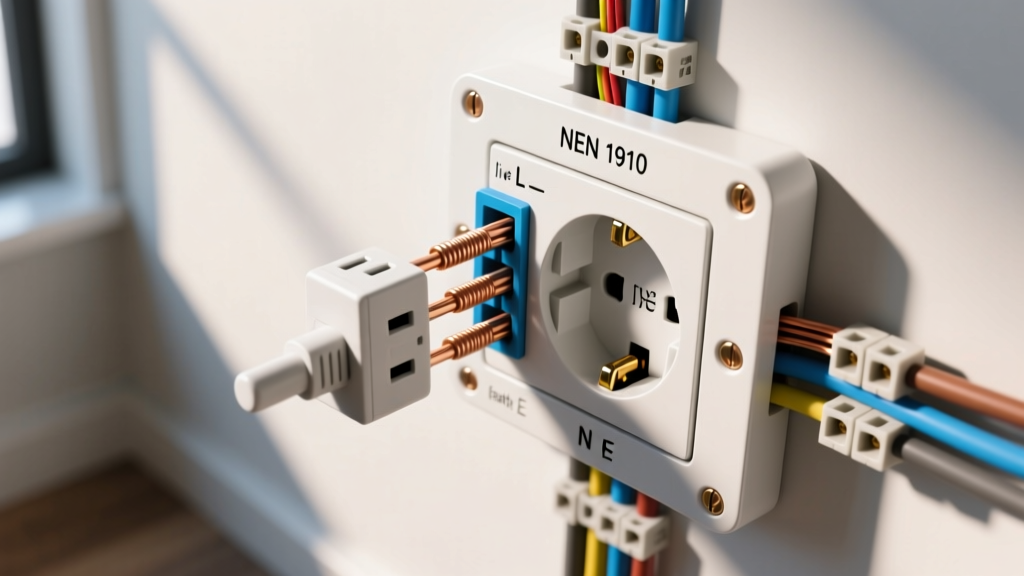
The standard amsterdam electrical outlet is the Type F Schuko (CEE 7/3 or CEE 7/4). Unlike the US system where the earth pin is a protruding prong on the plug, the Schuko system utilizes dual earthing clips on the top and bottom inner rims of the receptacle.
Critical Physical Specifications
- Pin Diameter: 4.8 mm (Standard Europlugs use 4.0 mm, which can cause loose, arcing connections in worn Schuko outlets).
- Pin Length: 19 mm.
- Recess Depth: 15 mm (Designed to ensure the earth clips engage before the live pins make contact).
- Child Protection: Modern NEN 1010 compliant outlets feature integrated, pressure-activated shutter mechanisms (kindveilige stopcontacten). Never bypass these by drilling them out.
Wiring Color Codes: Modern vs. Historic Amsterdam Homes
One of the most dangerous traps for DIYers in Amsterdam is assuming the wiring colors behind the wall match modern standards. The Netherlands transitioned to the harmonized European color code in 1970, but many older homes—especially pre-war canal houses—still contain legacy wiring.
| Function | Modern Code (Post-1970) | Legacy Code (Pre-1970) |
|---|---|---|
| Phase (Live / Line) | Brown (Bruin) | Red (Rood) or Green (Groen) |
| Neutral | Blue (Blauw) | Black (Zwart) or Grey (Grijs) |
| Protective Earth (PE) | Green/Yellow (Geel/Groen) | Bare Copper or Lead Sheath |
Expert Warning: If you open a junction box or outlet backbox in an Amsterdam home built before 1970 and find green wire, do not assume it is earth. In legacy Dutch wiring, green was frequently used as a switched live or phase wire. Always use a calibrated CAT III multimeter or a two-pole voltage tester (Duspol) to verify dead circuits before touching any conductors.
Mandatory Earthing and RCD Requirements
According to VeiligheidNL, electrical fires and fatal shocks are heavily mitigated by proper earthing and Residual Current Devices (RCDs). In Dutch terminology, an RCD is an aardlekschakelaar.
The 30mA Rule
Every group of outlets in an Amsterdam residence must be protected by a 30mA RCD. While North American GFCIs trip at an ultra-sensitive 5mA, the European 30mA threshold is designed to prevent lethal ventricular fibrillation while minimizing nuisance tripping from minor capacitive leakage in appliances. If you are upgrading an old fuse box (groepenkast), you must install a 30mA Type A RCD, which can handle both AC and pulsating DC leakage currents (essential for modern LED drivers and washing machine inverters).
What If There Is No Earth Wire?
In some historic Amsterdam properties, you may find old two-core cloth or rubber-insulated cables with no Protective Earth (PE). Under NEN 1010, it is strictly illegal to install a standard Schuko outlet without a functional earth connection. You cannot use a 'cheater plug' or bootleg ground. Your only code-compliant options are:
- Pull new 3-core (3x2.5mm²) VD-wire through the existing conduits back to the distribution board.
- If the conduit is blocked, install a specialized, locally approved RCD-protected outlet that does not require a PE conductor (though this is a rare exception and must be signed off by a certified NEN 3140 inspector).
Code Requirements for Wet Areas (Bathrooms & Kitchens)
Bathrooms in Amsterdam are governed by NEN 1010 NPR 5388, which defines strict volumetric zones for electrical installations due to the presence of water and human skin resistance reduction.
- Zone 0 (Inside the bath/shower tray): No outlets permitted. Only SELV (Separated Extra-Low Voltage) IPX8 rated lighting is allowed.
- Zone 1 (Directly above bath/shower up to 2.25m): No standard outlets. Only IPX4 rated water heaters or specialized shower pumps are permitted.
- Zone 2 (60cm radius outside the bath/shower): IPX4 rated fixtures allowed. Standard amsterdam electrical outlet receptacles are prohibited here unless they are specifically designed for shavers (incorporating an isolation transformer) and placed at least 1.5 meters from the shower head.
- Zone 3 (Beyond 60cm): Standard Schuko outlets are permitted, provided the circuit is protected by a 30mA RCD.
Step-by-Step: Replacing a Damaged Schuko Receptacle
If an existing outlet shows signs of thermal damage (brown scorch marks on the faceplate) or loose plug retention, it must be replaced immediately. The IEC World Plugs Guide notes that worn Type F receptacles are a leading cause of high-resistance connections and subsequent thermal runaway.
Required Tools & Materials
- VDE-certified insulated screwdrivers (1000V rated, e.g., Wiha or Wera).
- Two-pole voltage tester (e.g., Benning Duspol).
- Wire strippers (e.g., Knipex MultiStrip 10).
- Replacement 16A 250V Type F Schuko receptacle (Brands: Niko, Busch-Jaeger, or Hager).
- WAGO 221-413 lever-nuts (if extending short legacy wires).
Installation Procedure
- Isolate the Circuit: Turn off the specific 16A MCB in the groupenkast. Do not rely solely on the main switch if labeling is poor.
- Verify Dead: Insert the Benning Duspol into the outlet slots and press the test button to confirm zero voltage. Test the earth clips by bridging Phase to Earth.
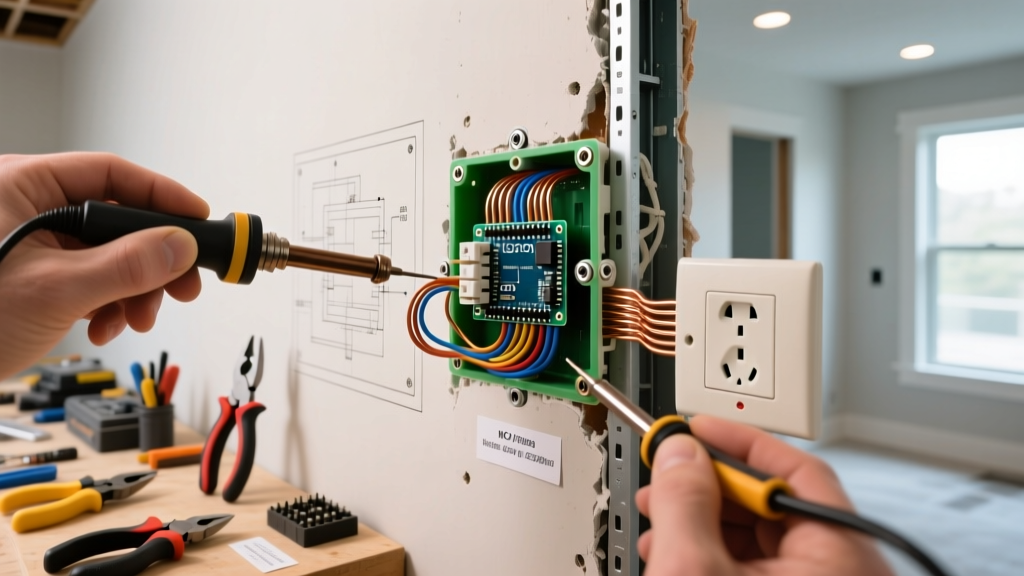
- Extract the Chassis: Remove the center M4 screw and gently pull the outlet chassis from the flush-mounted backbox (inbouwdoos). Note: Amsterdam homes typically use standard 71mm diameter round backboxes.
- Inspect Wire Length: You need at least 12cm of wire protruding from the backbox to safely strip and terminate. If the legacy wires are too short and brittle, cut them back and use WAGO 221 lever-nuts to pigtail new 2.5mm² solid copper VD-wire.
- Terminate: Connect Brown to L1, Blue to N, and Green/Yellow to the Earth terminal. Ensure no bare copper is exposed outside the terminal cage. Torque the terminal screws to the manufacturer's spec (usually 0.8 Nm).
- Mount and Test: Push the wires neatly into the backbox using a folding technique (accordion style, never cram). Secure the chassis, restore power, and test with a dedicated Schuko socket tester (e.g., Ideal Industries or Beha-Amprobe) to verify correct phase, neutral, and earth clip continuity.
Smart Home Integration: Upgrading to Connected Outlets
In 2026, energy monitoring is a priority for Amsterdam residents facing fluctuating dynamic energy contracts. Upgrading to smart Schuko outlets is a popular DIY project. However, code dictates that smart outlets with internal relays must still maintain the physical earth clips and shutter mechanisms. Brands like Niko Home Control and Busch-Jaeger free@home offer flush-mounted smart receptacles that integrate directly with standard 55mm European faceplates. When installing these, ensure the backbox depth is at least 50mm, as the internal relay and power supply modules add significant bulk behind the chassis.
Summary: Respect the NEN 1010 Standard
Working with an amsterdam electrical outlet requires a fundamental shift in mindset from North American or Asian electrical practices. The 230V system is unforgiving, and the NEN 1010 code is designed with rigorous safety margins. Always prioritize verified earthing, respect the 30mA RCD mandate, and never compromise on wire termination quality. When in doubt, consult a certified Dutch electrician registered with Techniek Nederland to ensure your installation passes the mandatory NEN 3140 safety inspection.