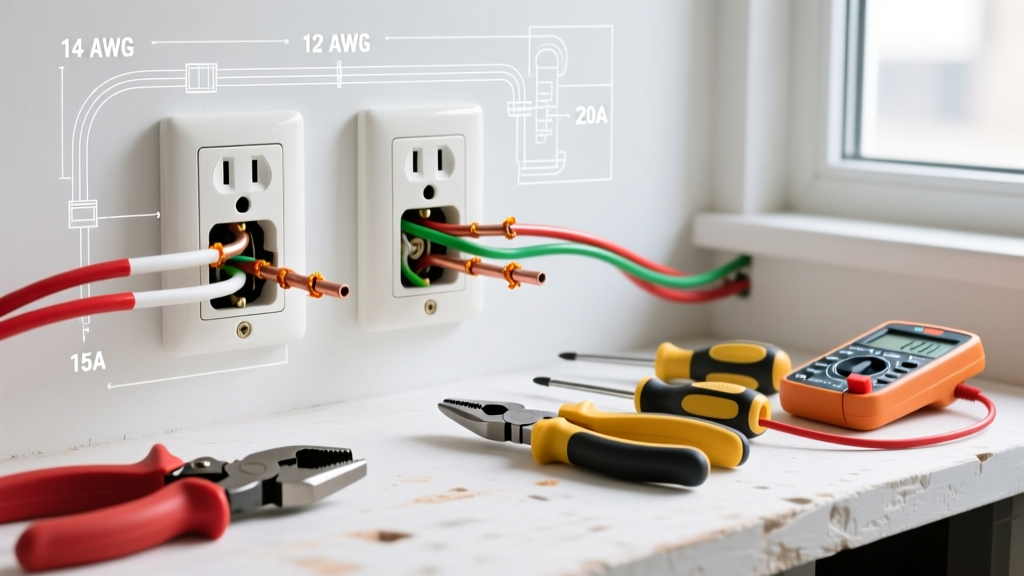

The Anatomy of a Dead Electric Power Outlet
A dead electric power outlet is one of the most common residential electrical complaints, but it is rarely as simple as 'the outlet broke.' According to the National Fire Protection Association (NFPA), electrical distribution and lighting equipment are consistently among the top causes of home structure fires. A non-functional receptacle is often a symptom of a deeper wiring fault, a tripped upstream protective device, or a high-resistance connection generating dangerous heat.
This comprehensive diagnostic guide moves beyond basic 'check the breaker' advice. We will use professional-grade diagnostic sequences to isolate the exact failure point of your 120V, 15A or 20A branch circuit, referencing current NEC (National Electrical Code) standards and 2026 best practices for residential wiring.
Required Diagnostic Arsenal
Do not rely on a $5 neon voltage tester for deep diagnostics. To properly troubleshoot an electric power outlet, you need tools that can measure exact voltage drops and verify ground integrity.
- True-RMS Digital Multimeter: The Fluke 117 (approx. $210) or Klein Tools MM700 (approx. $65). True-RMS is critical for accurate readings on circuits with non-linear loads like LED drivers or smart home hubs.
- GFCI/AFCI Receptacle Tester: Klein Tools RT250 (approx. $45) to simulate ground faults and verify upstream protection.
- Insulated Torque Screwdriver: Wiha 11-Piece Insulated Set (approx. $130). NEC 110.14(D) mandates specific torque values for terminations; hand-tightening is no longer code-compliant for new work or replacements.
- Non-Contact Voltage Tester (NCVT): For initial safety verification before removing the faceplate.
Phase 1: The Upstream GFCI and AFCI Cascade
Before touching a screwdriver, you must rule out upstream protective devices. Modern homes are wired with daisy-chained circuits. A standard electric power outlet in your living room or hallway might be on the 'LOAD' side of a GFCI receptacle located in the garage, bathroom, or exterior wall.
Expert Insight: Under NEC Article 210.8, GFCI protection is required in kitchens, bathrooms, garages, outdoors, crawl spaces, and unfinished basements. However, many electricians wire downstream standard receptacles to the GFCI's LOAD terminals to save money on breaker costs. If the upstream GFCI trips, every standard outlet downstream dies silently.
Action Step: Map your home's GFCI receptacles. Press the 'TEST' button on every GFCI in the home, then reset them. If your dead outlet suddenly regains power, you have found your culprit. If the GFCI immediately trips again upon resetting, you have a ground fault (current leaking to ground) somewhere on the LOAD side wiring or in a connected appliance.
Phase 2: Voltage Testing at the Receptacle Face
If the breaker panel shows no tripped switches and all GFCIs are reset, it is time to test the dead electric power outlet directly. Insert your multimeter probes into the slots. Set your multimeter to AC Voltage (V~).
The Diagnostic Voltage Matrix
| Test Points | Expected Reading | Actual Reading | Diagnosis & Failure Mode |
|---|---|---|---|
| Hot (Short Slot) to Neutral (Long Slot) | 118V - 122V | 0V | Open Hot or Open Neutral. Breaker is off, wire is severed, or backstab connection failed. |
| Hot to Ground (U-Shape Slot) | 118V - 122V | 120V (but Hot-Neutral is 0V) | Open Neutral. The hot wire is live, but the return path is broken. High shock hazard. |
| Neutral to Ground | < 2.0V | > 5.0V | High-Resistance Neutral. Loose wire nut upstream or corroded neutral bus bar in the panel. |
| Hot to Neutral (Under Load) | 118V - 122V | Drops to < 105V | Voltage Drop. Undersized wire (14 AWG on a long 15A run) or severe corrosion at a splice. |
If your Hot-to-Ground reads 120V, but Hot-to-Neutral reads 0V, you have an Open Neutral. This is a highly dangerous condition. The outlet appears dead, but the internal components of any appliance plugged in are still energized at 120V, waiting for a path to ground. The Consumer Product Safety Commission (CPSC) warns that open neutrals can cause severe shock hazards and damage sensitive electronics due to floating voltages on multi-wire branch circuits.
Phase 3: Physical Teardown and Failure Mode Analysis
Once voltage testing confirms a dead circuit, shut off the branch circuit breaker at the main panel. Use your NCVT to verify the absence of voltage at the outlet face, then remove the faceplate and unscrew the receptacle from the junction box.
The 'Backstab' Push-In Connection Failure
Pull the receptacle out and inspect the wiring. If the wires are inserted into the small holes on the back of the device (push-in or 'backstab' connections), you have likely found the root cause of the failure.
- The Mechanism: Backstab connections rely on a small internal brass spring clip to grip the wire. Over time, thermal cycling (heating and cooling under load) causes the spring to lose tension.
- The Failure: When a high-draw appliance (like a vacuum or space heater) is used, the loose connection arcs microscopically, generating immense heat. This melts the plastic housing and eventually breaks the circuit entirely.
- The Fix: Cut the damaged wire back to clean, un-oxidized copper. Strip 3/4 inch of insulation and terminate the wire under the side screw terminals. Use your torque screwdriver set to the manufacturer's specification (typically 14 in-lbs for standard Leviton or Eaton 15A/20A receptacles).
Melted Plastic and Thermal Damage
If the plastic yoke (the metal strap holding the outlet) is discolored brown, or the thermoplastic face is warped, the outlet has experienced severe thermal runaway. Do not attempt to salvage it. Replace it with a commercial-grade specification receptacle, such as the Leviton T5262 (approx. $4.50), which features thicker internal brass contacts and higher thermal tolerances than standard builder-grade $1.25 models.
Phase 4: Advanced Edge Cases and Hidden Hazards
Multi-Wire Branch Circuits (MWBC)
When you pull the outlet from the box, count the cables. If you see a 3-wire cable (Black, Red, White, Bare) connected to a single duplex receptacle, you are dealing with an MWBC. This means the top and bottom halves of the outlet are on two different breakers sharing a single neutral wire.
Critical Safety Warning: If you only turned off one breaker, the other half of the circuit is still live. The Occupational Safety and Health Administration (OSHA) strictly mandates simultaneous disconnecting means for MWBCs to prevent electricians from being shocked by the shared neutral return current. Always turn off both adjacent breakers (which should be tied together with a handle tie) before working on an MWBC.
Aluminum Wiring (Pre-1973 Homes)
If the wire is silver-colored, you have aluminum branch circuit wiring. Aluminum expands and contracts at a different rate than copper, leading to loose connections and fires at standard copper-rated outlets. If you find aluminum wire, you cannot simply swap in a standard receptacle. You must use a receptacle rated 'CO/ALR' (Copper/Aluminum Revised), such as the Leviton 1650-AC (approx. $9.00), or use AlumiConn connectors to pigtail copper to the aluminum before connecting to a standard device.
When to Escalate to a Licensed Professional
While replacing a failed receptacle or resetting a GFCI is a standard DIY task, certain diagnostic findings require a licensed electrician:
- Burn Marks Inside the Junction Box: If the drywall or wood behind the box is scorched, the fault may extend into the wall cavity.
- Missing Equipment Ground: If your Hot-to-Ground reads 0V, your home lacks a grounding path. Upgrading to a GFCI receptacle provides shock protection (per NEC 406.4(D)), but does not provide a true equipment ground for surge protectors.
- Frequent AFCI Tripping: If your AFCI breaker trips repeatedly and you cannot find the fault, you may have a damaged cable staple piercing the wire insulation inside the wall, requiring a circuit rewire.
Troubleshooting a dead electric power outlet requires a methodical, safety-first approach. By utilizing a true-RMS multimeter, understanding upstream GFCI cascades, and terminating wires to precise torque specifications, you ensure your home's electrical system remains safe, code-compliant, and fully operational.