
Navigating the African Electrical Landscape: A Wiring Reference
Wiring an Africa electrical outlet requires far more than a universal adapter; it demands a deep understanding of fragmented regional standards, legacy colonial wiring codes, and modern IEC harmonizations. While the baseline electrical supply across the vast majority of the continent is 230V at 50Hz, the physical receptacles, grounding requirements, and circuit topologies vary drastically from Nairobi to Cape Town, and Cairo to Lagos.
For electrical contractors, expats undertaking DIY renovations, and industrial technicians, misidentifying the local socket standard or applying the wrong wiring color code can result in catastrophic failure, especially given the prevalence of grid instability and surge events. This comprehensive wiring diagram reference details the dominant outlet types, terminal configurations, and installation specifications required for safe, code-compliant deployments across African regions.
Regional Outlet Standard Matrix
Before pulling wire, identify the governing standard for your specific locale. The International Electrotechnical Commission (IEC) categorizes these into distinct types, but local adoption often includes heavy-duty variants not seen in Europe or North America.
| IEC Type | Standard Designation | Primary Regions | Pin Config & Grounding | Max Current Rating |
|---|---|---|---|---|
| Type G | BS 1363 | Kenya, Nigeria, Uganda, Ghana, Malta-influenced zones | 3 Rectangular Pins (Fused) | 13A (Socket: 20A radial / 32A ring) |
| Type M | BS 546 (15A) | South Africa, Lesotho, Eswatini (Heavy Duty) | 3 Large Round Pins | 15A (Dedicated circuits) |
| Type N | SANS 164-2 | South Africa, Botswana (Modern Standard) | 3 Hexagonal/Round Pins | 16A |
| Type C/E/F | CEE 7 / Schuko | North Africa, Francophone West/Central Africa | 2 Round Pins (Schuko has Earth clips) | 16A |
| Type D | BS 546 (5A) | Older installations in East/Southern Africa (Lighting) | 3 Small Round Pins | 5A |
Deep Dive: Wiring the Type G (BS 1363) Receptacle
Dominant in East and West Africa, the Type G outlet is a direct descendant of the British BS 1363 standard. It features integrated safety shutters and relies on a fused plug topology. The socket itself is typically wired on a 32A ring final circuit or a 20A radial circuit using 2.5mm² or 4.0mm² copper conductors, respectively.
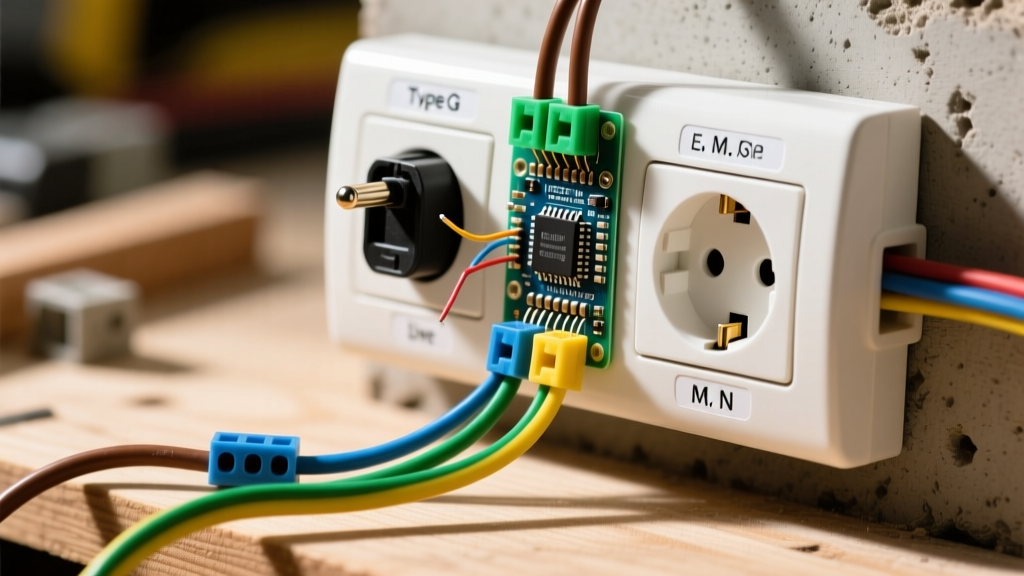
Terminal Layout & Diagram Reference (Faceplate Removed)
When viewing the rear of a standard Type G socket (e.g., Crabtree or MK Logic Plus), the terminal layout is strictly standardized:
- Top Center (Earth/PE): Accepts Green/Yellow (or bare copper with sleeve). This pin operates the internal safety shutters. Failure to wire this correctly will physically prevent plug insertion.
- Bottom Right (Live/L): Accepts Brown (or Red in legacy). Connects to the fused side of the mating plug.
- Bottom Left (Neutral/N): Accepts Blue (or Black in legacy).
Expert Warning: In many older Nigerian and Kenyan commercial buildings, you will encounter legacy UK pre-2006 color codes (Red=Live, Black=Neutral, Green=Earth). Always use a non-contact voltage tester and a multimeter to verify polarity before terminating, as reverse polarity on a Type G socket leaves the appliance fused but energized even when switched off.
Deep Dive: Type M and Type N (Southern African Standards)
South Africa and its neighbors utilize unique heavy-duty standards. While Type C is used for low-draw lighting and electronics, high-draw appliances (geysers, HVAC, industrial tools) require Type M or the modern Type N.
Type M (BS 546 15A) Wiring Specs
The Type M socket features massive 7.05mm diameter pins. It is almost exclusively wired on dedicated 20A radial circuits using 4.0mm² wire. Unlike Type G, Type M plugs do not contain fuses. Therefore, the branch circuit breaker (MCB) must be precisely sized to protect the appliance flex cord. The Earth pin is 8.71mm and must be terminated with a heavy-duty brass earth bar in the backbox to handle high fault currents.
Type N (SANS 164-2) The Modern Shift
Recognizing the fire hazards of universal travel adapters, the South African Bureau of Standards (SABS) introduced Type N. It features a compact, hexagonal 3-pin design rated for 16A. Wiring Note: Type N sockets are dimensionally compatible with standard European Type C (Europlug) ungrounded devices. When wiring a Type N receptacle, the Earth pin is positioned at 12 o'clock, Live at 4 o'clock, and Neutral at 8 o'clock. Torque terminal screws to exactly 1.5 Nm to prevent thermal creep under continuous 16A loads.
Wiring Color Code & Legacy Matrix
One of the highest risk factors when wiring an Africa electrical outlet is encountering mixed color codes in the same junction box. Below is the translation matrix required for safe termination.
| Function | Modern IEC 60446 (Post-2006) | Legacy UK / Colonial (Pre-2006) | Francophone / CEE Standard |
|---|---|---|---|
| Line / Live (L) | Brown | Red | Brown (or Black in older CEE) |
| Neutral (N) | Blue | Black | Blue |
| Protective Earth (PE) | Green / Yellow Stripe | Green (Solid) | Green / Yellow Stripe |
Step-by-Step Installation: 230V Radial Circuit Termination
Whether installing a Crabtree Type G in Nairobi or a CBI Type N in Johannesburg, follow this precise termination sequence to ensure compliance with local wiring codes (such as SANS 10142-1 or BS 7671 equivalents).
- Isolate & Verify: Lock out the distribution board (DB). Test with a CAT III rated multimeter to confirm 0V across L-N, L-PE, and N-PE.
- Conductor Preparation: Strip the outer PVC sheath to expose 150mm of cores. Strip individual core insulation to exactly 12mm. Do not nick the copper strands.
- Ferrule Crimping: If using stranded wire (common in African conduit pulls due to heat flexibility), apply bootlace ferrules and crimp with a ratcheting crimper. Bare stranded wire in screw-terminals causes strand splaying and high-resistance hotspots.
- Earth Sleeve Mandate: If the cable is SWA (Steel Wire Armored) or lacks a green/yellow earth core, you must slide a green/yellow PVC sleeve over the bare earth wire before termination. This is a strict code requirement.
- Termination & Torque: Insert L, N, and PE into their respective terminals. Tighten to 1.2 Nm - 1.5 Nm. Perform a 'tug test' on each wire.
- Gasket & Seal: In humid coastal regions (e.g., Mombasa, Durban), apply a bead of neutral-cure silicone around the backbox entry points to prevent moisture ingress and subsequent copper oxidation.
Grid Instability: Surge Protection & Failure Modes
Wiring the outlet is only half the battle; protecting it from the local grid is the other. Many African power grids experience severe voltage sags, frequency drift, and catastrophic inrush surges when power is restored after load-shedding or rolling blackouts.
Common Failure Modes
- Neutral-Float Damage: In areas with overhead distribution, a lost neutral on a 3-phase transformer can push single-phase outlet voltages up to 400V, instantly destroying connected appliances and melting Type C/E ungrounded sockets.
- Thermal Creep: High ambient temperatures (often exceeding 40°C in wall cavities) combined with loose terminal screws cause cyclic expansion/contraction, leading to arcing and faceplate melting.
- Earth Loop Impedance (Ze) Failures: In rural or informal settlements, the grounding rod may have dried out or corroded, resulting in a Ze > 5 Ohms. This prevents standard MCBs from tripping during a fault, leaving the outlet faceplate energized.
The SPD Solution
For any critical Africa electrical outlet installation (server rooms, medical equipment, high-end residential), integrate a Type 2 Surge Protective Device (SPD) at the local distribution board. Models like the ABB OVR T2 40-275 or Schneider Electric iPRD 40r (priced between $45 - $85 USD) are essential. Ensure the SPD is wired with a dedicated 32A backup breaker and 6.0mm² earth conductor to safely divert transient spikes to ground without choking the main panel.
Sourcing & Component Recommendations (2026 Market)
Sourcing authentic, arc-resistant components is critical. Counterfeit sockets with thin brass contacts and non-flame-retardant urea-formaldehyde plastics are prevalent in informal markets.
- Type G (Premium): Crabtree Platinum or MK Logic Plus. Expect to pay $10 - $18 USD per socket. Features high-mass brass busbars and robust shutter mechanisms.
- Type N (Standard): CBI Astute or Major Tech. Priced at $6 - $12 USD. Ensure the SABS approval mark is physically embossed on the rear thermoplastic, not just printed on the box.
- Type M (Heavy Duty): GE Industrial or Defy Heritage. Priced at $15 - $25 USD. Must feature ceramic or high-grade bakelite internals to withstand 15A continuous resistive loads (e.g., water heaters).
By adhering to these specific wiring diagrams, torque specifications, and regional standard matrices, electricians and DIYers can ensure safe, durable, and code-compliant power delivery across Africa's diverse and demanding electrical landscape. For further reading on regional wiring regulations, consult the Institution of Engineering and Technology (IET) for BS 7671 frameworks often adopted in Commonwealth African nations.